

Package Exports
- @heleneb1/ts-errors
- @heleneb1/ts-errors/dist/index.js
This package does not declare an exports field, so the exports above have been automatically detected and optimized by JSPM instead. If any package subpath is missing, it is recommended to post an issue to the original package (@heleneb1/ts-errors) to support the "exports" field. If that is not possible, create a JSPM override to customize the exports field for this package.
Readme
🧱 ts-errors
ts-errors is a lightweight TypeScript library for creating structured, typed errors with style. Perfect for TypeScript, Node.js, Express, and JavaScript applications.






📘 This README is also available in 🇫🇷 French and 🇬🇧 English.
Handle HTTP errors painlessly — with elegance, strict typing, and a touch of emoji ✨
A minimalist TypeScript library to create, format, and manage HTTP errors with style, structure, and expressiveness. Compatible with JavaScript, Express, and external loggers like winston, pino, etc.
💡 Why ts-errors ?
Because errors deserve better than throw new Error("Oops").ts-errors helps you to:
- Give meaning to your errors (categories, details, typing)
- Display them clearly (console, logs, API)
- Integrate them easily into your stack (Express, Winston, etc.)
Requirements: Node >= 18, TypeScript >= 5
✨ Features
✅ Extensible CustomError class with emoji, statusCode, category, details
🎯 Ready-to-use errors (NotFoundError, UnauthorizedError, etc.)
🎨 Formatted output: compact, colorized, or tabular
⚙️ Built-in Express middleware
🔌 External logger support (winston, pino, etc.)
📦 Zero external dependencies
🧠 Strict typing + JS/TS autocompletion
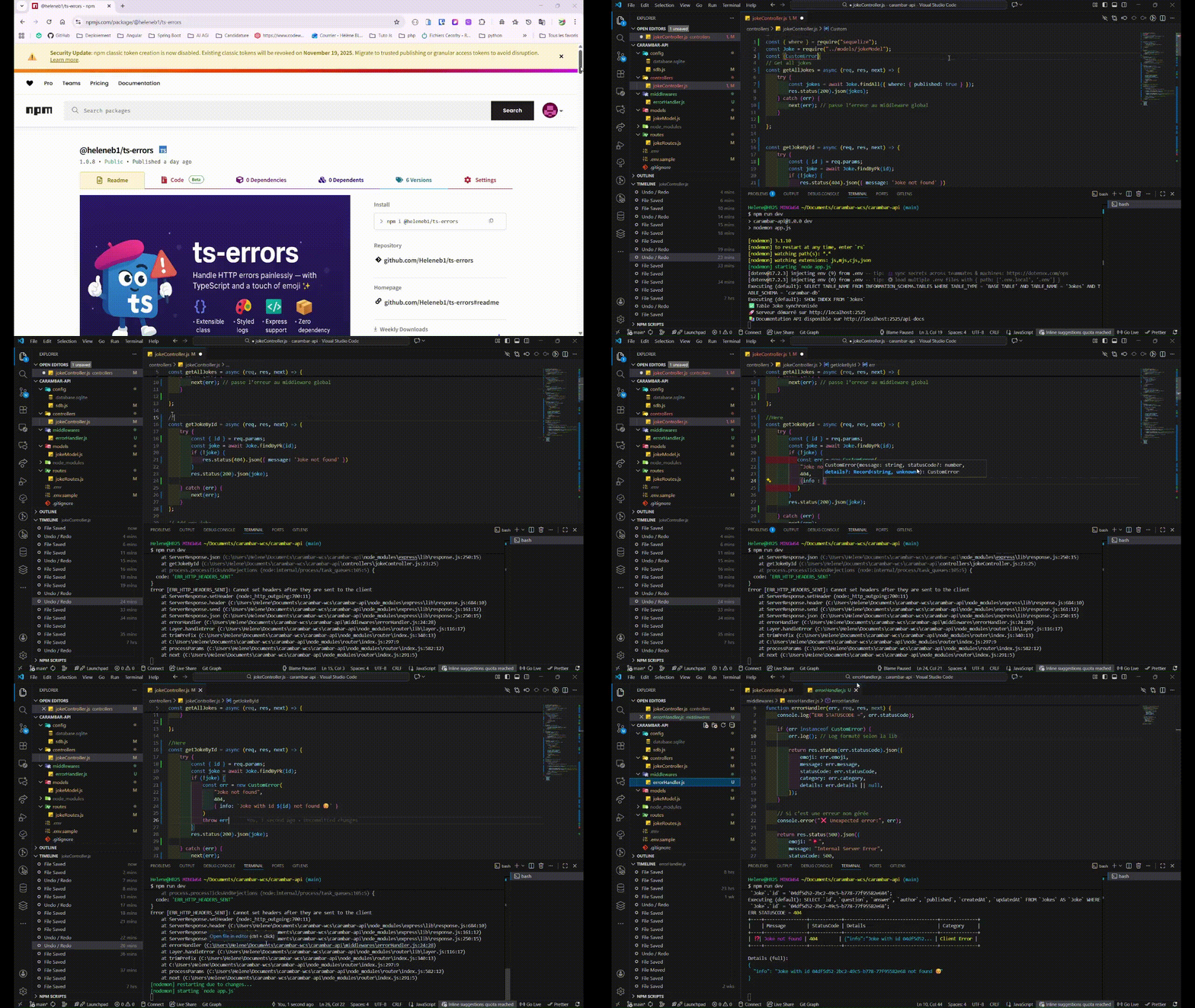
👀 Demo
🚀 Installation
# With npm
npm install @heleneb1/ts-errors

# Or yarn
yarn add @heleneb1/ts-errors
⚙️ Quick Start
TypeScript
import { NotFoundError } from "@heleneb1/ts-errors";

throw NotFoundError("User not found", { userId: 42 });
JavaScript
const { NotFoundError } = require("@heleneb1/ts-errors");

throw NotFoundError("User not found", { userId: 42 });
🧩Using CustomError
import { CustomError } from "@heleneb1/ts-errors";

throw new CustomError("Something went wrong", 500, {
  context: "DB connection",
});
⚠️ Creating a CustomError Correctly
The order of arguments matters!
💡 Signature:
new CustomError(
  message: string,                // error text
  statusCode?: number,            // HTTP status code (default 500)
  details?: Record<string, any>   // additional info
)
✅ Correct example:
throw new CustomError("Joke not found", 404, {
  info: `Joke with id ${id} not found 😔`, // free text, add anything you want
});
❌ Example to avoid:
// Wrong order → statusCode will be replaced by the details object
throw new CustomError("Joke not found", { jokeId: id }, 404);
💡 Tip: You can also pass an object directly:
throw new CustomError({
  message: "Joke not found",
  statusCode: 404,
  details: { jokeId: id },
});
🧰 Express Middleware
import express from "express";
import { errorMiddleware, CustomError } from "@heleneb1/ts-errors";

const app = express();

app.get("/test-error", (req, res, next) => {
  next(new CustomError("Something went wrong!", 400, { route: "/test-error" }));
});

app.use(errorMiddleware);
The errorMiddleware automatically serializes and sends JSON responses to the client.
// Exemple with Sequelize and DB error handling

import { Sequelize } from "sequelize";
import express from "express";
import { errorMiddleware, CustomError } from "@heleneb1/ts-errors";
const app = express();
const sequelize = new Sequelize("sqlite::memory:");

app.get("/db-error", async (req, res, next) => {
  try {
    await sequelize.query("SELECT * FROM jokes");
    res.send("✅ DB query ok");
  } catch (err) {
    next(
      new CustomError("Database error", 500, {
        category: "DB",
        details: err.message,
      })
    );
  }
});
// simulated route to trigger a DB error
app.get("/db-error-test", (req, res, next) => {
  next(
    new CustomError("Database error", 500, {
      category: "DB",
      details: "Simulated error",
    })
  );
});

// Mount the error middleware
app.use(errorMiddleware);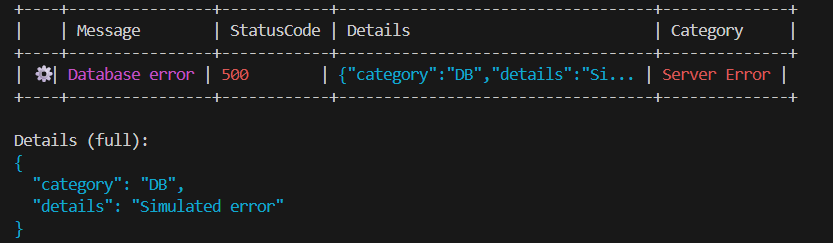
Terminal output
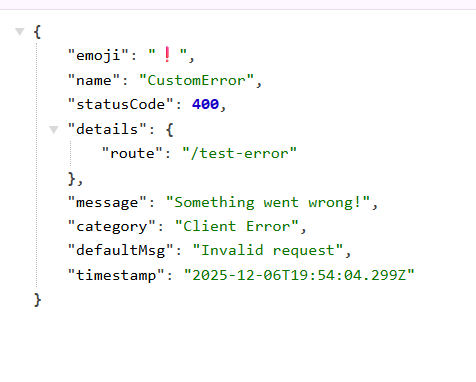
Client output
{
  "message": "Database error",
  "statusCode": 500,
  "emoji": "💥",
  "category": "Server Error",
  "details": {
    "category": "DB",
    "details": "Simulated error"
  }
}
Best practices
Always include statusCode and details in your errors.
Configure global options (showEmoji, colorize, autoLog) according to dev/prod environment.
Use the middleware to centralize error handling.
Frontend errors can be logged using formattedMessage().
Exemples concrets
Express
app.get("/test-error", (req, res, next) => {
  next(new CustomError("Something went wrong!", 400, { route: "/test-error" }));
});
NestJS
@Catch(CustomError)
export class CustomErrorFilter implements ExceptionFilter {
  catch(exception: CustomError, host: ArgumentsHost) {
    const response = host.switchToHttp().getResponse();
    response.status(exception.statusCode || 500).json(exception.toJSON());
  }
}
⚙️ Global Configuration
import { CustomError } from "@heleneb1/ts-errors";

CustomError.settings = {
  showEmoji: false,
  defaultCompact: true,
  colorize: false,
};
CustomError.config({ showEmoji: true, colorize: true });
CustomError.setLogger(myWinstonLogger, "error");
🔌 External Logger Integration
import { CustomError } from "@heleneb1/ts-errors";
import winston from "winston";

const logger = winston.createLogger({
  /* config */
});

CustomError.setLogger(logger, "error");
🖼️ Formatted Output
try {
  throw NotFoundError("Page not found", { url: "/404" });
} catch (err) {
  if (err instanceof CustomError) {
    err.log(); // Affiche l’erreur formatée dans la console
  }
}
🗃️ Access as Table or JSON
Each CustomError can be displayed as a table in the console using log() or retrieved as JSON using toJSON().
import { NotFoundError, CustomError } from "@heleneb1/ts-errors";

try {
  throw NotFoundError(undefined, { userId: 42 });
} catch (err) {
  if (err instanceof CustomError) {
    // Display as a table in the console
    err.log();

    // Get the JSON object for API or other usage

    console.log(err.toJSON());
  }
}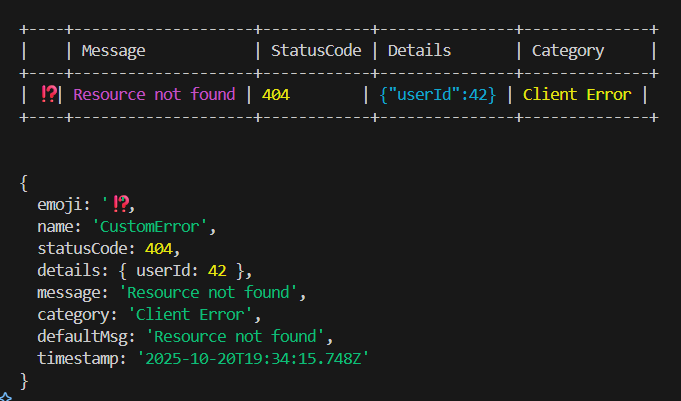
Console Output example
+----+----------------+------------+----------------+--------------+
|    | Message        | StatusCode | Details        | Category     |
+----+----------------+------------+----------------+--------------+
| ⁉️ | Page not found | 404        | {"url":"/404"} | Client Error |
+----+----------------+------------+----------------+--------------+
In your terminal

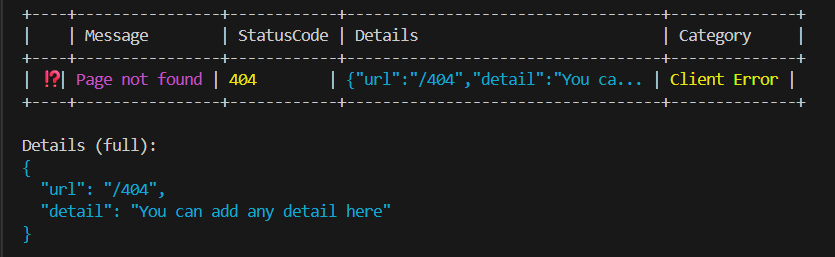
If details are too long, they're truncates in the table and printed bellow.
+----+----------------+------------+-----------------------------------+--------------+
|    | Message        | StatusCode | Details                           | Category     |
+----+----------------+------------+-----------------------------------+--------------+
| ⁉️ | Page not found | 404        | {"url":"/404","detail":"You ca... | Client Error |
+----+----------------+------------+-----------------------------------+--------------+

Details (full):
{
  "url": "/404",
  "detail": "You can add any detail here"
}
In your terminal.
⚡ Available Errors
- BadRequestError
- UnauthorizedError
- ForbiddenError
- NotFoundError
- ConflictError
- UnprocessableEntityError
- TooManyRequestsError
- InternalServerError
- ServiceUnavailableError
- GatewayTimeoutError
📚 CustomError API
| Propriété | Type | Description |
|---|---|---|
message |
string |
Error message |
statusCode |
number |
HTTP status code |
emoji |
string |
Associated Emoji |
category |
string |
"Client Error" ou "Server Error" |
details |
Record<string, unknown> |
Additional data |
Methods
log()— prints the formatted errorformattedMessage(compact, showEmoji, colorize)— returns a styled messagetoJSON()— serializes the error for API responses
🧱 Package Structure
export * from "./CustomError";
export * from "./createError";
export * from "./errorHelpers";
export * from "./middlewares/errorMiddleware";
🧪 Tests
npm run test📝 Changelog
- 1.0.0 — Initial release
🛡️ License
MIT — see LICENSE for details. You're free to use and modify this library as you see fit.
✨ Author
Made with ❤️ & TypeScript by HeleneB1 — creative technologist & digital art director.