

Package Exports
- @oxdeai/core
- @oxdeai/core/adapters
- @oxdeai/core/crypto
- @oxdeai/core/snapshot
- @oxdeai/core/verification
Readme
@oxdeai/core
Deterministic Execution Authorization Layer for Autonomous Systems
[High-signal] Controls whether actions are allowed to execute - before any side effect occurs.




Package: deterministic, fail-closed execution authorization layer that decides whether an agent action may execute before any side effect, emitting verifiable artifacts for allowed actions. Not an agent framework.
Core invariant: No valid authorization → no execution path.
Sits between agent runtimes and external side effects (APIs, infrastructure, payments).
Core invariant
No valid authorization → no execution path. Same (intent, state, policy, engine) ⇒ same decision and hashes; missing trust or policy mismatch fails closed.
Prevents retries, loops, and unintended side effects from ever reaching execution.
Quickstart (minimal)
import { PolicyEngine, verifyAuthorization } from "@oxdeai/core";

const engine = new PolicyEngine({
  policy_version: "v1.7",
  authorization_ttl_seconds: 60,
  authorization_signing_alg: "Ed25519",
  authorization_private_key_pem: process.env.OXDEAI_SIGNING_KEY_PEM!,
  engine_secret: process.env.OXDEAI_ENGINE_SECRET!,
  strictDeterminism: true
});

const intent = {
  intent_id: "intent-1",
  agent_id: "agent-123",
  type: "EXECUTE",
  action_type: "PAYMENT",
  target: "tool/openai",
  metadata_hash: "0".repeat(64),
  nonce: 1n,
  amount: 100n,
  timestamp: 1_730_000_000,
  depth: 0
};

const state = {
  policy_version: "v1.7",
  period_id: "2026-02",
  kill_switch: { global: false, agents: {} },
  allowlists: {},
  budget: { budget_limit: { "agent-123": 10_000n }, spent_in_period: {} },
  max_amount_per_action: { "agent-123": 5_000n },
  velocity: { config: { window_seconds: 60, max_actions: 100 }, counters: {} },
  replay: { window_seconds: 3600, max_nonces_per_agent: 256, nonces: {} },
  recursion: { max_depth: { "agent-123": 2 } },
  concurrency: { max_concurrent: { "agent-123": 2 }, active: {}, active_auths: {} },
  tool_limits: { window_seconds: 60, max_calls: { "agent-123": 10 }, calls: {} }
};

const decision = engine.evaluatePure(intent, state);

if (decision.decision === "DENY") {
  throw new Error(decision.reasons.join(", "));
}

// Allowed: authorization artifact is attached
const auth = decision.authorization;
const verified = verifyAuthorization(auth, { policyId: engine.computePolicyId() });
if (verified.status !== "ok") throw new Error("authorization failed verification");

if (decision.decision === "ALLOW") {
  // execute tool
} else {
  // tool never runs
}

// persist decision.nextState and proceed to execution boundary
Status
@oxdeai/core is a stable protocol library.
Current protocol stack line: v1.7.x.
v1.7.x adds on top of the preserved v1.6.x verification surface:
createVerifierwith explicittrustedKeySetsas the PEP-side trust entry point- Strict mode fails closed when no
trustedKeySetsconfigured (TRUSTED_KEYSETS_REQUIRED) - Trust boundary made explicit in API, documentation, and CLI tooling
- Conformance suite: deterministic secret fixture, env var override removed
Preserved from v1.6.x:
DelegationV1- first-class delegation artifactverifyDelegation()/verifyDelegationChain()- stateless delegation verifierscreateDelegation()- delegation signing helper- Scope narrowing enforcement (budget ceiling, tool allowlist, expiry ceiling)
Preserved stateless verification surface (v1.2+):
verifySnapshot,verifyAuditEvents,verifyEnvelope,verifyAuthorizationVerificationResultschema,VerificationEnvelopeV1format- Ed25519 signatures,
alg/kidfields, KeySet-based key resolution
Validation status:
- conformance suite: continuously validated via CI
- working demos (all produce
ALLOW,ALLOW,DENY,verifyEnvelope() => ok):examples/openai-tools(protocol reference)examples/langgraphexamples/crewaiexamples/openai-agents-sdkexamples/autogenexamples/openclaw
Future protocol releases maintain backward compatibility for frozen verification artifacts unless a major protocol version declares otherwise.
@oxdeai/core is the TypeScript reference library for deterministic execution authorization in autonomous systems. It evaluates whether a proposed action is allowed under the current policy state before any side effect occurs, and emits a cryptographically verifiable authorization artifact on every allowed action.
It answers a narrow question:
Given an intent, a state, and a policy configuration, is this action allowed to execute - deterministically?
If allowed, it emits a signed, expiring authorization bound to the intent and state snapshot. If denied, it fails closed.
No dashboards. No LLM classifiers. No heuristics. No post-fact monitoring. No post-execution monitoring. The decision happens before execution.
Just deterministic pre-execution authorization with verifiable artifacts.
@oxdeai/core sits at the execution boundary of agent runtimes and external systems.
Overview
@oxdeai/core is the TypeScript reference implementation of the OxDeAI execution authorization protocol.
It enforces authorization invariants before an action executes and emits cryptographically verifiable artifacts that can be verified independently - offline, without access to the running system. It is an execution boundary layer, not an agent framework. evaluatePure is side-effect free and deterministic. evaluate may interact with configured adapters (state/audit).
The library exposes:
- deterministic policy evaluation
- signed authorization artifacts (
AuthorizationV1) - canonical state snapshots
- hash-chained audit events
- stateless verification primitives
Key Concepts
PolicyEngine
Deterministic evaluation of action intents against a policy state.
Canonical Snapshot
Deterministic binary representation of the policy state.
Audit Chain
Hash-chained sequence of execution events.
DelegationV1
First-class authorization artifact enabling scoped delegation from a parent AuthorizationV1.
A delegation narrows the parent's scope (budget ceiling, tool allowlist, expiry)
and is cryptographically bound to the parent AuthorizationV1 via parent_auth_hash.
VerificationEnvelopeV1
Portable artifact combining:
- snapshot
- audit events
- policy identity
Stateless Verification
Stateless verification API:
verifySnapshot(snapshotBytes)verifyAuditEvents(events)verifyEnvelope(envelopeBytes)verifyAuthorization(auth, opts?)
All return VerificationResult with status:
okinvalidinconclusive
The Problem
Autonomous systems often fail operationally before they fail semantically.
Common failure modes:
- runaway tool-call loops
- recursive planning explosions
- uncontrolled concurrency
- replayed actions
- silent resource exhaustion
- unbounded external side effects
Most “guardrails” operate after execution or rely on probabilistic models.
Execution authorization decisions should not be probabilistic.
What This Library Is
A deterministic execution authorization substrate that:
- evaluates
(intent, state, policy)→ stable, reproducible decision - emits signed
AuthorizationV1artifacts (Ed25519-based signatures; legacy HMAC paths available for compatibility only) - enforces policy domains as authorization invariants:
- budget - per-period spend caps
- velocity - rate and window limits
- concurrency - parallel slot control
- recursion - depth limits
- replay - nonce-based replay protection
- capability - allowlists and kill switches
- produces hash-chained, tamper-evident audit logs
- supports pure evaluation (
evaluatePure) - no side effects - produces content-addressed
policyId, canonicalstateHash, tamper-evidentauditHeadHash - packages snapshot + audit events into a portable
VerificationEnvelopeV1 - exposes stateless verifiers:
verifySnapshot,verifyAuditEvents,verifyEnvelope,verifyAuthorization
Same inputs ⇒ same outputs. Policy domains are enforced as deterministic authorization invariants.
What This Library Is Not
- Not a billing system or metering pipeline
- Not a cloud budget monitor or cost dashboard
- Not a reservation or settlement ledger
- Not a prompt filter or model-output classifier
- Not an observability or post-execution monitoring tool
- Not distributed coordination infrastructure
- Not an agent framework or runtime
@oxdeai/core can enforce spend, velocity, concurrency, and capability policies as authorization invariants. Its core role is execution authorization and verifiable artifacts - not downstream accounting.
Deterministic Guarantees
Deterministic invariants enforced and tested:
I1 Canonical hashing ignores key insertion order
I2 Snapshot round-trip is idempotent
I3 Decision equivalence across import/export
I4 Replay verification determinism
I5 Cross-process determinism
I6 Evaluation isolation - concurrent evaluations must not share mutable state (
getState: () => structuredClone(state))D-1
evaluatePureproduces identical outputs for identical inputs across repeated callsD-2
evaluatePuredoes not mutate the input stateD-3
structuredCloneinputs yield identical outputs (no aliasing between clone and engine working state)D-4 Object key insertion order does not affect decisions or derived hashes
D-5 Same inputs produce identical decisions and state hashes across separate processes
D-6 Strict mode rejects missing explicit time inputs - no implicit
Date.now()fallbackpolicyId- content-addressed engine configurationstateHash- canonical snapshot hashauditHeadHash- tamper-evident execution trace hashformatVersion: 1for canonical snapshotscanonical JSON snapshot payloads (
modules: Record<string, unknown>)portability across runtimes (no v8 blobs in snapshots)
decode validation rejects malformed snapshots
If the engine version, module set, state, and event sequence are the same, these hashes are identical across runs.
Intent identity is canonical and signature-stripped.
Strict mode removes implicit entropy sources.
Show me the invariant
const out = engine.evaluatePure(intent, state);
if (out.decision !== "ALLOW") throw new Error(out.reasons.join(", "));
const policyId = engine.computePolicyId();
const stateHash = engine.computeStateHash(out.nextState);
const auditHead = engine.audit.headHash();
console.log(policyId, stateHash, auditHead);
Invariant:
Same (engine version + modules + options + state + intent sequence)
⇒ identical policyId, stateHash, and auditHead.
No randomness. No hidden clocks (in strict mode). No non-deterministic ordering.
Minimal Example
import { PolicyEngine, verifyEnvelope } from "@oxdeai/core";
const engine = new PolicyEngine({...});
const decision = engine.evaluatePure(intent, state);
if (decision.decision !== "ALLOW") throw new Error(decision.reasons.join(", "));

const result = verifyEnvelope(envelopeBytes);
if (result.status === "ok") console.log("artifact verified");
// status === "ok" only when the envelope contains a STATE_CHECKPOINT.
// Set checkpoint_every_n_events: 1 (or N) in the engine options to emit one.
Design Philosophy
- Fail closed.
- Make invariants explicit.
- Make state portable.
- Make execution replayable.
- Separate identity from proof.
- Prefer deterministic containment over probabilistic detection.
Installation
npm install @oxdeai/coreCore Model
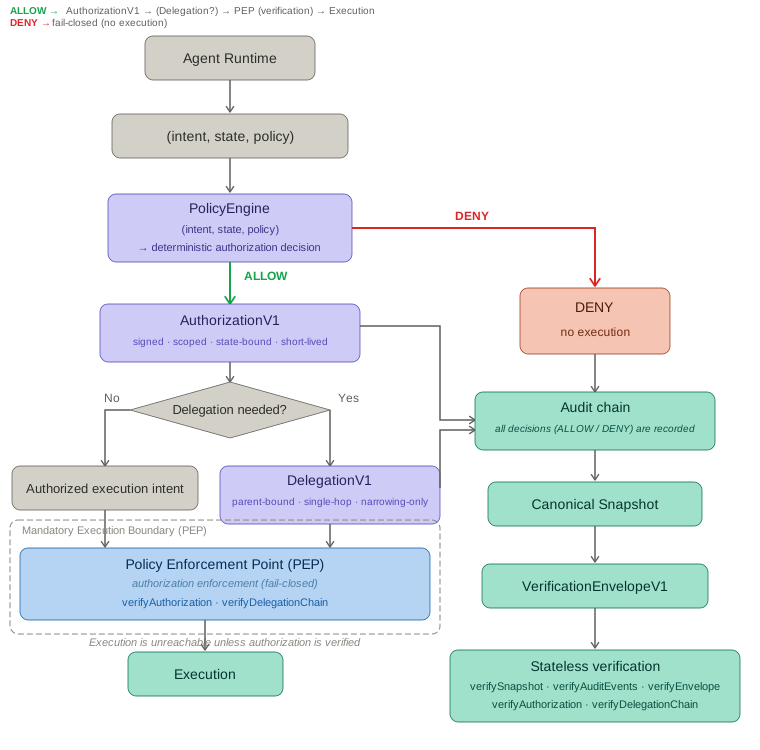
Diagram source/editing policy:
Trust Boundary
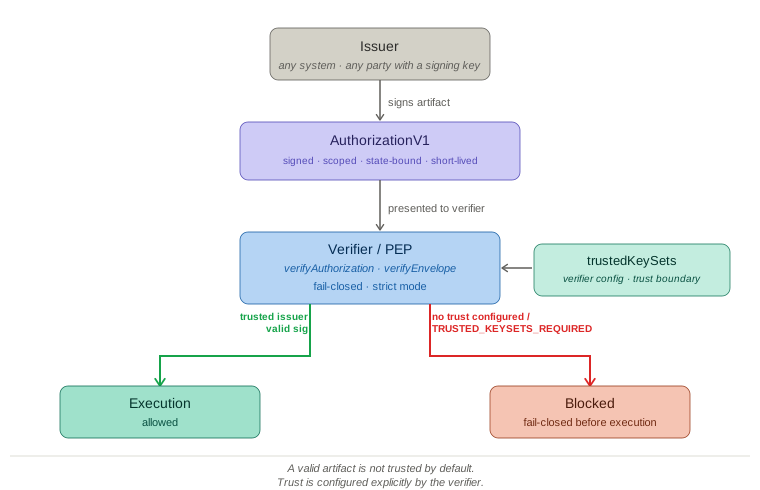
The core model shows what the protocol decides (deterministic authorization logic). This diagram shows who is trusted to make that decision (issuer model + verifier configuration).
The two concerns are deliberately separate:
- Any party that controls a signing key can produce a cryptographically valid artifact. The protocol does not prevent this.
- A cryptographically valid artifact is not trusted by default.
- The verifier defines the trust boundary via
trustedKeySets. - In strict mode, a missing or empty
trustedKeySetsis a hard failure (TRUSTED_KEYSETS_REQUIRED), not a warning. - Validity is cryptographic. Trust is explicit.
policyId is a content hash of the policy configuration - it identifies a specific policy but does not authenticate the authority that defined it. Verifiers MUST NOT treat a matching policyId as proof of issuer legitimacy.
Trust is configured explicitly at the verifier. OxDeAI enforces the execution boundary; who is trusted is defined outside the protocol.
Concepts
Intent
A structured authorization action.
Examples:
EXECUTEa paid tool callRELEASEan authorization-bound concurrency slot
State
Deterministic policy state containing:
- per-agent budgets
- per-action caps
- velocity windows
- replay nonce windows
- recursion depth caps
- concurrency caps + active authorizations
- tool amplification limits
- kill switches and allowlists
Authorization
If an intent is allowed, the engine emits AuthorizationV1:
auth_id,issuer,audienceintent_hash,state_hash,policy_idissued_at,expiry,decision- optional
nonce,capability,signature - verified pre-execution via
verifyAuthorization()
Verification envelopes remain post-execution evidence artifacts verified with verifyEnvelope().
Example: Pure Evaluation
import { PolicyEngine } from "@oxdeai/core";
import type { State, Intent } from "@oxdeai/core";

// Policy configuration is bound in the engine instance.
// evaluatePure(intent, state) evaluates against that bound policy.
const engine = new PolicyEngine({
  policy_version: "v1.7",
  authorization_ttl_seconds: 60,
  authorization_signing_alg: "Ed25519",
  authorization_private_key_pem: process.env.OXDEAI_SIGNING_KEY_PEM!,
  engine_secret: process.env.OXDEAI_ENGINE_SECRET!,
  strictDeterminism: true
});

const now = 1730000000; // injected timestamp (seconds)

const state: State = {
  policy_version: "v1.7",
  period_id: "2026-02",
  kill_switch: { global: false, agents: {} },
  allowlists: {},
  budget: { budget_limit: { "agent-1": 10_000n }, spent_in_period: { "agent-1": 0n } },
  max_amount_per_action: { "agent-1": 5_000n },
  velocity: { config: { window_seconds: 60, max_actions: 100 }, counters: {} },
  replay: { window_seconds: 3600, max_nonces_per_agent: 256, nonces: {} },
  recursion: { max_depth: { "agent-1": 2 } },
  concurrency: { max_concurrent: { "agent-1": 2 }, active: {}, active_auths: {} },
  tool_limits: { window_seconds: 60, max_calls: { "agent-1": 10 }, calls: {} }
};
// policy_version must match engine.opts.policy_version - evaluatePure fails-closed on mismatch

const intent: Intent = {
  intent_id: "intent-1",
  agent_id: "agent-1",
  action_type: "PAYMENT",
  target: "openai-api",
  metadata_hash: "0".repeat(64),
  signature: "",
  type: "EXECUTE",
  tool_call: true,
  tool: "openai.responses",
  nonce: 42n,
  amount: 100n,
  timestamp: now,
  depth: 0
};

const out = engine.evaluatePure(intent, state, { mode: "fail-fast" });

if (out.decision === "DENY") {
  console.error(out.reasons);
} else {
  // persist out.nextState
  // execute using out.authorization
}
Concurrency Lifecycle: RELEASE
RELEASE must reference a valid active authorization_id.
if (out.decision === "DENY") {
  throw new Error("RELEASE requires a prior allowed EXECUTE with an active authorization");
}

const releaseIntent: Intent = {
  intent_id: "intent-2",
  agent_id: "agent-1",
  action_type: "PAYMENT",
  target: "openai-api",
  metadata_hash: "0".repeat(64),
  signature: "",
  type: "RELEASE",
  authorization_id: out.authorization.authorization_id,
  nonce: 43n,
  amount: 0n,
  timestamp: now
};

const rel = engine.evaluatePure(releaseIntent, out.nextState);
Built-In Modules
- KillSwitchModule
- AllowlistModule
- ReplayModule
- RecursionDepthModule
- ConcurrencyModule
- ToolAmplificationModule
- BudgetModule
- VelocityModule
Determinism and Auditability
- Pure evaluation mode available
- Stable canonical JSON encoding
- BigInt normalization
- Sorted key hashing
- Hash-chained audit log
- Strict-mode clock injection
- Property-based determinism tests (seeded, no deps): I1–I5 (
property.test.ts), D-1–D-6 decision-path determinism (property.decision.test.ts), delegation chain D-P1–D-P5 (delegation.property.test.ts), cross-adapter CA-1–CA-10 (@oxdeai/compat)
Canonical Snapshot API
import {
  PolicyEngine,
  encodeCanonicalState,
  decodeCanonicalState
} from "@oxdeai/core";

// 1. Export canonical snapshot
const snapshot = engine.exportState(state);
// 2. Encode to portable bytes (canonical JSON)
const bytes = encodeCanonicalState(snapshot);
// 3. Decode in another process/runtime
const decoded = decodeCanonicalState(bytes);
// 4. Import into fresh state container
const freshState = structuredClone(state);
engine.importState(freshState, decoded);
engine.computeStateHash(freshState); // deterministically identical stateHash
importState enforces:
formatVersion: 1- policy binding (
policyIdmust matchengine.computePolicyId())
Snapshots are:
- Canonical JSON (no v8 serialization)
- Versioned (
formatVersion: 1) - Policy-bound (policyId must match)
- Deterministically hashed
Snapshots are portable, deterministic, and verifiable across runtimes.
Adapters (v0.8)
import { PolicyEngine } from "@oxdeai/core";
import { FileStateStore, FileAuditSink } from "@oxdeai/core/adapters";

const stateStore = new FileStateStore("./policy-state.bin");
const auditSink = new FileAuditSink("./audit.ndjson");

const engine = new PolicyEngine({
  policy_version: "v1.7",
  authorization_ttl_seconds: 60,
  authorization_signing_alg: "Ed25519",
  authorization_private_key_pem: process.env.OXDEAI_SIGNING_KEY_PEM!,
  engine_secret: process.env.OXDEAI_ENGINE_SECRET!,
  stateStore,
  auditSink
});

const out = engine.evaluate(intent, state);
engine.commitState(state);
await engine.flushAudit();
await engine.flushState();
Core ships only minimal in-memory and file adapters; no redis/postgres adapters in core. Build those in separate packages.
Replay Verification (v0.7)
Replay verification uses the public stateless verifier surface.
In strict mode, verification returns ok once the audit trace includes at least one STATE_CHECKPOINT.
verifyAuditEvents(...) recomputes auditHeadHash offline from the provided audit events, and validates policy binding (policyId) plus non-decreasing timestamps.
import { PolicyEngine, verifyAuditEvents } from "@oxdeai/core";
const engine = new PolicyEngine({
  policy_version: "v1.7",
  authorization_ttl_seconds: 60,
  authorization_signing_alg: "Ed25519",
  authorization_private_key_pem: process.env.OXDEAI_SIGNING_KEY_PEM!,
  checkpoint_every_n_events: 2
});
const first = engine.evaluatePure(intent1, state);
if (first.decision !== "ALLOW") throw new Error(first.reasons.join(", "));
const out = engine.evaluatePure(intent2, first.nextState);
const events = engine.audit.snapshot();
const verified = verifyAuditEvents(events, { policyId: engine.computePolicyId() }); // strict by default
console.log(verified.status === "ok"); // true when checkpoints exist
Benchmarks
Adds ~80–150µs per action (p50) for the full protected path (evaluation + authorization verification).
Negligible compared to multi-second agent loops.
The protected path includes deterministic policy evaluation and authorization verification before execution becomes reachable.
Roadmap
v0.6 - Stateful Canonical Snapshots (shipped)
- State-bound module codecs (canonical JSON)
- Snapshot round-trip invariants (smoke + property tests)
- Versioned canonical snapshot format (formatVersion=1)
- Strict determinism completeness (no implicit entropy)
v0.7 - Replay as Verification (shipped)
- Replay verification API
- Optional deterministic state checkpoints (
STATE_CHECKPOINT) - Misuse hardening (
strict=>inconclusivewithout state anchors)
v0.8 - Host Integration Adapters (shipped)
- StateStore interface
- AuditSink interface
- Minimal in-memory + file adapters
v0.9 - Stateless Verification Surface (shipped)
Stateless verification layer for protocol artifacts.
- Pure verifiers:
verifySnapshot,verifyAuditEvents,verifyEnvelope - Portable Verification Envelope (snapshot + audit events)
- Unified
VerificationResult(ok/invalid/inconclusive) - Deterministic violation ordering
v1.0.3 - Stable Protocol Core (shipped)
- deterministic policy engine
- canonical snapshots
- hash-chained audit
- stateless verification
- verification envelope
- conformance tests
- reference integration demo (OpenAI tools boundary)
v1.1 - Authorization Artifact (shipped)
- formalize AuthorizationV1 as first-class protocol artifact
- relying-party verification contract
- verifyAuthorization() as explicit protocol primitive
- spec updates for PDP / PEP separation
v1.2 - Non-Forgeable Verification (shipped)
- Ed25519 support
- kid / alg fields
- public-key verification
- future keyset / rotation model
v1.3 - Guard Adapter + Integration Surface (shipped)
@oxdeai/guard- universal PEP package, all adapters delegate here@oxdeai/sdk- stable integration surface@oxdeai/cli-build,verify,replaytooling
v1.4 - Ecosystem Adoption (shipped)
- 5 runtime adapter packages:
@oxdeai/langgraph,@oxdeai/openai-agents,@oxdeai/crewai,@oxdeai/autogen,@oxdeai/openclaw - shared adapter contract and cross-adapter validation
- integration documentation for all maintained adapters
- case studies: API cost containment, infrastructure provisioning control
v1.5 - Developer Experience (shipped)
- demo GIFs and visual architecture diagrams
- improved quickstart and architecture explainer
- cross-links between protocol, integrations, and cases
v1.6 - Delegated Agent Authorization (shipped)
DelegationV1- chain-of-trust delegation from principal to sub-agent- Scope narrowing enforcement (budget ceiling, tool allowlist, expiry ceiling)
verifyDelegation()/verifyDelegationChain()stateless verifiersdelegationParentHash- cryptographic binding to the parentAuthorizationV1viaparent_auth_hash- Property-based coverage: D-P1 through D-P5 (
delegation.property.test.ts) - Cross-adapter delegation guard tests: G-D1 through G-D3 (
@oxdeai/guard)
v1.7 - Explicit Trust Boundary (shipped)
createVerifierwith explicittrustedKeySetsas the canonical PEP-side entry point- Strict mode fails closed with
TRUSTED_KEYSETS_REQUIREDwhen no keyset is configured - Trust boundary diagram and architecture documentation
- CLI: all strict verification entry points require
--trusted-keysetor--mode best-effort @oxdeai/sdk@1.3.2: JSDoc clarifications pointing tocreateVerifierand explicit trust- Conformance: deterministic secret fixture, env var override removed from validator
v2.x - Verifiable Execution Infrastructure (planned)
- deterministic execution receipts
- binary Merkle batching of receipt hashes
- proof-of-inclusion for individual receipts
- optional on-chain proof anchoring / smart-contract verifier
- authorization remains off-chain-first
See also
License
Apache-2.0