

Package Exports
- @stdlib/math-base-special-kernel-cos
- @stdlib/math-base-special-kernel-cos/dist
- @stdlib/math-base-special-kernel-cos/dist/index.js
- @stdlib/math-base-special-kernel-cos/lib/index.js
This package does not declare an exports field, so the exports above have been automatically detected and optimized by JSPM instead. If any package subpath is missing, it is recommended to post an issue to the original package (@stdlib/math-base-special-kernel-cos) to support the "exports" field. If that is not possible, create a JSPM override to customize the exports field for this package.
Readme
About stdlib...
We believe in a future in which the web is a preferred environment for numerical computation. To help realize this future, we've built stdlib. stdlib is a standard library, with an emphasis on numerical and scientific computation, written in JavaScript (and C) for execution in browsers and in Node.js.
The library is fully decomposable, being architected in such a way that you can swap out and mix and match APIs and functionality to cater to your exact preferences and use cases.
When you use stdlib, you can be absolutely certain that you are using the most thorough, rigorous, well-written, studied, documented, tested, measured, and high-quality code out there.
To join us in bringing numerical computing to the web, get started by checking us out on GitHub, and please consider financially supporting stdlib. We greatly appreciate your continued support!
kernelCos


Compute the cosine of a double-precision floating-point number on
[-π/4, π/4].
Installation
npm install @stdlib/math-base-special-kernel-cosUsage
var kernelCos = require( '@stdlib/math-base-special-kernel-cos' );kernelCos( x, y )
Computes the cosine of a double-precision floating-point number on [-π/4, π/4].
var v = kernelCos( 0.0, 0.0 );
// returns ~1.0

v = kernelCos( 3.141592653589793/6.0, 0.0 );
// returns ~0.866

v = kernelCos( 0.785, -1.144e-17 );
// returns ~0.707

v = kernelCos( NaN, 0.0 );
// returns NaN
Notes
For increased accuracy, the number for which the cosine should be evaluated can be supplied as a double-double number (i.e., a non-evaluated sum of two double-precision floating-point numbers
xandy).As components of a double-double number, the two double-precision floating-point numbers
xandymust satisfy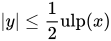
where
ulpstands for units in the last place.
Examples
var uniform = require( '@stdlib/random-array-uniform' );
var logEachMap = require( '@stdlib/console-log-each-map' );
var PI = require( '@stdlib/constants-float64-pi' );
var kernelCos = require( '@stdlib/math-base-special-kernel-cos' );

var opts = {
    'dtype': 'float64'
};
var x = uniform( 100, -PI/4.0, PI/4.0, opts );

logEachMap( 'kernelCos(%0.4f, %0.4f) = %0.4f', x, 0.0, kernelCos );
C APIs
Usage
#include "stdlib/math/base/special/kernel_cos.h"stdlib_base_kernel_cos( x, y )
Computes the cosine of a double-precision floating-point number on [-π/4, π/4].
double v = stdlib_base_kernel_cos( 0.0, 0.0 );
// returns ~1.0

v = stdlib_base_kernel_cos( 3.141592653589793/6.0, 0.0 );
// returns ~0.866
The function accepts the following arguments:
- x:
[in] doubleinput value (in radians, assumed to be bounded by~pi/4in magnitude). - y:
[in] doubletail ofx.
double stdlib_base_kernel_cos( const double x, const double y );Notes
- For increased accuracy, the number for which the cosine should be evaluated can be supplied as a double-double number (i.e., a non-evaluated sum of two double-precision floating-point numbers
xandy).
Examples
#include "stdlib/math/base/special/kernel_cos.h"
#include <stdio.h>

int main( void ) {
    const double x[] = { -0.7853981633974483, -0.6108652381980153, -0.4363323129985824, -0.26179938779914946, -0.08726646259971649, 0.08726646259971649, 0.26179938779914935, 0.43633231299858233, 0.6108652381980153, 0.7853981633974483 };

    double out;
    int i;
    for ( i = 0; i < 10; i++ ) {
        out = stdlib_base_kernel_cos( x[ i ], 0.0 );
        printf ( "x[ i ]: %lf, y: %lf, out: %lf\n", x[ i ], 0.0, out );
    }
}Notice
This package is part of stdlib, a standard library for JavaScript and Node.js, with an emphasis on numerical and scientific computing. The library provides a collection of robust, high performance libraries for mathematics, statistics, streams, utilities, and more.
For more information on the project, filing bug reports and feature requests, and guidance on how to develop stdlib, see the main project repository.
Community

Copyright
Copyright © 2016-2026. The Stdlib Authors.