

Package Exports
- @stdlib/math-base-tools-evalrational
This package does not declare an exports field, so the exports above have been automatically detected and optimized by JSPM instead. If any package subpath is missing, it is recommended to post an issue to the original package (@stdlib/math-base-tools-evalrational) to support the "exports" field. If that is not possible, create a JSPM override to customize the exports field for this package.
Readme
evalrational




Evaluate a rational function.
A rational function f(x) is defined as
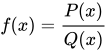
where both P(x) and Q(x) are polynomials in x. A polynomial in x can be expressed

where c_n, c_{n-1}, ..., c_0 are constants.
Installation
npm install @stdlib/math-base-tools-evalrationalUsage
var evalrational = require( '@stdlib/math-base-tools-evalrational' );evalrational( P, Q, x )
Evaluates a rational function at a value x. The coefficients P and Q are expected to be arrays of the same length.
var P = [ -6.0, -5.0 ];
var Q = [ 3.0, 0.5 ];

var v = evalrational( P, Q, 6.0 ); //  => ( -6*6^0 - 5*6^1 ) / ( 3*6^0 + 0.5*6^1 ) = (-6-30)/(3+3)
// returns -6.0
For polynomials of different degree, the coefficient array for the lower degree polynomial should be padded with zeros.
// 2x^3 + 4x^2 - 5x^1 - 6x^0 => degree 4
var P = [ -6.0, -5.0, 4.0, 2.0 ];

// 0.5x^1 + 3x^0 => degree 2
var Q = [ 3.0, 0.5, 0.0, 0.0 ]; // zero-padded

var v = evalrational( P, Q, 6.0 ); // => ( -6*6^0 - 5*6^1 + 4*6^2 + 2*6^3 ) / ( 3*6^0 + 0.5*6^1 + 0*6^2 + 0*6^3 ) = (-6-30+144+432)/(3+3)
// returns 90.0
Coefficients should be ordered in ascending degree, thus matching summation notation.
evalrational.factory( P, Q )
Uses code generation to in-line coefficients and return a function for evaluating a rational function.
var P = [ 20.0, 8.0, 3.0 ];
var Q = [ 10.0, 9.0, 1.0 ];

var rational = evalrational.factory( P, Q );

var v = rational( 10.0 ); // => (20*10^0 + 8*10^1 + 3*10^2) / (10*10^0 + 9*10^1 + 1*10^2) = (20+80+300)/(10+90+100)
// returns 2.0

v = rational( 2.0 ); // => (20*2^0 + 8*2^1 + 3*2^2) / (10*2^0 + 9*2^1 + 1*2^2) = (20+16+12)/(10+18+4)
// returns 1.5
Notes
- For hot code paths in which coefficients are invariant, a compiled function will be more performant than
evalrational(). - While code generation can boost performance, its use may be problematic in browser contexts enforcing a strict content security policy (CSP). If running in or targeting an environment with a CSP, avoid using code generation.
var randu = require( '@stdlib/random-base-randu' );
var round = require( '@stdlib/math-base-special-round' );
var Float64Array = require( '@stdlib/array-float64' );
var evalrational = require( '@stdlib/math-base-tools-evalrational' );

var rational;
var sign;
var len;
var P;
var Q;
var v;
var i;

// Create two arrays of random coefficients...
len = 10;
P = new Float64Array( len );
Q = new Float64Array( len );
for ( i = 0; i < len; i++ ) {
    if ( randu() < 0.5 ) {
        sign = -1.0;
    } else {
        sign = 1.0;
    }
    P[ i ] = sign * round( randu()*100 );
    Q[ i ] = sign * round( randu()*100 );
}

// Evaluate the rational function at random values...
for ( i = 0; i < 100; i++ ) {
    v = randu() * 100.0;
    console.log( 'f(%d) = %d', v, evalrational( P, Q, v ) );
}

// Generate an `evalrational` function...
rational = evalrational.factory( P, Q );
for ( i = 0; i < 100; i++ ) {
    v = (randu()*100.0) - 50.0;
    console.log( 'f(%d) = %d', v, rational( v ) );
}
Notice
This package is part of stdlib, a standard library for JavaScript and Node.js, with an emphasis on numerical and scientific computing. The library provides a collection of robust, high performance libraries for mathematics, statistics, streams, utilities, and more.
For more information on the project, filing bug reports and feature requests, and guidance on how to develop stdlib, see the main project repository.
License
See LICENSE.
Copyright
Copyright © 2016-2021. The Stdlib Authors.