

Package Exports
- apprun
This package does not declare an exports field, so the exports above have been automatically detected and optimized by JSPM instead. If any package subpath is missing, it is recommended to post an issue to the original package (apprun) to support the "exports" field. If that is not possible, create a JSPM override to customize the exports field for this package.
Readme
AppRun 




AppRun is a Javascript library for building reliable, high-performance web applications using the Elm inspired Architecture, event pub-sub and components.
AppRun is a MIT-licensed open source project. Please consider supporting the project on Patreon. 👍❤️🙏
AppRun Benefits
- Write less code
- No proprietary syntax to learn
- Compiler/transpiler is optional
- State management, routing and directives included
- Run side-by-side with other frameworks
AppRun Book from Apress
Architecture Concept
Application logic is broken down into three separated parts in the AppRun architecture.
- State (a.k.a. Model) — the state of your application
- View — a function to display the state
- Update — a collection of event handlers to update the state
AppRun ties the three parts together and drives the applications using event pub-sub.
Applications built with AppRun have less lines of code, smaller js files, and better performance. See a comparison from A Real-World Comparison of Front-End Frameworks with Benchmarks (2019 update). You can also see the performance results compared to other frameworks and libraries in the js-framework-benchmark project.
Quick Start
Below is a counter application using AppRun (Online Demo).
<html>
<head>
  <meta charset="utf-8">
  <title>Counter</title>
</head>
<body>
  <script src="https://unpkg.com/apprun@latest/dist/apprun-html.js"></script>
  <div id="my-app"></div>
  <script>
    const state = 0;
    const view = state => {
      return `<div>
        <h1>${state}</h1>
        <button onclick='app.run("-1")'>-1</button>
        <button onclick='app.run("+1")'>+1</button>
      </div>`;
    };
    const update = {
      '+1': state => state + 1,
      '-1': state => state - 1
    };
    app.start('my-app', state, view, update);
  </script>
</body>
</html>
Web Components
Using apprun@es6, you can convert AppRun components into web components. AppRun components become the custom elements that also can handle AppRun events (Online Demo).
<html>
<head>
  <meta charset="utf-8">
  <title>Counter as web component</title>
</head>
<body>
  <my-app id='counter'></my-app>
  <script src="https://cdnjs.cloudflare.com/ajax/libs/custom-elements/1.1.2/custom-elements.min.js"></script>
  <script src="https://unpkg.com/apprun@es6/dist/apprun-html.js"></script>
  <script>
    class Counter extends Component {
      constructor() {
        super();
        this.state = 0;
        this.view = state => `<div>
          <h1>${state}</h1>
          <button onclick='counter.run("-1")'>-1</button>
          <button onclick='counter.run("+1")'>+1</button>
          </div>`;
        this.update = {
          '+1': state => state + 1,
          '-1': state => state - 1
        };
      }
    }
    app.webComponent('my-app', Counter);
  </script>
</body>
</html>
AppRun Playground
Try the AppRun Playground.
Install
You can include AppRun in your html directly and use it with JavaScript.
<script src="https://unpkg.com/apprun@latest/dist/apprun-html.js"></script>CLI
Or you can use AppRun with TypeScript and Webpack. Use the AppRun CLI to initialize a TypeScript and webpack configured project:
npx apprun --init --spa
npm start
To initialize a project that targets ES6/ES2015, use the AppRun CLI with the --es6 flag:
npx apprun --init --spa --es6
npm start
Dev-Tools CLI
We have been using the command line interface (CLI) in the terminal window and the command prompt. Have you thought of a CLI in the console of the browser's developer tool?
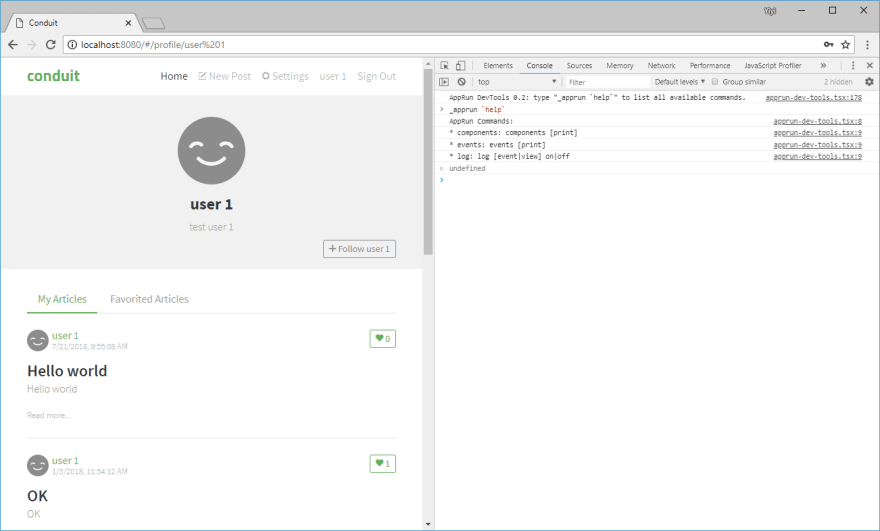
To use the AppRun dev-tools CLI, include the the dev-tools script.
<script src="https://unpkg.com/apprun@latest/dist/apprun-dev-tools.js"></script>Dev-Tools
AppRun support the Redux DevTools Extension. To use the dev-tools, install the Redux DevTools Extension. You can monitor the events and states in the devtools.

VS Code Extension
AppRun has a code snippet extension for VS Code that you can install from the extension marketplace. It inserts AppRun code template for application, component and event handling.

Contribute
You can launch the webpack dev-server and the demo app from the demo folder with the following npm commands:
npm install
npm start
You can run the unit tests from the tests folder.
npm testUnit tests can serve as functional specifications.
Finally, to build optimized js files to the dist folder, just run:
npm run buildHave fun and send pull requests.
License
MIT
Copyright (c) 2015-2019 Yiyi Sun