
Package Exports
This package does not declare an exports field, so the exports above have been automatically detected and optimized by JSPM instead. If any package subpath is missing, it is recommended to post an issue to the original package (clawdi) to support the "exports" field. If that is not possible, create a JSPM override to customize the exports field for this package.
Readme
Clawdi
The best home for all your AI agents — Projects, sessions, memory, skills, cron jobs, and app connections.




Website · GitHub · Docs · npm · Architecture · Quickstart · CLI Reference · Troubleshooting
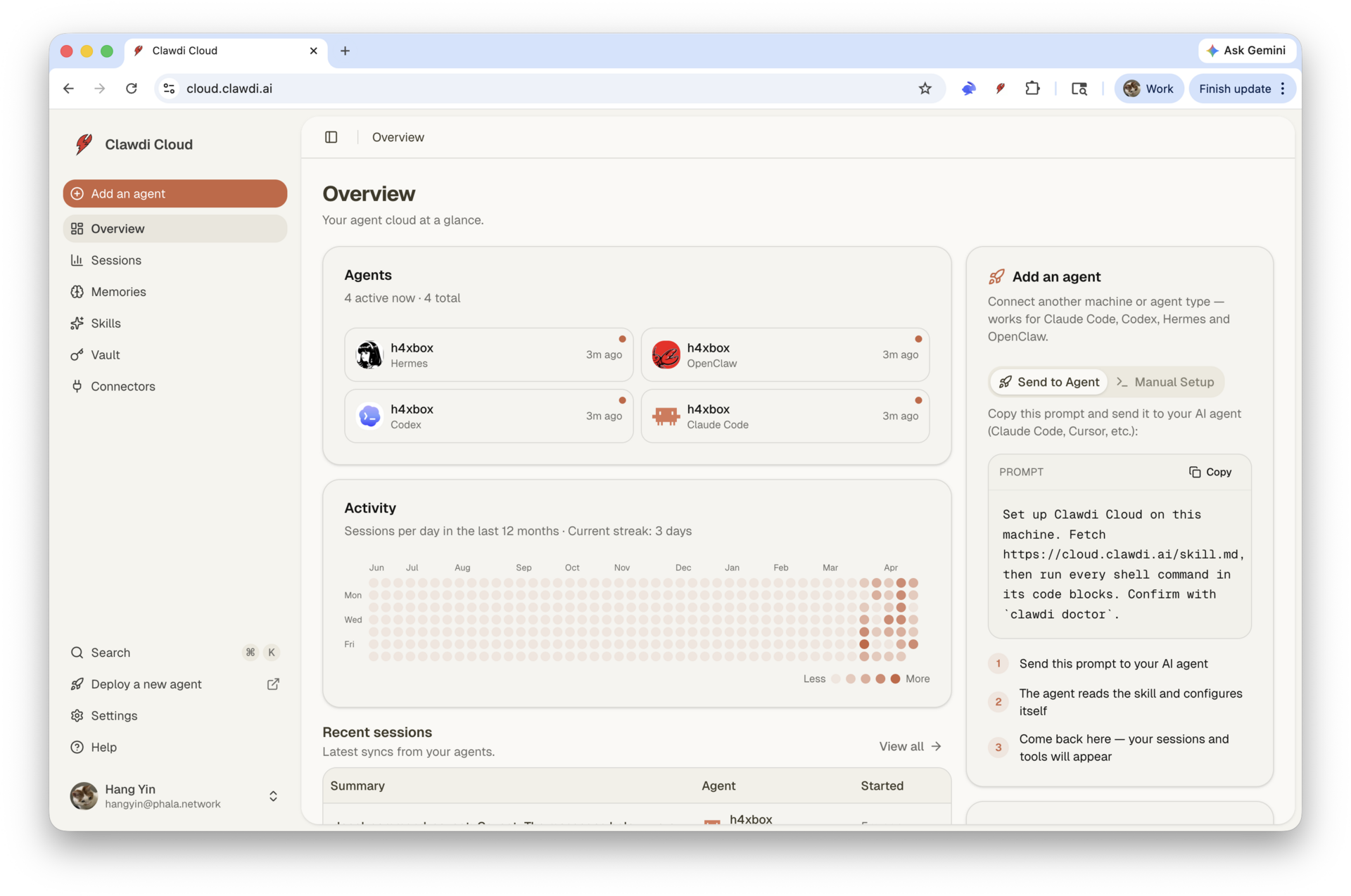
Think of Clawdi as iCloud for AI agents — install once on any device, and your Claude Code, Codex, Hermes, and OpenClaw agents share the same memory, secrets, skills, sessions, and app connections. Switch frameworks or machines; nothing gets lost.
The fastest way to try it is hosted Clawdi Cloud. The whole stack is also here: MIT-licensed CLI, FastAPI backend, Next.js dashboard, database schema, migrations, and docs. Use the hosted service, self-host it, fork it, or build your own agent sync layer from the pieces.
Quickstart
npm i -g clawdi

clawdi auth login
clawdi setup
clawdi doctor
That gets you:
- Browser-based login to Clawdi Cloud
- Agent auto-detection for Claude Code, Codex, Hermes, and OpenClaw
- MCP registration so your agent can call Clawdi tools
- The bundled
clawdiskill installed into each detected agent - Background sync daemons installed and started for every registered agent
- A health check that verifies auth, agent paths, vault access, and MCP config
By default the CLI talks to hosted Clawdi Cloud. Want to run your own backend? See Own the Stack.
Requires Node ≥ 22.5 (the CLI uses the built-in node:sqlite module).
You can also try without installing:
npx clawdi --helpHeadless environment? Use the manual flow:
clawdi auth login --manualWhy Clawdi
AI agents are still treated like isolated apps. Claude Code has one set of sessions and instructions. Codex has another. Secrets sit in shell profiles and .env files. Useful memories get trapped in whichever agent happened to learn them. App integrations get rebuilt from scratch every time you switch tools.
Clawdi is the shared layer underneath:
- Cross-agent memory — Store durable preferences, decisions, facts, and project context once. Search them from any connected agent.
- Portable skills — Upload or install agent instructions once, then sync them into every registered agent.
- Project sharing — Share read-only Project access from the dashboard or CLI, accept it from a share page or CLI inbox, and explicitly attach accepted Projects to Agents when they should be used at runtime.
- Session sync — Push local session history to the dashboard for review and recall.
- Vault secrets — Store secrets server-side, commit only
clawdi://references, and resolve them at runtime. - AI Providers — Define model providers once, keep keys in env/Vault/auth profiles, and apply verified Codex, Hermes, or OpenClaw agent config without proxying BYOK model traffic.
- App connections — Hook agents into Notion, Gmail, Drive, Calendar, Linear, GitHub, and more from the dashboard. Tools show up inside every connected agent automatically over MCP.
- MCP tools — Memory, vault, and connector tools served through the Model Context Protocol so any MCP-aware agent can use them.
In practice — teach one agent something:
remember that this repo uses Bun for TypeScript and PDM for backend scriptsLater, in a different agent or a fresh session, ask "what package manager should I use here?" — it can call Clawdi memory search and answer from your actual context instead of guessing.
Run a fullstack dev command with vault references without putting plaintext secrets on disk:
clawdi vault set OPENAI_API_KEY --prompt
printf '%s\n' "$OPENAI_API_KEY" | clawdi vault set api-service/env/OPENAI_API_KEY --stdin
clawdi vault import --vault api-service --section stripe --project personal --yes .env.stripe
echo "OPENAI_API_KEY=clawdi://project/<project-id>/vault/default/field/OPENAI_API_KEY" > .env.clawdi
clawdi run --dry-run --env-file .env.clawdi -- npm run dev
clawdi run --env-file .env.clawdi -- npm run dev
clawdi read clawdi://project/<project-id>/vault/default/field/OPENAI_API_KEY
clawdi inject --dry-run --in .env.clawdi --out .env.local
clawdi inject --force --in .env.clawdi --out .env.local
Vaults are account-level key bundles. Projects attach to a Vault to use the same shared key set. clawdi vault set, clawdi vault import, clawdi vault rm, and clawdi vault list print the concrete Project target or exact references that include the Project ID. vault set supports --prompt for secure one-off entry, --stdin for scripts, and --value when shell history exposure is acceptable; empty stdin is rejected unless --allow-empty is passed intentionally. vault import supports --vault, --section, --project, and warns about skipped invalid dotenv identifiers. Use clawdi vault attach <vault> --project <project> to make an existing Vault available in another Project, and clawdi vault detach <vault> --project <project> to remove one Project's access without deleting keys. vault rm deletes a key from the shared Vault; when a Vault is attached to multiple Projects, it requires --global. Prefer service-specific vault slugs such as api-service over broad environment slugs such as prod. Project-relative references such as clawdi://default/OPENAI_API_KEY still work for portable templates, but exact references are the default copy/read UX.
Agents should prefer clawdi run --env-file .env.clawdi -- <command> when they can launch the tool themselves. Use clawdi inject only for tools that must read a physical .env.local; generated files are written owner-only and should stay gitignored.
Use --dry-run on clawdi read, clawdi inject, clawdi run, and clawdi vault resolve to verify provenance without requesting plaintext values. clawdi doctor checks vault metadata only; it does not resolve stored secrets.
Sync a local CLI credential profile to another machine. For Codex model-provider
auth, prefer the AI Provider commands in the next section; the lower-level
agent credentials commands remain available for compatibility and for
non-provider CLI credentials such as Claude Code and GitHub CLI.
clawdi agent credentials import claude-code
clawdi agent credentials import gh
clawdi agent credentials materialize claude-code
clawdi agent credentials materialize gh
Credential profile sync is separate from clawdi run: it stores and restores a supported tool's local auth file, while run injects explicit clawdi:// references into one child process. Profiles default to your stable Personal Project so import on one machine and materialize on another resolve the same namespace. They are personal backup/restore artifacts: shared Project viewers and env-bound Agent keys cannot materialize them. macOS Keychain imports are guarded behind --source keychain and require explicit --keychain-service plus --keychain-account; Clawdi does not guess or silently scrape credential-store items, and Keychain reads cannot use --yes.
Manage model providers without turning Clawdi into a model proxy:
clawdi ai-provider add openai-main \
  --type openai \
  --default-model gpt-5.2 \
  --auth env:OPENAI_API_KEY \
  --capability chat \
  --capability responses \
  --capability tools

clawdi ai-provider validate openai-main
clawdi ai-provider test openai-main        # config + auth availability
clawdi ai-provider test openai-main --live # optional direct provider probe
AI Provider metadata lives in ~/.clawdi/ai-providers/catalog.json; API keys do not. Use env:... refs, clawdi://... Vault refs, none for local unauthenticated endpoints, or a verified auth profile such as agent:codex/default. BYOK model requests still go directly from the agent runtime to OpenAI, Anthropic, OpenRouter, Gemini, Mistral, or your compatible endpoint.
Apply provider config explicitly, with a dry run first:
clawdi ai-provider apply --engine codex --dry-run
clawdi ai-provider apply --engine codex
codex --profile clawdi-ai-provider

clawdi ai-provider apply --engine hermes --dry-run
clawdi ai-provider apply --engine openclaw --dry-run
Codex OAuth is managed through the AI Provider surface:
clawdi ai-provider add openai-codex \
  --type openai \
  --default-model gpt-5-codex \
  --auth agent:codex/default
clawdi ai-provider connect openai-codex --tool codex
clawdi ai-provider materialize-auth openai-codex
Use clawdi ai-provider connect ... --callback manual in headless environments. Export/import is metadata-only by default; --include-secrets requires passphrase-encrypted secret export.
Current vault storage is server-managed encryption. Clawdi avoids plaintext secrets in repo files and local templates, but the backend can decrypt stored vault values and credential profiles today. Do not treat this release as zero-knowledge.
Install a shared skill into every registered agent at once:
clawdi skill install anthropics/skills/artifacts-builderRoadmap
Today Clawdi gives individuals and read-only Project collaborators a shared layer across their agents. Two bigger bets come next.
The first is autonomy. Agents should work without you at the keyboard.
- Cron jobs for recurring agent runs.
- Remote control for agents on any of your machines.
- Automatic memory built from session history.
The second is deepening multi-player workflows beyond read-only Project sharing.
- Richer team roles and broader access controls.
- Shared memory, skills, and connections.
- An agent-to-agent channel for handoff and ask-for-help.
- Task tracking that every connected agent can use.
We'll also keep adding adapters. Cursor, OpenCode, Amp, Pi, and others. The same memory, skills, and connections follow you everywhere.
Want any of this sooner? Open an issue. What's loud is what we build first.
Hosted or Self-Hosted
Clawdi has two intended paths.
Use Clawdi Cloud
Best for trying it in minutes.
npm i -g clawdi
clawdi auth login
clawdi setup
The published CLI defaults to the hosted API. You get the least setup friction and can focus on wiring agents, memories, skills, and vault secrets.
Own the Stack
Best when you want to inspect, modify, self-host, or build on Clawdi.
git clone https://github.com/Clawdi-AI/clawdi.git
cd clawdi
bun install
docker compose up -d postgres
Then run the backend and dashboard locally:
cd backend
cp .env.example .env
pdm install
pdm migrate
pdm dev
cd ../apps/web
cp .env.example .env.local
bun run devPoint your CLI at your local backend:
clawdi config set apiUrl http://localhost:8000Local self-hosting currently expects:
- Node.js 22.5+ and Bun 1.3+
- Python 3.12 with PDM
- PostgreSQL 16 with
pg_trgmandpgvector - Clerk keys for dashboard auth
- Two generated encryption keys for vault data and MCP bridge JWTs
See backend/.env.example and apps/web/.env.example for the exact environment variables.
What Is In This Repo
apps/web/          Next.js 16 dashboard with Clerk auth, shadcn/ui, Tailwind v4
packages/cli/      Published `clawdi` CLI, agent adapters, and MCP server
packages/shared/   Shared API types, schemas, and constants
backend/           FastAPI backend, SQLAlchemy models, Alembic migrations
docs/              Architecture notes, scenarios, and development guides
The system is deliberately boring where it should be:
- FastAPI API server
- PostgreSQL for structured data and memory search
- File storage for session and skill bodies
- Local CLI state under
~/.clawdi - MCP stdio server spawned by each agent
- No Redis, Celery, or hidden worker fleet required for the core local stack
For the deeper map, read docs/architecture.md.
Supported Agents
| Agent | Sessions | Skills | MCP setup |
|---|---|---|---|
| Claude Code | Yes | Yes | Automatic |
| Codex | Yes | Yes | Automatic |
| Hermes | Yes | Yes | Automatic |
| OpenClaw | Yes | Yes | Manual MCP hint where required |
Each agent has a dedicated adapter in packages/cli/src/adapters. Adding another agent means implementing the same adapter shape: detect it, read sessions, read/write skills, and define how commands run with injected env.
CLI Reference
| Command | What it does |
|---|---|
clawdi auth login / logout |
Authenticate this machine |
clawdi status [--json] |
Show auth and sync state |
clawdi config list/get/set/unset |
Read or write CLI configuration |
clawdi setup [--agent <type>] [--no-daemon] |
Register local agents, install MCP, install the bundled skill, and install/start daemons by default |
clawdi teardown [--agent <type>] |
Remove Clawdi's local agent wiring |
clawdi daemon run/install/status/logs/doctor/restart/uninstall |
Run and manage the background sync daemon (serve remains a legacy alias) |
clawdi push |
Upload sessions and skills |
clawdi pull |
Download cloud skills into registered agents |
clawdi session list/extract |
Inspect local agent sessions |
clawdi memory list/search/add/rm |
Manage cross-agent long-term memory |
clawdi skill list/add/install/rm/init |
Manage portable skills |
clawdi project create/list/show/share/share-links/invite/invites/members/leave/unshare |
Manage Projects and read-only sharing |
clawdi inbox [accept/decline/forget] |
Accept invitations and share links |
clawdi agent projects list/attach/detach/move |
View the fixed Agent Project and manage attached Projects |
clawdi agent credentials import/materialize |
Compatibility backup/restore for local CLI credential profiles; use ai-provider import-auth/connect/materialize-auth for Codex provider auth |
clawdi ai-provider list/add/edit/remove/validate/test/connect/import-auth/materialize-auth/apply/status/export/import |
Manage reusable AI Providers, provider auth, and verified agent config application |
clawdi project folder link/status/unlink |
Link a local folder to a Project for vault reference selection |
clawdi vault set/list/import/attach/detach/rm |
Manage encrypted secrets, Project access, and copy exact references |
clawdi read <clawdi://...> |
Explicitly print one vault reference value |
clawdi inject --in <file> --out <file> |
Render clawdi:// references into templates |
clawdi run --env-file <file> -- <cmd> |
Run a command with explicit vault references resolved |
clawdi doctor |
Diagnose auth, agent paths, vault, and MCP config |
clawdi update |
Install the latest CLI version (--check only reports) |
clawdi mcp |
Start the MCP stdio server used by agents |
Auto-update is enabled by default for all newer releases, including majors. Human CLI invocations update the global CLI in the background; installed daemons check on their own cadence, install silently, then let launchd/systemd restart them onto the new code. Disable both with CLAWDI_NO_AUTO_UPDATE=1 or clawdi config set autoUpdate false.
Every command supports --help.
App connections are configured in the Clawdi Cloud dashboard and surface inside agents automatically over MCP — there is no CLI command to manage them.
Development
Install dependencies:
bun installRun the web app and workspace dev tasks:
bun run devRun the backend:
cd backend
pdm dev
Run checks:
bun run check
bun run typecheck

cd backend
pdm lint
pdm test
Run the CLI from source:
bun run packages/cli/src/index.ts --helpBuild and link the CLI locally:
cd packages/cli
bun run build
bun link
clawdi --version
Troubleshooting
Run the diagnostic first:
clawdi doctorCommon issues:
clawdi auth loginfails - Re-run login, or useclawdi auth login --manualin headless environments.- No supported agent detected - Install a supported agent or pass
--agent claude_code,--agent codex,--agent hermes, or--agent openclaw. - Memory search is empty - Add a memory first with
clawdi memory add "...", then verify withclawdi memory search "...". - Local backend cannot start because
vectoris missing - Installpgvectorfor your PostgreSQL 16 instance, or use the included Docker Compose database. - Agent MCP tools look stale - Run
clawdi setup --agent <type>again, thenclawdi daemon restart --all.
License
MIT. See LICENSE.