
Package Exports
- geotiff
Readme
geotiff.js



Read (geospatial) metadata and raw array data from a wide variety of different (Geo)TIFF files types.
Features
Currently available functionality:
- Parsing TIFFs from various sources:
- remote (via
fetchor XHR) - from a local
ArrayBuffer - from the filesystem (on Browsers using the
FileReaderand on node using the filesystem functions)
- remote (via
- Parsing the headers of all possible TIFF files
- Rudimentary extraction of geospatial metadata
- Reading raster data from:
- stripped images
- tiled images
- band interleaved images
- pixel interleaved images
- Supported data-types:
- (U)Int8/16/32
- UInt1-31 (with some drawbacks)
- Float16/32/64
- Enabled compressions:
- no compression
- Packbits
- LZW
- Deflate (with floating point or horizontal predictor support)
- JPEG
- LERC (with additional Deflate compression support)
- Zstandard
- image formats supported via the browser (such as WebP)
- Automatic selection of overview level to read from
- Subsetting via an image window or bounding box and selected bands
- Reading of samples into separate arrays or a single pixel-interleaved array
- Configurable tile/strip cache
- Configurable Pool of workers to increase decoding efficiency
- Utility functions for geospatial parameters (Bounding Box, Origin, Resolution)
- Limited bigTIFF support
- Automated testing via PhantomJS
Further documentation can be found here.
Example Usage
Geotiff gives you access to all GeoTIFF metadata, but does not offer any one specific higher level API (such as GDAL) for things like transforms or data extraction. However, you can write your own higher level API using this library, given your specific dataset needs.
As an example, here is how you would resolve GPS coordinates to elevation in a GeoTIFF that encodes WGS-84 compliant geo data:
import { fromUrl, fromArrayBuffer, fromBlob  } from "geotiff";

const lerp = (a, b, t) => (1 - t) * a + t * b;

function transform(a, b, M, roundToInt = false) {
  const round = (v) => (roundToInt ? v | 0 : v);
  return [
    round(M[0] + M[1] * a + M[2] * b),
    round(M[3] + M[4] * a + M[5] * b),
  ];
}

// Load our data tile from url, arraybuffer, or blob, so we can work with it:
const tiff = await fromArrayBuffer(...);
const image = await tiff.getImage(); // by default, the first image is read.

// Construct the WGS-84 forward and inverse affine matrices:
const s = image.fileDirectory.getValue('ModelPixelScale');
const t = image.fileDirectory.getValue('ModelTiepoint');
let [sx, sy, sz] = s;
let [px, py, k, gx, gy, gz] = t;
sy = -sy; // WGS-84 tiles have a "flipped" y component

const pixelToGPS = [gx, sx, 0, gy, 0, sy];
console.log(`pixel to GPS transform matrix:`, pixelToGPS);

const gpsToPixel = [-gx / sx, 1 / sx, 0, -gy / sy, 0, 1 / sy];
console.log(`GPS to pixel transform matrix:`, gpsToPixel);

// Convert a GPS coordinate to a pixel coordinate in our tile:
const [gx1, gy1, gx2, gy2] = image.getBoundingBox();
const lat = lerp(gy1, gy2, Math.random());
const long = lerp(gx1, gx2, Math.random());
console.log(`Looking up GPS coordinate (${lat.toFixed(6)},${long.toFixed(6)})`);

const [x, y] = transform(long, lat, gpsToPixel, true);
console.log(`Corresponding tile pixel coordinate: [${x}][${y}]`);

// And as each pixel in the tile covers a geographic area, not a single
// GPS coordinate, get the area that this pixel covers:
const gpsBBox = [transform(x, y, pixelToGPS), transform(x + 1, y + 1, pixelToGPS)];
console.log(`Pixel covers the following GPS area:`, gpsBBox);

// Finally, retrieve the elevation associated with this pixel's geographic area:
const rasters = await image.readRasters();
const { width, [0]: raster } = rasters;
const elevation = raster[x + y * width];
console.log(`The elevation at (${lat.toFixed(6)},${long.toFixed(6)}) is ${elevation}m`);
Advanced Example Usage
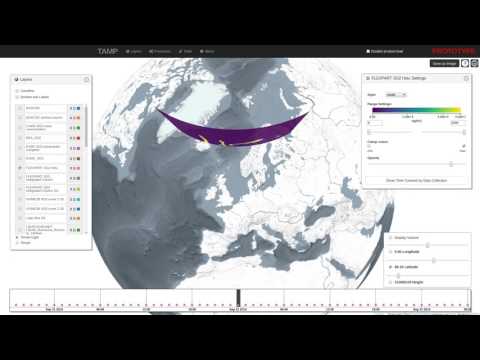
For more advanced examples of geotiff in larger codebases, please have a look at the following projects:

Migration Guide (v2 to v3)
Version 3.0 introduces significant performance improvements through deferred tag reading, but includes breaking changes to some APIs. This guide will help you migrate your code.
Summary of Changes
For most users: Minimal changes required. The high-level APIs (getImage(), readRasters(), etc.) remain compatible. You'll mainly need to:
- Add
awaittogetTiePoints()andgetGDALMetadata() - Change
image.geoKeystoimage.getGeoKeys()
For advanced users: If you directly access fileDirectory properties, you'll need to migrate to the new ImageFileDirectory methods.
Breaking Changes
1. GeoKeys Access
Before (v2):
const image = await tiff.getImage();
const geoKeys = image.geoKeys;
After (v3):
const image = await tiff.getImage();
const geoKeys = image.getGeoKeys();
2. getTiePoints() and getGDALMetadata() are now async
Before (v2):
const tiePoints = image.getTiePoints();
const metadata = image.getGDALMetadata();
After (v3):
const tiePoints = await image.getTiePoints();
const metadata = await image.getGDALMetadata();
3. Accessing fileDirectory properties
The fileDirectory object has been replaced with an ImageFileDirectory class that supports deferred loading.
Before (v2):
const image = await tiff.getImage();
const { ModelPixelScale: s, ModelTiepoint: t } = image.fileDirectory;
const width = image.fileDirectory.ImageWidth;
const compression = image.fileDirectory.Compression;
After (v3) - Use getValue() for synchronous access:
const image = await tiff.getImage();
const s = image.fileDirectory.getValue('ModelPixelScale');
const t = image.fileDirectory.getValue('ModelTiepoint');
const width = image.fileDirectory.getValue('ImageWidth');
const compression = image.fileDirectory.getValue('Compression');Note: getValue() throws an error if the tag is deferred. For tags that might be deferred (like large arrays), use loadValue():
const colorMap = await image.fileDirectory.loadValue('ColorMap');4. Checking if tags exist
Before (v2):
if (image.fileDirectory.ModelTiepoint) {
  // ...
}
After (v3):
if (image.fileDirectory.hasTag('ModelTiepoint')) {
  // ...
}
5. Accessing array elements
For large arrays (like TileOffsets, StripOffsets), individual elements can now be loaded on-demand:
Before (v2):
const offset = image.fileDirectory.TileOffsets[5];After (v3):
const offset = await image.fileDirectory.loadValueIndexed('TileOffsets', 5);6. Pool API changes
If you're using the Pool class directly (most users don't):
Before (v2):
const pool = new GeoTIFF.Pool();
const decoded = await pool.decode(fileDirectory, buffer);
After (v3):
const pool = new GeoTIFF.Pool();
const compression = fileDirectory.getValue('Compression');
const params = await getDecoderParameters(compression, fileDirectory);
const boundPool = pool.bindParameters(compression, params);
const decoded = await boundPool.decode(buffer);Note: When using readRasters({ pool }), this is handled automatically.
7. Custom Decoders
If you've implemented custom decoders:
Before (v2):
class MyDecoder extends BaseDecoder {
  async decode(fileDirectory, buffer) {
    // decode using fileDirectory properties
  }
}
After (v3):
class MyDecoder extends BaseDecoder {
  constructor(parameters) {
    super(parameters);
    // parameters extracted once during construction
  }

  async decode(buffer) {
    // decode using this.parameters
  }
}

// Register with parameter extraction function
addDecoder(
  12345, // compression ID
  () => import('./mydecoder.js').then(m => m.default),
  async (fileDirectory) => {
    return {
      ...await defaultDecoderParameterFn(fileDirectory),
      myCustomParam: await fileDirectory.loadValue('MyCustomTag')
    };
  }
);
Migration Examples
Example 1: Reading with ModelTiepoint/ModelPixelScale
Before (v2):
const tiff = await fromUrl(url);
const image = await tiff.getImage();
const { ModelPixelScale: s, ModelTiepoint: t } = image.fileDirectory;
const [sx, sy, sz] = s;
const [px, py, k, gx, gy, gz] = t;
After (v3):
const tiff = await fromUrl(url);
const image = await tiff.getImage();
const s = image.fileDirectory.getValue('ModelPixelScale');
const t = image.fileDirectory.getValue('ModelTiepoint');
const [sx, sy, sz] = s;
const [px, py, k, gx, gy, gz] = t;
Example 2: Working with ColorMap (potentially deferred)
Before (v2):
const image = await tiff.getImage();
const colorMap = image.fileDirectory.ColorMap;
After (v3):
const image = await tiff.getImage();
const colorMap = await image.fileDirectory.loadValue('ColorMap');
Example 3: Checking PhotometricInterpretation
Before (v2):
const pi = image.fileDirectory.PhotometricInterpretation;
if (pi === photometricInterpretations.RGB) {
  // ...
}
After (v3):
const pi = image.fileDirectory.getValue('PhotometricInterpretation');
if (pi === photometricInterpretations.RGB) {
  // ...
}
What Hasn't Changed
These APIs remain fully backwards compatible:
// GeoTIFF class
const tiff = await fromUrl(url);
const tiff = await fromArrayBuffer(buffer);
const tiff = await fromBlob(blob);
const imageCount = await tiff.getImageCount();
const image = await tiff.getImage(index);

// GeoTIFFImage class
const width = image.getWidth();
const height = image.getHeight();
const samplesPerPixel = image.getSamplesPerPixel();
const tileWidth = image.getTileWidth();
const tileHeight = image.getTileHeight();
const origin = image.getOrigin();
const resolution = image.getResolution();
const bbox = image.getBoundingBox();

// Reading raster data
const data = await image.readRasters({ window, samples, interleave, pool });
const rgb = await image.readRGB({ window });

// Writing GeoTIFFs
const arrayBuffer = await writeArrayBuffer(values, metadata);
Performance Benefits
The new deferred loading system provides significant performance improvements:
- Faster initial parsing: Large arrays (like tile offsets) are not loaded upfront
- Reduced memory usage: Only load the data you actually need
- On-demand array access: Access individual array elements without loading the entire array
- Backward compatible caching: Frequently accessed tags are eagerly loaded by default
Setup
To setup the repository do the following steps:
# clone repo
git clone https://github.com/constantinius/geotiff.js.git
cd geotiff.js/

# install development dependencies
npm install
Testing and Building
In order to run the tests you first have to set up the test data. This requires the GDAL and ImageMagick tools. Installation of these tools varies according to the operating system, the following listing shows the installation on Ubuntu (using the ubuntugis-unstable repository):
sudo add-apt-repository -y ppa:ubuntugis/ubuntugis-unstable
sudo apt-get update
sudo apt-get install -y gdal-bin imagemagick
To install GDAL and ImageMagick on MacOS X, please use Homebrew. The setup script also needs wget on MacOS X
brew install wget gdal imagemagickWhen GDAL and ImageMagick is installed, the test data setup script can be run:
cd test/data
sh setup_data.sh
cd -
To test the library (using PhantomJS, karma, mocha and chai) do the following:
npm testTo do some in-browser testing do:
npm run devand navigate to http://localhost:8090/test/
To build the library do:
npm run buildThe output is written to dist-browser/main.js and dist-node/main.js.
Install
You can install geotiff.js using npm:
npm install geotiffor you can use the prebuilt version with a CDN:
<script src="https://cdn.jsdelivr.net/npm/geotiff"></script>Usage
geotiff.js works with both require, import and the global variable GeoTIFF:
const GeoTIFF = require('geotiff');
const { fromUrl, fromUrls, fromArrayBuffer, fromBlob } = GeoTIFF;

// or
import GeoTIFF, { fromUrl, fromUrls, fromArrayBuffer, fromBlob } from 'geotiff';
or:
<script src="https://cdn.jsdelivr.net/npm/geotiff"></script>
<script>
  console.log(GeoTIFF);
</script>
To parse a GeoTIFF, first a data source is required. To help with the development, there are shortcuts available. The following creates a source that reads from a remote GeoTIFF referenced by a URL:
fromUrl(someUrl)
  .then(tiff => { /* ... */});

// or when using async/await
(async function() {
  const tiff = await fromUrl(someUrl);
  // ...
})()
Note: the interactions with geotiff.js objects are oftentimes asynchronous. For
the sake of brevity we will only show the async/await syntax and not the
Promise based one in the following examples.
Accessing remote images is just one way to open TIFF images with geotiff.js. Other
options are reading from a local ArrayBuffer:
// using local ArrayBuffer
const response = await fetch(someUrl);
const arrayBuffer = await response.arrayBuffer();
const tiff = await fromArrayBuffer(arrayBuffer);
or a Blob/File:
<input type="file" id="file">
<script>
  const input = document.getElementById('file');
  input.onchange = async function() {
    const tiff = await fromBlob(input.files[0]);
  }
</script>
Now that we have opened the TIFF file, we can inspect it. The TIFF is structured
in a small header and a list of one or more images (Image File Directory, IFD to
use the TIFF nomenclature). To get one image by index the getImage() function
must be used. This is again an asynchronous operation, as the IFDs are loaded
lazily:
const image = await tiff.getImage(); // by default, the first image is read.Now that we have obtained a GeoTIFFImage object we can inspect its metadata
(like size, tiling, number of samples, geographical information, etc.). All
the metadata is parsed once the IFD is first parsed, thus the access to that
is synchronous:
const width = image.getWidth();
const height = image.getHeight();
const tileWidth = image.getTileWidth();
const tileHeight = image.getTileHeight();
const samplesPerPixel = image.getSamplesPerPixel();

// when we are actually dealing with geo-data the following methods return
// meaningful results:
const origin = image.getOrigin();
const resolution = image.getResolution();
const bbox = image.getBoundingBox();
The actual raster data is not fetched and parsed automatically. This is because it is usually much more spacious and the decoding of the pixels can be time consuming due to the necessity of decompression.
To read a whole image into one big array of arrays the following method call can be used:
const data = await image.readRasters();For convenience the result always has a width and height attribute:
const data = await image.readRasters();
const { width, height } = data;
By default, the raster is split to a separate array for each component. For an RGB image for example, we'd get three arrays, one for red, green and blue.
const [red, green, blue] = await image.readRasters();If we want instead all the bands interleaved in one big array, we have to pass the
interleave: true option:
const [r0, g0, b0, r1, g1, b1, ...] = await image.readRasters({ interleave: true });If we are only interested in a specific region of the image, the window option can be
used to limit reading in that bounding box. Note: the bounding box is in 'image coordinates'
not geographical ones:
const left = 50;
const top = 10;
const right = 150;
const bottom = 60;

const data = await image.readRasters({ window: [left, top, right, bottom] });
This image window can go beyond the image bounds. In that case it might be usefull to supply
a fillValue: value option (can also be an array, one value for each sample).
It is also possible to just read specific samples for each pixel. For example, we can only read the red component from an RGB image:
const [red] = await image.readRasters({ samples: [0] });When you want your output in a specific size, you can use the width and height options.
This defaults of course to the size of your supplied window or the image size if no
window was supplied.
As the data now needs to be resampled, a resampleMethod can be specified. This defaults to
the nearest neighbour method, but also the 'bilinear' method is supported:
const data = await image.readRasters({ width: 40, height: 40, resampleMethod: 'bilinear' });Using decoder pools to improve parsing performance
Decoding compressed images can be a time consuming process. To minimize this
geotiff.js provides the Pool mechanism which uses WebWorkers to split the amount
of work on multiple 'threads'.
const pool = new GeoTIFF.Pool();
const data = await image.readRasters({ pool });
It is possible to provide a pool size (i.e: number of workers), by default the number of available processors is used.
Dealing with visual data
The TIFF specification provides various ways to encode visual data. In the specification this is called photometric interpretation. The simplest case we already dealt with is the RGB one. Others are grayscale, paletted images, CMYK, YCbCr, and CIE Lab.
geotiff.js provides a method to automatically convert these images to RGB:
readRGB(). This method is very similar to the readRasters method with
the distinction that the interleave option now defaults to true and the
samples are automatically chosen.
const rgb = await image.readRGB({
  // options...
});
Automatic image selection (experimental)
When dealing with images that have internal (or even external, see the next section)
overviews, GeoTIFF objects provide a separate readRasters method. This method
works very similar to the method on the GeoTIFFImage objects with the same name.
By default, it uses the larges image available (highest resolution), but when either
width, height, resX, or resY are specified, then the best fitting image will
be used for reading.
Additionally, it allows the bbox instead of the window parameter. This works
similarly, but uses geographic coordinates instead of pixel ones.
const data = await tiff.readRasters({
  bbox: [10.34, 57.28, 13.34, 60.23],
  resX: 0.1,
  resY: 0.1
});
External overviews
Especially for certain kinds of high resolution images it is not uncommon to separate
the highest resolution from the lower resolution overviews (usually using the .ovr
extension). With geotiff.js it is possible to use files of this setup, just as you
would use single-file images by taking advantage of the MultiGeoTIFF objects. They
behave exactly the same as the before mentioned GeoTIFF objects: you can select
images by index or read data using readRasters. Toget such a file use the fromUrls
factory function:
const multiTiff = await fromUrls(
  'LC08_L1TP_189027_20170403_20170414_01_T1_B3.TIF',
  ['LC08_L1TP_189027_20170403_20170414_01_T1_B3.TIF.ovr']
);
AbortController Support
Geotiff.js supports the use of AbortControllers. Calls to getRasters, readRGB and getTileOrStrip will throw an Error with name AbortSignal similar to the browser's fetch behavior.
const tiff = await fromUrl(source);
const abortController = new AbortController();
const { signal } = abortController;
abortController.abort();
try {
  const data = await tiff.readRasters({ signal });
} catch(e) {
  if (err.name === 'AbortError') {
    // do stuff
  }
}
Writing GeoTIFFs (Beta Version)
You can create a binary representation of a GeoTIFF using writeArrayBuffer.
This function returns an ArrayBuffer which you can then save as a .tif file.
⚠️ writeArrayBuffer currently writes the values uncompressed
import GeoTIFF, { writeArrayBuffer } from 'geotiff';

const values = [1, 2, 3, 4, 5, 6, 7, 8, 9];
const metadata = {
  height: 3,
  width: 3
};
const arrayBuffer = await writeArrayBuffer(values, metadata);
You can also customize the metadata using names found in the TIFF Spec and GeoTIFF spec.
import { writeArrayBuffer } from 'geotiff';

const values = [1, 2, 3, 4, 5, 6, 7, 8, 9];
const metadata = {
  GeographicTypeGeoKey: 4326,
  height: 3,
  ModelPixelScale: [0.031355, 0.031355, 0],
  ModelTiepoint: [0, 0, 0, 11.331755000000001, 46.268645, 0],
  width: 3
};
const arrayBuffer = await writeArrayBuffer(values, metadata);
What to do with the data?
There is a nice HTML 5/WebGL based rendering library called plotty, that allows for some really nice on the fly rendering of the data contained in a GeoTIFF.
<canvas id="plot"></canvas>
<script>
  // ...

  (async function() {
    const tiff = await fromUrl(url);
    const image = await tiff.getImage();
    const data = await image.readRasters();

    const canvas = document.getElementById("plot");
    const plot = new plotty.plot({
      canvas,
      data: data[0],
      width: image.getWidth(),
      height: image.getHeight(),
      domain: [0, 256],
      colorScale: "viridis"
    });
    plot.render();
  })();
</script>
There's also a library called geotiff-geokeys-to-proj4, that allows for reprojecting pixel coordinates and, therefore, consuming geospatial data contained in GeoTIFF.
BigTIFF support
geotiff.js has a limited support for files in the BigTIFF format. The limitations originate in the capabilities of current JavaScript implementations regarding 64 bit integer parsers and structures: there are no functions to read 64 bit integers from a stream and no such typed arrays. As BigTIFF relies on 64 bit offsets and also allows tag values of those types. In order to still provide a reasonable support, the following is implemented:
- 64 bit integers are read as two 32 bit integers and then combined. As numbers in JavaScript are typically implemented as 64 bit floats, there might be inaccuracies for very large values.
- For 64 bit integer arrays, the default
Arraytype is used. This might cause problems for some compression algorithms if those arrays are used for pixel values.
n-bit Support
geotiff.js has some n-bit support which means that it supports unsigned integer data reading with each element using a non-multiple of 8 bit depth. This only works with band interleaved images (see this related issue).
Planned stuff:
- Better support of geospatial parameters:
- WKT representation
Known Issues
The open issues can be found on GitHub.
Contribution
If you have an idea, found a bug or have a remark, please open a ticket, we will look into it ASAP.
Pull requests are welcome as well!
Community Packages
A list of community packages can be found in COMMUNITY.md
Acknowledgements
This library was inspired by GeotiffParser. It provided a great starting point, but lacked the capabilities to read the raw raster data which is the aim of geotiff.js.