

Package Exports
- graphql-typed-client
This package does not declare an exports field, so the exports above have been automatically detected and optimized by JSPM instead. If any package subpath is missing, it is recommended to post an issue to the original package (graphql-typed-client) to support the "exports" field. If that is not possible, create a JSPM override to customize the exports field for this package.
Readme
graphql-typed-client 

A tool that generates a strongly typed client library for any GraphQL endpoint. The client allows writing GraphQL queries as plain JS objects (with type safety, awesome code completion experience, custom scalar type mapping, type guards and more)
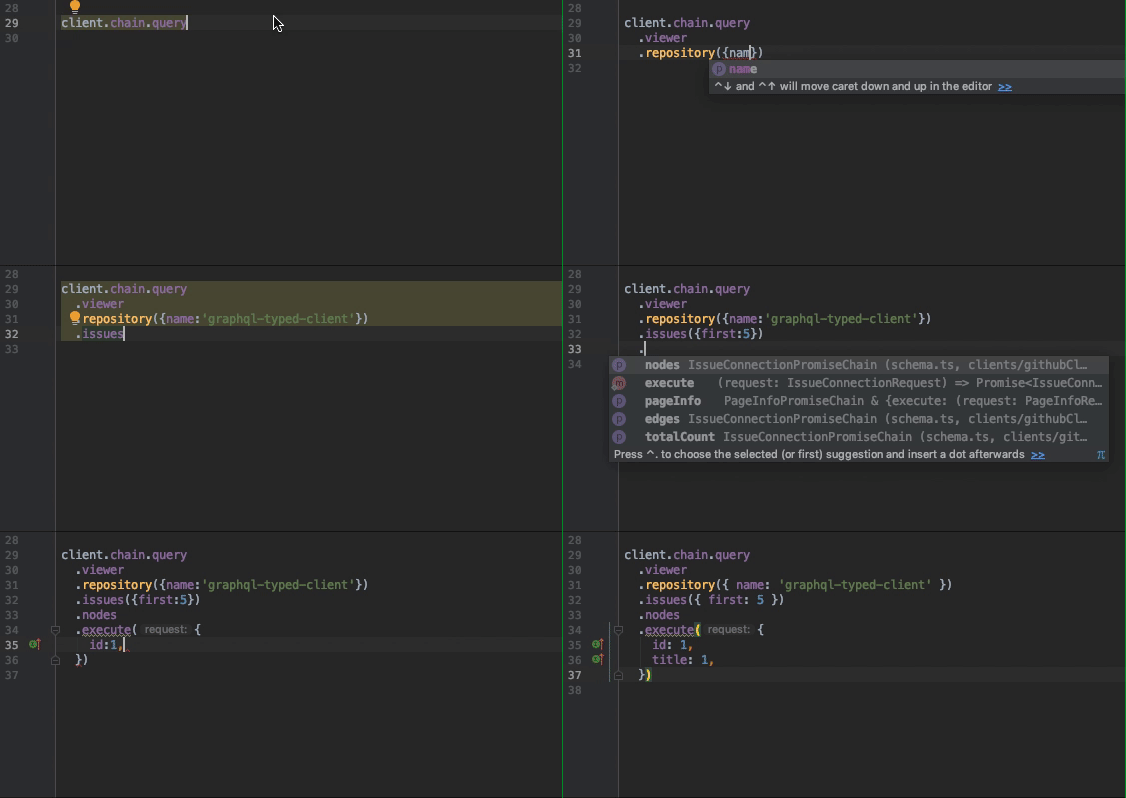
Chain request syntax
Raw request syntax
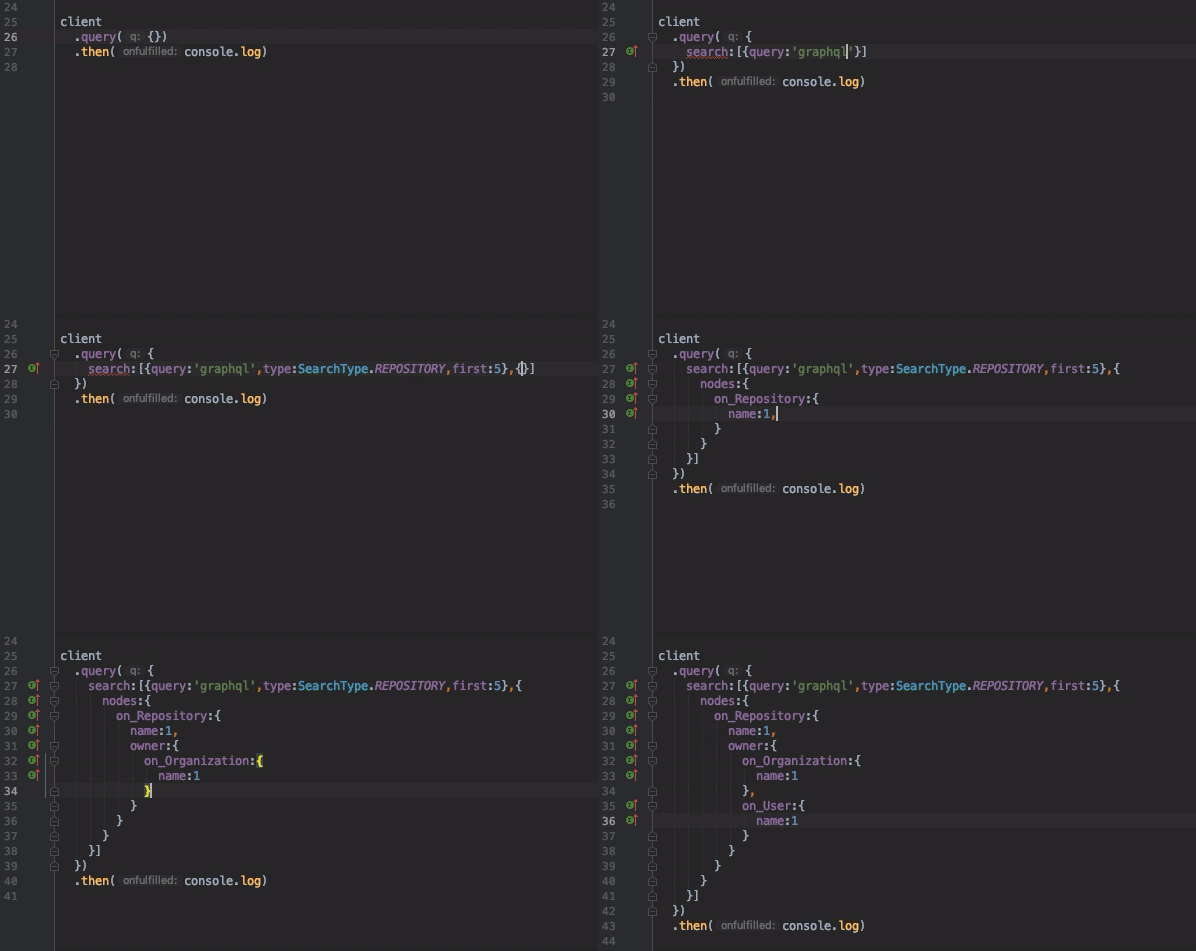
The request above is then converted to the GraphQL query and variables
query Query($v1: String!, $v2: SearchType!, $v3: Int) {
  search(query: $v1, type: $v2, first: $v3) {
    nodes {
      ...f3
    }
  }
}
fragment f1 on User {
  name
}
fragment f2 on Organization {
  name
}
fragment f3 on Repository {
  name
  owner {
    ...f1
    ...f2
  }
}
{ "v1": "graphql", "v2": "REPOSITORY", "v3": 5 }Install
yarn global add graphql-typed-client # needed for the CLI to work globally
yarn add graphql-typed-client # needed for the generated client to work
Generate the client
To generate the client, use the CLI tool
generate-graphql-clientUsage: generate-graphql-client [options]
Options:
-o, --output <./myClient> output directory
-e, --endpoint <http://example.com/graphql> GraphQL endpoint
-p, --post use POST for introspection query
-s, --schema <./mySchema.graphql> path to GraphQL schema definition file
-f, --fetcher <./schemaFetcher.js> path to introspection query fetcher file
-c, --config <./myConfig.js> path to config file
-v, --verbose verbose output
-h, --help output usage informationIf your endpoint is able to respond to introspection query without authentication, provide the endpoint option
(use post option to use POST request)
generate-graphql-client -e http://example.com/graphql -o myClient

# or using POST
generate-graphql-client -e http://example.com/graphql -p -o myClient
If your endpoint requires authentication or maybe some custom headers, use fetcher option to provide
a custom fetcher function.
We will pass fetch and qs
instances to your function for convenience, but you can use anything you like to fetch the introspection query
generate-graphql-client -f customFetcher.js -o myClient// customFetcher.js
module.exports = function(query, fetch, qs) {
return fetch(`https://api.github.com/graphql?${qs.stringify({ query: query })}`, {
headers: {
Authorization: 'bearer YOUR_GITHUB_API_TOKEN',
},
}).then(r => r.json())
}If instead of making a query to some endpoint, you just want to use a GraphQL schema definition, use schema option
generate-graphql-client -s mySchema.graphql -o myClient

# this will also work
generate-graphql-client -s "type User { name: String } type Query { users: [User] }" -o myClient
Alternatively, you can use a JS or JSON config file to define how you want the client to be generated. Also, using the config file you can define more than one client.
The config file should contain an object or an array of objects, each representing a client to be generated.
Object fields are named the same way as the CLI arguments described above + options field
for passing various parsing/generation options (see config.ts to learn more)
generate-graphql-client -c myConfig.js// myConfig.js
module.exports = [
{
schema: 'type Query { hello: String }',
output: 'clients/simpleClient',
},
{
schema: 'schemas/mySchema.graphql',
output: 'clients/clientFromSchema',
},
{
endpoint: 'http://example.com/graphql',
post: true,
output: 'clients/exampleClient',
},
{
fetcher: 'customFetcher.js',
output: 'clients/customClient',
},
{
fetcher: (query, fetch, qs) =>
fetch(`https://api.github.com/graphql?${qs.stringify({ query })}`, {
headers: {
Authorization: 'bearer YOUR_GITHUB_API_TOKEN',
},
}).then(r => r.json()),
output: 'clients/githubClient',
},
]Create the client instance
To create the client instance, you have to call createClient() function that was generated with the client
If you want to execute Queries and Mutations, provide a fetcher function.
Just like with the fetcher that can be used for client generation, we will
pass fetch and qs instances
inside for convenience, but the function can be implemented in any way you want
If you want to execute Subscriptions, provide subscriptionCreatorOptions object with uri and options fields, where
options are ClientOptions passed down
to subscriptions-transport-ws
(reconnect and lazy options are already enabled by default)
// myClient.js

import { createClient } from './clients/myClient/createClient'

export const myClient = createClient({
  fetcher: ({ query, variables }, fetch, qs) =>
    fetch(`http://example.com/graphql?${qs.stringify({ query, variables })}`, {
      headers: {
        Authorization: 'bearer MY_TOKEN',
      },
    }).then(r => r.json()),
  subscriptionCreatorOptions: {
    uri: 'wss://example.com/graphql-subscriptions',
    options: {
      connectionParams: {
        token: 'MY_TOKEN',
      },
    },
  },
})
Making GraphQL requests in JS
Raw request syntax
The format for the request object is visually similar to an actual GraphQL query, so something like
query({
  user: [{ id: 'USER_ID' }, {
      username: 1,
      email: 1,
      on_AdminUser: {
        isSuperAdmin: 1,
      },
  }],
})
is easily recognizable as
query {
  user(id: "USER_ID") {
    username
    email
    ... on AdminUser {
      isSuperAdmin
    }
  }
}
Here are the rules governing the format:
fields with scalar types are written as
name: 1orname: truefields with object types are written as JS objects
user: { name: 1 }fields that have arguments are written as arrays with argument object and the field selection
user: [{ id: 'USER_ID' }, { name: 1 }]if the field has arguments, but the return type is scalar, just pass the array with argument object
userCount: [{ status: 'active' }]if all the arguments for the field are optional, you can omit the array and just pass the field selection
friend: { name: 1 }is the same asfriend: [{}, { name: 1 }]
fields with
unionorinterfacetypes can have fragments defined on them to select fields of a specific typeon_AdminUser: { superAdmin: 1 }additionally, there is a special
__scalarfield, that can be included in the field selection to automatically include all scalar fields from an object/interface type (excluding__typename, which you have to request manually if you need it)user: { __scalar: 1 }
Here is an example request object, showing all possible field types
myClient.query({
  user: [{ id: 'USER_ID' }, {
    username: 1,
    email: 1,
    wasEmployed: [{ recently: true }],
    friends: {
      username: 1,
      email: 1,
    },
    posts: [{ limit: 5 }, {
      __scalar: 1,
    }],
    pets: {
      name: 1,
      on_Cat: {
        eyeColor: 1,
      },
      on_Snake: {
        length: 1,
      },
    },
  }],
})
When executed, it will send the following GraphQL query and variables to the server
{ "v1": "USER_ID", "v2": true, "v3": 5 }query($v1: ID!, $v2: Boolean, $v3: Int) {
user(id: $v1) {
username
email
wasEmployed(recently: $v2)
friends {
username
email
}
posts(limit: $v3) {
...f1
}
pets {
name
...f2
...f3
}
}
}
fragment f1 on Post {
id
title
content
}
fragment f2 on Cat {
eyeColor
}
fragment f3 on Snake {
length
}Chain request syntax
chain.query.user({ id: 'USER_ID' }).execute({
  username: 1,
  email: 1,
  on_AdminUser: {
    isSuperAdmin: 1,
  },
})

// execute() returns Promise<User | undefined> on query/mutation and Observable<User | undefined> on subscription
In the chain, each member refers to a GraphQL field going down the tree. Fields with arguments can be called like methods.
You can continue the chain so long as the fields that are mentioned are object types or interfaces (not arrays, unions etc.).
At any point, you can finish the chain by calling execute() (without arguments, if the last field is a scalar or with
field selection if the last field is an object). Calling execute() returns a Promise (for query/mutation) or an
Observable (subscription) of type equal to the type of the last field in the chain or undefined. Unlike in raw request
syntax, where GraphQL errors are just returned in the response, chain execution will throw an error if GraphQL endpoint
responds with errors or empty data.
Custom scalar type mapping
By default, all custom scalar types are generated as aliases to TypeScript's any
You can override this behavior by providing your own type mapper that will be used during the schema generation and applied to query responses
For example, let's say you have a custom Date type
scalar DateBy default, the we will generate it as
export type Date = anyWith the type mapper present, we can generate it as
export type Date = ReturnType<typeof typeMapper.Date>To do that, create a type mapper file somewhere in your app
// path/to/typeMapper.ts

import moment, { Moment } from 'moment'

export const typeMapper = {
  Date: (value: string): Moment => moment(value),
}
Add typeMapper option to client generation config
module.exports = {
  endpoint: 'http://example.com/graphql',
  output: 'clients/myClient',
  options: { typeMapper: { location: 'path/to/typeMapper', types: ['Date'] } },
}
Now when you generate the client, all fields of Date type in query responses will be run through the provided mapping
function, and the return type of that function is used as the field type in TypeScript (enabling correct code completion and
type checking)
myClient
  .query({
    user: [{ id: 'USER_ID' }, {
      name: 1,
      birthday: 1,
    }],
  })
  .then(result => {
    if (!result.data) return
    const user = result.data.user

    // moment's methods are now available
    console.log(user.birthday.startOf('day').toISOString())
  })
Type guards
Additionally, Typescript type guard functions are generated for every object, interface and union type in your schema
import { isCat, isSnake } from './clients/testClient/schema'

myClient
  .query({
    pet: [{ id: 'PET_ID' }, {
      name: 1,
      on_Cat: { eyeColor: 1 },
      on_Snake: { length: 1 },
    }],
  })
  .then(result => {
    if (!result.data) return
    const pet = result.data.pet

    console.log(pet.name) // pet type is abstract type Pet, so you only get access to shared fields

    if (isCat(pet)) {
      console.log(pet.eyeColor) // pet type is Cat, so you get access to fields of the specific type
    } else if (isSnake(pet)) {
      console.log(pet.length) // same here
    }
  })
Notes on type annotation generation
- all known Scalar types are converted to their Typescript counterparts
- all unknown Scalar types are converted to type aliases for
anyunless type mapper is provided - all Enum types are converted to Typescript enums, so you can import and use them in your code (even if you're not using Typescript)
Notes on subscriptions
The generated client uses Apollo's
subscriptions-transport-ws for executing Subscriptions
Subscriptions are wrapped in RxJs' Observable which is chained
to the SubscriptionClient so that a connection is opened when you subscribe to the first subscription,
shared among all subscriptions and closed when you unsubscribe from the last one.