
Package Exports
- inu
This package does not declare an exports field, so the exports above have been automatically detected and optimized by JSPM instead. If any package subpath is missing, it is recommended to post an issue to the original package (inu) to support the "exports" field. If that is not possible, create a JSPM override to customize the exports field for this package.
Readme
inu 





simple composable unidirectional user interfaces using pull streams
npm install --save inu
why?
explained best by jarvisaoieong/redux-architecture,
In classical Redux, which side effect is handled by thunk middleware, is not fractal (a term that is nicely explained by @stalz)

Even with some new Redux additions, like redux-saga, are also not composable in a fractal way with the rest of architecture.
I think elm architecture has found the proper way to do it right. Beside composing Views, State and Reducers (which are already composed in classical Redux), Actions and Effects should be composed too. All that leads to composition of application pieces at the higher level.

inu's implementation is more or less a direct port of tom using pull streams instead of rx.
example
const { start, html, pull } = require('inu')
const delay = require('pull-delay')

const app = {

  init: () => ({
    model: 0,
    effect: 'SCHEDULE_TICK' // start perpetual motion
  }),

  update: (model, action) => {
    switch (action) {
      case 'TICK':
        return {
          model: (model + 1) % 60,
          effect: 'SCHEDULE_TICK'
        }
      default:
        return { model }
    }
  },

  view: (model, dispatch) => html`
    <div class='clock'>
      Seconds Elapsed: ${model}
    </div>
  `,

  run: (effect) => {
    switch (effect) {
      case 'SCHEDULE_TICK':
        return pull(
          pull.values(['TICK']),
          delay(1000)
        )
    }
  }
}

const main = document.querySelector('.main')
const { views } = start(app)

pull(
  views(),
  pull.drain(function (view) {
    html.update(main, view)
  })
)
for a full example of composing multiple apps together, see source and demo.
usage
where state is an object with a required key model and an optional key effect,
an inu app is defined by an object with the following (optional) keys:
init: a function returning the initial stateupdate: aupdate(model, action)pure function, returns the new stateview: aview(model, dispatch)pure function, returns the user interface declarationrun: arun(effect, actions)function, returns an optional pull source stream of future actions
inu = require('inu')
the top-level inu module is a grab bag of all inu/* modules.
you can also require each module separately like require('inu/start').
streams = inu.start(app)
streams is an object with the following keys:
actions: a function that returns a pull source stream for actionsstates: a function that returns a state-ful* pull source stream for statesmodels: a function that returns a state-ful* pull source stream for modelsviews: a function that returns a state-ful* pull source stream for viewseffects: a function that returns a state-ful* pull source stream for effectseffectActionsSources: a function that returns a pull source stream for any streams of next actions caused by effects
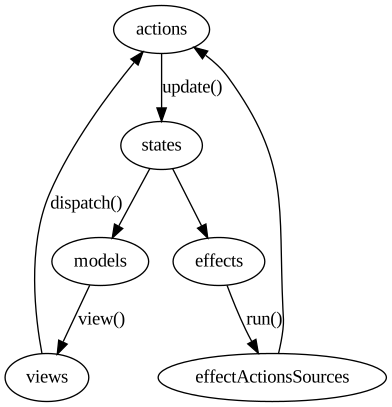
* in this context, state-ful means that the pull source stream will always start with the last value (if any) first.
inu.html === require('yo-yo')
inu.pull === require('pull-stream')
examples
- ./examples/clock: simple app to count seconds
- ./examples/title: simple app to change document.title
- ./examples/routing: url routing with
sheet-router - ./examples/compose: multiplex many apps into one app
- ./examples/counter: simple counter expressed in standard redux pattern
- ./examples: above examples composed into one app deployed at http://dinosaur.is/inu.
- pietgeursen/ssb-gathering-ui: Facebook-style events using
inu,muxrpc,sheetify,tcomband other fun stuff. - ahdinosaur/inu-plays-roguelike: 'Twitch Plays Pokémon'-style 'Roguelike' game using
inu,tcomb, and things.
inspiration
license
The Apache License
Copyright © 2016 Michael Williams
Licensed under the Apache License, Version 2.0 (the "License"); you may not use this file except in compliance with the License. You may obtain a copy of the License at
http://www.apache.org/licenses/LICENSE-2.0Unless required by applicable law or agreed to in writing, software distributed under the License is distributed on an "AS IS" BASIS, WITHOUT WARRANTIES OR CONDITIONS OF ANY KIND, either express or implied. See the License for the specific language governing permissions and limitations under the License.