
Package Exports
- tslog
Readme
📝 tslog: Beautiful logging experience for TypeScript and JavaScript







Powerful, fast and expressive logging for TypeScript and JavaScript
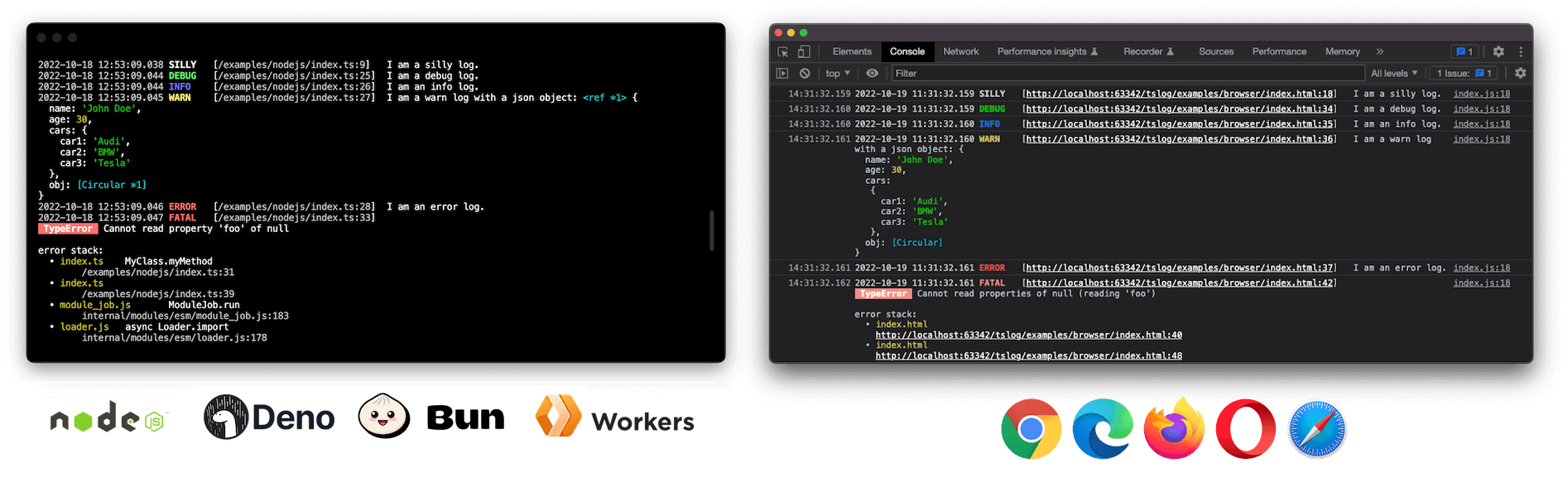
Highlights
⚡ Fast and powerful
🪶 Lightweight and flexible
🏗 Isomorphic: Works in Browsers and Node.js
👮️ Fully typed with TypeScript support (native source maps)
🗃 Pretty or JSON output
📝 Customizable log level
⭕️ Supports circular structures
🦸 Custom pluggable loggers
💅 Object and error interpolation
🤓 Stack trace and pretty errors
👨👧👦 Sub logger with inheritance
🙊 Mask/hide secrets and keys
📦 ESM with tree shaking support
✍️ well documented and tested
Example
import { Logger } from "tslog";

const log: Logger = new Logger();
log.silly("I am a silly log.");
Become a Sponsor
Donations help me allocate more time for my open source work.
Install
npm install tslogEnable TypeScript source map support:
This feature enables tslog to reference a correct line number in your TypeScript source code.
// tsconfig.json
{
  // ...
  compilerOptions: {
    // ...
    sourceMap: true,
    // we recommend using a current ES version
    target: "es2020",
  },
}
And run with:
Node.js with JavaScript:
node --enable-source-mapsNode.js with TypeScript (with ESM support):
node --enable-source-maps --experimental-specifier-resolution=node --no-warnings --loader ts-node/esmBrowser:
<!doctype html>
<html lang="en">
<head>
<title>tslog example</title>
</head>
<body>
<h1>Example</h1>

<script src="tslog.js"></script>

<script>
  const logger = new tslog.Logger({});
  logger.silly("I am a silly log.");
</script>

</body>
</html>
Simple example
import { Logger } from "tslog";

const logger = new Logger({ name: "myLogger" });
logger.silly("I am a silly log.");
logger.trace("I am a trace log.");
logger.debug("I am a debug log.");
logger.info("I am an info log.");
logger.warn("I am a warn log with a json object:", { foo: "bar" });
logger.error("I am an error log.");
logger.fatal(new Error("I am a pretty Error with a stacktrace."));
All Features
- Universal: Works in browsers and Node.js
- Tested: 100% code coverage, CI
- Super customizable: Every aspect can be overwritten
- Fully typed: Written in TypeScript, with native TypeScript support
- Default log level:
silly,trace,debug,info,warn,error,fatal(different colors) - Customizable log level: BaseLogger with configurable log level
- Pretty & JSON output: Structured/pretty,
JSONor suppressed output - Attachable transports: Send logs to an external log aggregation services, file system, database, or email/slack/sms/you name it...
- Minimum log level per output:
minLevellevel can be set individually per transport - Native source maps lookup: Shows exact position also in TypeScript code (compile-to-JS), one click to IDE position
- Pretty Error: Errors and stack traces printed in a structured way and fully accessible through JSON (e.g. external Log services)
- ES Modules: import syntax with (tree-shaking)
- Object/JSON highlighting: Nicely prints out an objects
- Sub Logger with inheritance: Powerful sub loggers with settings inheritance, also at runtime
- Secrets masking: Prevent passwords and secrets from sneaking into log files by masking them
- Short paths: Paths are relative to the root of the application folder
- Prefixes: Prefix log messages and bequeath prefixes to child loggers
API documentation
Lifecycle of a log message
Every incoming log message runs through a number of steps before being displayed or handed over to a "transport". Every steps can be overwritten and adjusted.
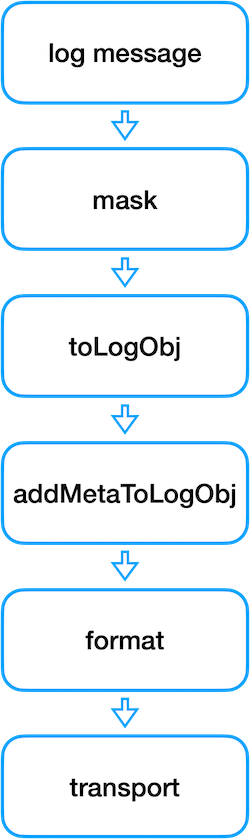
- log message Log message comes in through the
BaseLogger.log()method - mask If masking is configured, log message gets recursively masked
- toLogObj Log message gets transformed into a log object: A default typed log object can be passed to constructor as a second parameter and will be cloned and enriched with the incoming log parameters. Error properties will be handled accordingly. If there is only one log property, and it's an object, both objects (cloned default
logObjas well as the log property object will be merged.) Are there more than one, they will be pu into properties called "0", "1", ... and so on. Alternatively, log message properties can be put into a property with a name configured with theargumentsArrayNamesetting. - addMetaToLogObj Additional meta information, like the source code position of the log will be gathered and added to the
_metaproperty or any other one configured with the settingmetaProperty. - format In case of "pretty" configuration, a log object will be formatted based on the templates configured in settings. Meta will be formatted by the method
_prettyFormatLogObjMetaand the actual log payload will be formatted byprettyFormatLogObj. Both steps can be overwritten with the settingsformatMetaandformatMeta. - transport Last step is to "transport" a log message to every attached transport from the setting
attachedTransports. Last step is the actual transport, either JSON (transportJSON), formatted (transportFormatted) or omitted, if its set to "hidden". Both default transports can also be overwritten by the corresponding setting.
Default log level
tslog comes with default log level 0: silly, 1: trace, 2: debug, 3: info, 4: warn, 5: error, 6: fatal.
Tip: Each logging method has a return type, which is a JSON representation of the log message (
ILogObject).
import { Logger } from "tslog";

const log: Logger = new Logger();
log.silly("I am a silly log.");
log.trace("I am a trace log.");
log.debug("I am a debug log.");
log.info("I am an info log.");
log.warn("I am a warn log with a json object:", { foo: "bar" });
log.error("I am an error log.");
log.fatal(new Error("I am a pretty Error with a stacktrace."));
Custom log level
In addition to the default log level, custom log level can be defined in the same way tslog does it under the hood, by extending the BaseLogger and utilizing the log method.
log method expects the following parameters:
- logLevelId - Log level ID e.g. 0
- logLevelName - Log level name e.g. silly
- args - Multiple log attributes that should be logged out.
Tip: Also the generic logging method (log()) returns a JSON representation of the log message (
ILogObject).
import { BaseLogger, ILogObjMeta, ISettingsParam, ILogObj } from "./BaseLogger";

export class CustomLogger<LogObj> extends BaseLogger<LogObj> {
  constructor(settings?: ISettingsParam<LogObj>, logObj?: LogObj) {
    super(settings, logObj, 5);
  }

  /**
   * Logs a _CUSTOM_ message.
   * @param args  - Multiple log attributes that should be logged out.
   */
  public custom(...args: unknown[]): LogObj & ILogObjMeta {
    return super.log(8, "CUSTOM", ...args);
  }

}
Settings
tslog is highly customizable and pretty much every aspect can bei either configured or overwritten.
A settings object is the first parameter passed to the tslog constructor:
const logger = new Logger<ILogObj>({ /* SETTINGS */ }, defaultLogObject);Type: pretty, json, hidden
prettyDefault setting prints out a formatted structured "pretty" log entry.jsonprints out aJSONformatted log entry.hiddensuppresses any output whatsoever and can be used with attached loggers for example.
// pretty output
const defaultPrettyLogger = new Logger();

// also pretty output
const prettyLogger = new Logger({type: "pretty"});

// JSON output
const jsonLogger = new Logger({type: "json"});

// hidden output
const hiddenLogger = new Logger({type: "hidden"});
minLevel
You can ignore every log message from being processed until a certain severity.
Default severities are:
0: silly, 1: trace, 2: debug, 3: info, 4: warn, 5: error, 6: fatal
const suppressSilly = new Logger({minLevel: 1 });
suppressSilly.silly("Will be hidden");
suppressSilly.trace("Will be visible");
argumentsArrayName
tslog < 4 wrote all parameters into an arguments array. In tslog >= 4 the main object becomes home for all log parameters, and they get merged with the default logObj.
If you still want to put them into a separated parameter, you can do so by defining the argumentsArrayName.
const logger = new Logger({
  type: "json",
  argumentsArrayName: "argumentsArray",
});
const logMsg = logger.silly("Test1", "Test2");

//logMsg : {
// argumentsArray: [ 'Test1', 'Test2' ],
//   _meta: {
//       [...]
//     }
//   }
// }
Pretty templates and styles (color settings)
Enables you to overwrite the looks of a formatted "pretty" log message by providing a template string. Following settings are available for styling:
Templates:
prettyLogTemplate: template string for logs message. Possible placeholder:{{yyyy}}: year{{mm}}: month{{dd}}: day{{hh}}: hour{{MM}}: minute{{ss}}: seconds{{ms}}: milliseconds{{dateIsoStr}}: Shortcut for{{yyyy}}.{{mm}}.{{dd}} {{hh}}:{{MM}}:{{ss}}:{{ms}}{{logLevelName}}: name of the log level{{fullFilePath}}: a full path starting from/root{{filePathWithLine}}: a full path below the project path with line number
prettyErrorTemplate: template string for error message. Possible placeholder:{{errorName}}: name of the error{{errorMessage}}: error message{{errorStack}}: Placeholder for all stack lines defined byprettyErrorStackTemplate
prettyErrorStackTemplate: template string for error stack trace lines. Possible placeholder:{{fileName}}: name of the file{{filePathWithLine}}: a full path below the project path with line number{{method}}: optional name of the invoking method
prettyInspectOptions: Available options
Styling:
stylePrettyLogs: defines whether logs should be styled and colorizedprettyLogStyles: provides colors and styles for different placeholders and can also be dependent on the value (e.g. log level)- Level 1: template placeholder (defines a style for a certain template placeholder, s. above, without brackets).
- Level 2: Either a string with one style (e.g.
white), or an array of styles (e.g.["bold", "white"]), or a nested object with key being a value. - Level 3: Optional nested style based on placeholder values. Key is the value of the template placeholder and value is either a string of a style, or an array of styles (s. above), e.g.
{ SILLY: ["bold", "white"] }which means: value "SILLY" should get a style of "bold" and "white".*means any value other than the defined.
prettyInspectOptions: When a (potentially nested) object is printed out in Node.js, we useutil.formatWithOptionsunder the hood. WithprettyInspectOptionsyou can define the output. Possible values
Log meta information
tslog collects meta information for every log, like runtime, code position etc. The meta information collected depends on the runtime (browser or Node.js) and is accessible through the LogObj.
You can define the property containing this meta information with metaProperty, which is "_meta" per default.
Pretty templates and styles (color settings)
const logger = new Logger({
  prettyLogTemplate: "{{yyyy}}.{{mm}}.{{dd}} {{hh}}:{{MM}}:{{ss}}:{{ms}}\t{{logLevelName}}\t[{{filePathWithLine}}]\t",
  prettyErrorTemplate: "\n{{errorName}} {{errorMessage}}\nerror stack:\n{{errorStack}}",
  prettyErrorStackTemplate: "  • {{fileName}}\t{{method}}\n\t{{filePathWithLine}}",
  stylePrettyLogs: true,
  prettyLogStyles: {
    logLevelName: {
      "*": ["bold", "black", "bgWhiteBright", "dim"],
      SILLY: ["bold", "white"],
      TRACE: ["bold", "whiteBright"],
      DEBUG: ["bold", "green"],
      INFO: ["bold", "blue"],
      WARN: ["bold", "yellow"],
      ERROR: ["bold", "red"],
      FATAL: ["bold", "redBright"],
    },
    dateIsoStr: "white",
    filePathWithLine: "white",
    errorName: ["bold", "bgRedBright", "whiteBright"],
    fileName: ["yellow"],
  },
});
Masking secrets in logs
One of the most common ways of a password/secret breach is through log files.
Given the central position of tslog as the collecting hub of all application logs, it's only natural to use it as a filter.
There are multiple ways of masking secrets, before they get exposed:
maskPlaceholder: Placeholder to replaced masked secrets with, Default:[***]maskValuesOfKeys: Array of keys to replace the values with the placeholder (maskPlaceholder). Default:["password"]maskValuesOfKeysCaseInsensitive: Should the keys be matched case insensitive (e.g. "password" would replace "password" as well as "Password", and "PASSWORD"). Default:falsemaskValuesRegEx: For even more flexibility, you can also replace strings and object values with a RegEx.
Prefixing logs
Prefix every log message with an array of additional attributes.
Prefixes propagate to sub loggers and can help to follow a chain of promises.
In addition to AsyncLocalStorage, prefixes can help further distinguish different parts of a request.
Hint: A good example could be a GraphQL request, that by design could consist of multiple queries and/or mutations.
Example:
const logger = new Logger({
  prefix: ["main-prefix", "parent-prefix"],
});
logger.info("MainLogger message");
// Output:
// main-prefix parent-prefix MainLogger message

const childLogger = logger.getSubLogger({
  prefix: ["child1-prefix"],
});
childLogger.info("child1 message");
// Output:
// main-prefix parent-prefix MainLogger message

const grandchildLogger = childLogger.getSubLogger({
  prefix: ["grandchild1-prefix"],
});
grandchildLogger.silly("grandchild1 message");
// Output:
// main-prefix parent-prefix child1-prefix grandchild1-prefix grandchild1 message
Attach additional transports
tslog focuses on the one thing it does well: capturing logs.
Therefore, there is no build-in file system logging, log rotation, or similar.
Per default all logs go to console, which can be overwritten (s. below).
However, you can easily attach as many transports as you wish, enabling you to do fancy stuff like sending messages to Slack or Telegram in case of an urgent error or forwarding them to a log aggregator service.
Attached transports are also inherited to child loggers.
Simple transport example
Here is a very simple implementation used in our jest tests.
This example with suppress logs from being send to console (type: "hidden") and will instead collect them in an array.
const transports: any[] = [];
const logger = new Logger({ type: "hidden" });

logger.attachTransport((logObj) => {
  transports.push(logObj);
});

const logMsg = logger.info("Log message");
Storing logs in a file
Here is an example how to store all logs in a file.
import { Logger } from "tslog";
import { appendFileSync } from "fs";

const logger = new Logger();
logger.attachTransport((logObj) => {
  appendFileSync("logs.txt", JSON.stringify(logObj) + "\n");
});

logger.debug("I am a debug log.");
logger.info("I am an info log.");
logger.warn("I am a warn log with a json object:", { foo: "bar" });
Storing logs in file system with rotating files
If you want to limit the file size of the stored logs, a good practice is to use file rotation, where old logs will be deleted automatically.
There is a great library called rotating-file-stream solving this problem for us and even adding features like compression, file size limit etc.
- First you need to install this library:
npm i rotating-file-stream- Combine it with
tslog:
import { Logger } from "tslog";
import { createStream } from "rotating-file-stream";

const stream = createStream("tslog.log", {
  size: "10M", // rotate every 10 MegaBytes written
  interval: "1d", // rotate daily
  compress: "gzip", // compress rotated files
});

const logger = new Logger();
logger.attachTransport((logObj) => {
  stream.write(JSON.stringify(logObject) + "\n");
});

logger.debug("I am a debug log.");
logger.info("I am an info log.");
logger.warn("I am a warn log with a json object:", { foo: "bar" });
Overwriting default behavior
One of the key advantages of tslog >= 4 is that you can overwrite pretty much every aspect of the log processing described in "Lifecycle of a log message".
For every log:
    const logger = new Logger({
  overwrite: {
    mask: (args: unknown[]): unknown[] => {
      // mask and return an array of log attributes for further processing
    },
    toLogObj: (args: unknown[], clonesLogObj?: LogObj): unknown => {
      // convert the log attributes to a LogObj and return it
    },
    addMeta: (logObj: any, logLevelId: number, logLevelName: string) => {
      // add meta information to the LogObj and return it
    }

  },
});
For pretty logs log:
    const logger = new Logger({
      type: "pretty",
      overwrite: {
        formatMeta: (meta?: IMeta) => {
          // format LogObj meta object to a string and return it
        },
        formatLogObj: <LogObj>(maskedArgs: unknown[], settings: ISettings<LogObj>) => {
            // format LogObj attributes to a string and return it
        },
        transportFormatted: (logMetaMarkup: string, logArgs: unknown[], logErrors: string[], settings: unknown) => {
          // overwrite the default transport for formatted (e.g. pretty) log levels. e.g. replace console with StdOut, write to file etc.
        },
      },
    });
For JSON logs log (no formatting happens here):
    const logger = new Logger({
      type: "pretty",
      overwrite: {
        transportJSON: (logObjWithMeta: any) => {
          // transport the LogObj to console, StdOut, a file or an external service
        },
      },
    });
Defining and accessing logObj
As described in "Lifecycle of a log message", every log message goes through some lifecycle steps and becomes an object representation of the log with the name logObj.
A default logObj can be passed to the tslog constructor and will be cloned and merged into the log message. This makes tslog >= 4 highly configurable and easy to integrate into any 3rd party service.
The entire logObj will be printed out in JSON mode and also returned by every log method.
Tip: All properties of the default
LogObjcontaining function calls will be executed for every log message making use cases possible likerequestId(s. below).
interface ILogObj {
    foo: string;
}

const defaultLogObject: ILogObj = {
  foo: "bar",
};

const logger = new Logger<ILogObj>({ type: "json" }, defaultLogObject);
const logMsg = logger.info("Test");

// logMsg: {
//  '0': 'Test',
//  foo: 'bar',
//  _meta: {
//    runtime: 'Nodejs',
//    hostname: 'Eugenes-MBP.local',
//    date: 2022-10-23T10:51:08.857Z,
//    logLevelId: 3,
//    logLevelName: 'INFO',
//    path: {
//      fullFilePath: 'file:///[...]/tslog/examples/nodejs/index.ts:113:23',
//      fileName: 'index.ts',
//      fileColumn: '23',
//      fileLine: '113',
//      filePath: '/examples/nodejs/index.ts',
//      filePathWithLine: '/examples/nodejs/index.ts:113'
//    }
//  }
//}
Tip: RequestID: Mark a request (e.g. HTTP) call with AsyncLocalStorage and tslog
Node.js 13.10 introduced a new feature called AsyncLocalStorage.
❗ Keep track of all subsequent calls and promises originated from a single request (e.g. HTTP).
In a real world application a call to an API would lead to many logs produced across the entire application.
When debugging it can get quite handy to be able to group all logs based by a unique identifier, e.g. requestId.
Some provides (e.g. Heroku) already set a X-Request-ID header, which we are going to use or fallback to a short ID generated by nanoid.
In this example every subsequent logger is a sub logger of the main logger and thus inherits all of its settings making requestId available throughout the entire application without any further ado.
tslog works with any API framework (like Express, Koa, Hapi and so on), but in this example we are using Koa.
  import { AsyncLocalStorage } from "async_hooks";
  import Koa from "koa";
  import { customAlphabet } from "nanoid";
  import { Logger } from "tslog";

  interface ILogObj {
    requestId?: string | (() => string | undefined);
  }

  const asyncLocalStorage: AsyncLocalStorage<{ requestId: string }> = new AsyncLocalStorage();

  const defaultLogObject: ILogObj = {
    requestId: () => asyncLocalStorage.getStore()?.requestId,
  };

  const logger = new Logger<ILogObj>({ type: "json" }, defaultLogObject);
  export { logger };

  logger.info("Test log without requestId");

  const koaApp = new Koa();

  /** START AsyncLocalStorage requestId middleware **/
  koaApp.use(async (ctx: Koa.Context, next: Koa.Next) => {
    // use x-request-id or fallback to a nanoid
    const requestId: string = (ctx.request.headers["x-request-id"] as string) ?? customAlphabet("1234567890abcdefghijklmnopqrstuvwxyz", 6)();
    // every other Koa middleware will run within the AsyncLocalStorage context
    await asyncLocalStorage.run({ requestId }, async () => {
      return next();
    });
  });
  /** END AsyncLocalStorage requestId middleware **/

  // example middleware
  koaApp.use(async (ctx: Koa.Context, next) => {

    // log request
    logger.silly({ originalUrl: ctx.originalUrl, status: ctx.response.status, message: ctx.response.message });

    // also works with a sub logger
    const subLogger = logger.getSubLogger();
    subLogger.info("Log containing requestId"); // <-- will contain a requestId

    return await next();
  });

  koaApp.listen(3000);

  logger.info("Server running on port 3000");