

Package Exports
- watch-state
- watch-state/Cache
- watch-state/Cache/index.js
- watch-state/State
- watch-state/State/index.js
- watch-state/Watch
- watch-state/Watch/index.js
- watch-state/index.es6.js
- watch-state/index.js
This package does not declare an exports field, so the exports above have been automatically detected and optimized by JSPM instead. If any package subpath is missing, it is recommended to post an issue to the original package (watch-state) to support the "exports" field. If that is not possible, create a JSPM override to customize the exports field for this package.
Readme

watch-state
CANT inc. state management system.
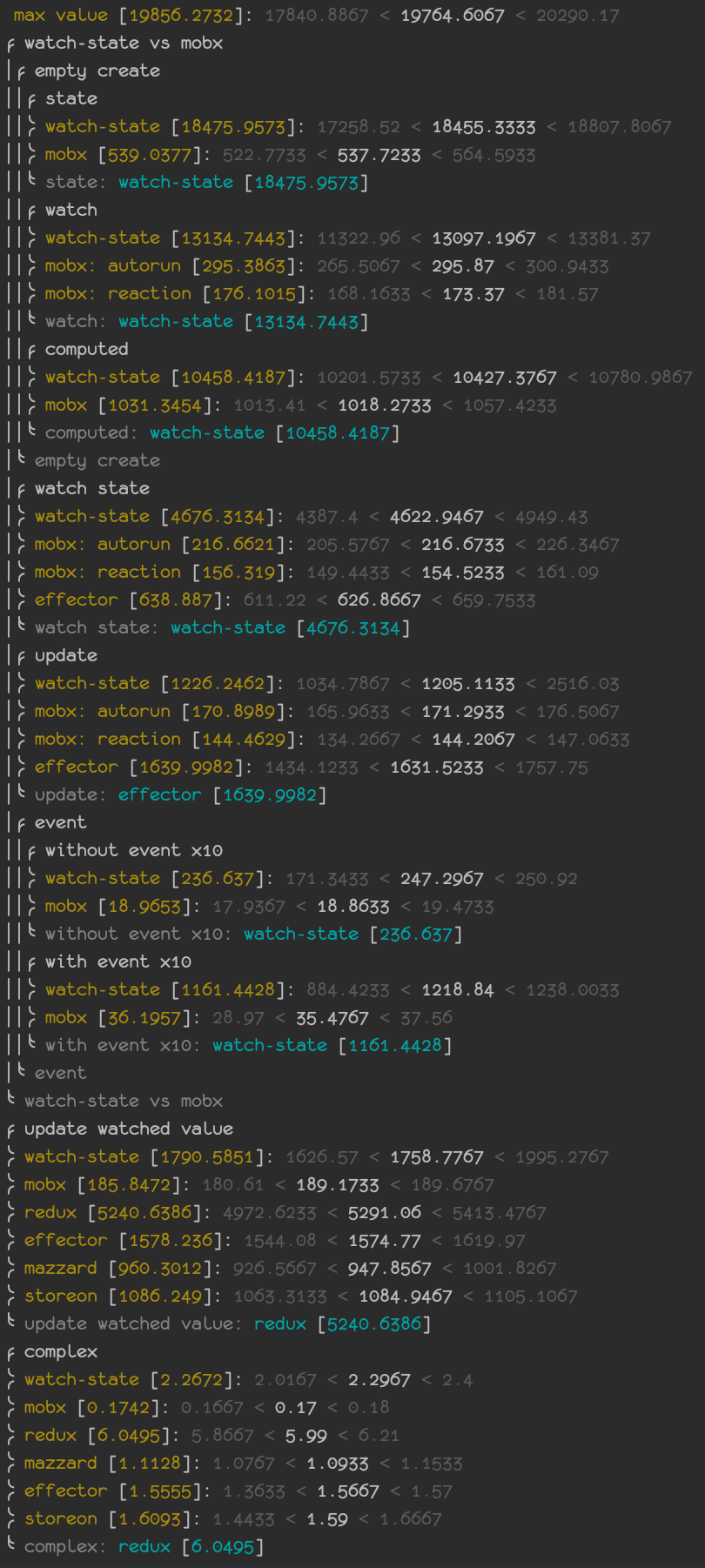
Fast One of the fastest |

Light Less than 1kb minzip |

Smart Steady architecture |






This is a fast, tiny and smart state management system. Based on simplest principles: you have a state and you can watch for the state changes. Was born during working on innet.
watch-state inspired by async-await pattern, you can image it like this:
state count = 0

watch {
  console.log(count)
}

Browser supports
Desktop
 Firefox Firefox |
 Chrome Chrome |
 Safari Safari |
 Opera Opera |
 Edge Edge |
|---|---|---|---|---|
| 45+ | 49+ | 9+ | 36+ | 13+ |
Mobile
| Firefox |
Chrome |
Safari |
Opera |
|---|---|---|---|
| 87+ | 90+ | 9+ | 62+ |
You can transpile it supporting old browsers, but the performance decreases.
Install
npm
npm i watch-stateyarn
yarn add watch-stateOr you can include this script to the head.
<script defer src="https://unpkg.com/watch-state/watch-state.min.js"></script>Use watchState to get any class from the library.
const {
  Watch,
  State,
  Cache,
  Event
} = watchState
Usage
Simple example:
You can create an instance of State and watch it's value.
import { Watch, State } from 'watch-state'

const count = new State(0)

new Watch(() => console.log(count.value))
// console.log(0)

count.value++
// console.log(1)

count.value++
// console.log(2)
Update argument:
You can check if the watching ran first by update argument.
const count = new State(0)

new Watch(update => {
  console.log(update, count.value)
})
// console.log(false, 0)

count.value++
// console.log(true, 1)

count.value++
// console.log(true, 2)
As example, you can watch a state once
const count = new State(0)

new Watch(update => {

  if (!update) {

    // Watch this value
    count.value

  } else {

    // React on changes
    console.log('The value was changed')

  }

})

count.value++
// console.log('The value was changed')

count.value++
// nothing happenes
Force update of State
You can run watchers of a state with update method.
const count = new State(0)

new Watch(() => {
  console.log(count.value)
})
// console.log(0)

count.update()
// console.log(0)
Force update of Watch
You can run a watcher even when it's states are not updated.
const count = new State(0)

const watcher = new Watch(() => {
  console.log(count.value)
})
// console.log(0)

watcher.update()
// console.log(0)
destroy
You can stop watching by destroy method of Watch.
const count = new State(0)

const watcher = new Watch(() => {
  console.log(count.value)
})
// console.log(0)

count.value++
// console.log(1)

watcher.destroy()

count.value++
// nothing happens
onDestroy()
You can subscribe on destroy or update of watcher
const count = new State(0)
const watcher = new Watch(() => {
  console.log('count', count.value)
  // the order does not matter
  onDestroy(() => console.log('destructor'))
})
// console.log('count', 0)

count.value++
// console.log('destructor')
// console.log('count', 1)

watcher.destroy()
// console.log('destructor')

watcher.destroy()
count.value++
// nothing happens
Deep watch:
You can use Watch inside a watcher.
Each watcher reacts on that states which used only inside it.
const watching = new State(true)
const state = new State(0)
let test = 0

new Watch(() => {
  test++
  if (watching.value) {
    new Watch(() => {
      console.log(state.value)
    })
  }
})
// console.log(0), test = 1

state.value++
// console.log(1), test = 1

watching.value = false
// test = 2

state.value++
// nothing happens
Cache:
You can cache computed state.
The watcher will not be triggered while new result is the same.
const name = new State('Foo')
const surname = new State('Bar')

const fullName = new Cache(() => (
  `${name.value} ${surname.value[0]}`
))

new Watch(() => {
  console.log(fullName.value)
})
// console.log('Foo B')

surname.value = 'Baz'
// nothing happens

surname.value = 'Quux'
// console.log('Foo Q')
You can force update the cache by update method.
fullName.update()
// console.log('Foo Q')
Cache will be immediately updated only if a watcher looks after the cache.
You can use destroy and onDestroy like you do it on a watcher.
fullName.destroy()The computing will be triggered only when a state inside the cache will be changed. So you can modify data only when it's needed.
const list = new State(['foo', 'bar', 'baz'])

const sortedList = new Cache(() => {
  console.log('computing')
  return [...list.value].sort()
})
// nothing happens

const value = sortedList.value
// console.log('computing')

console.log(sortedList.value)
// console.log(['bar', 'baz', 'foo'])

console.log(value === sortedList.value)
// console.log(true)

list.value = ['b', 'c', 'a']
// nothing happens

console.log(sortedList.value)
// console.log('computing')
// console.log(['a', 'b', 'c'])
Event:
Use Event when you change several states to run their watchers after the event finished.
const name = new State('Foo')
const surname = new State('Bar')
const event = new Event()

new Watch(() => {
  console.log(name.value, surname.value)
})
// console.log('Foo', 'Bar')

event.start()
name.value = 'Baz'
surname.value = 'Boo'
event.end()
// console.log('Baz', 'Boo')
You can use an event inside a watcher when you do not want to react on states
const count = new State(0)
const event = new Event()

new Watch(() => {
  event.start()
  console.log(count.value++)
  event.end()
})
You will get loop without event
You can use globalEvent every time if you do not want to extend the Event functionality.
import { State, globalEvent } from 'watch-state'
const count = new State(0)

new Watch(() => {
  globalEvent.start()
  console.log(count.value++)
  globalEvent.end()
})
createEvent
You can create event function with createEvent
import { State, createEvent } from 'watch-state'

const count = new State(0)
const increase = createEvent(() => {
  console.log(count.value++)
})

new Watch(increase)
Typescript:
Generic of State
const key = new State<string | number>()

key.value = false
// error, you can use only streng or number
Generic of Cache
new Cache<string>(() => false)
// error, target of cache should return string
Performance
You can check the performance test with MobX, Effector, Storeon, Mazzard and Redux. Clone the repo, install packages and run this command
npm run speedLinks
You can find more tools here
Issues
If you find a bug or have a suggestion, please file an issue on GitHub
