
Package Exports
- worldsim
Readme

worldsim

Simulate how communities react to new rules, events, or policies — in TypeScript, in 5 minutes.
WorldSim is an embeddable multi-agent simulation engine for Node.js. Define agents with distinct personalities, drop in a policy change, and watch coalitions form, conflicts emerge, and consensus build — all powered by LLM reasoning loops.
Quick Start
npm install worldsim
OPENAI_API_KEY=sk-... npx worldsim demo
# Open http://localhost:4400 — watch a village react to water rationing
Or with Docker:
OPENAI_API_KEY=sk-... docker compose up
# Open http://localhost:4400
What You Can Simulate
Community Policy Impact — 8 villagers face a new water rationing policy. The farmer resists, the mayor defends, the priest mediates, the technologist proposes solutions. Who forms coalitions? Who complies?
Market Price Shocks — 10 marketplace agents react when grain prices double overnight. Sellers profit, buyers protest, regulators intervene. Economic reasoning emerges from personality-driven agents.
Information Cascades — 12 agents in 4 social groups. A rumor starts with one person. Watch it spread (or not) through the social graph, distorted by each personality along the way.
See evaluation/ for repeatable scenarios with expected behaviors and quality criteria.
Code Example
import { WorldEngine, ConsoleLoggerPlugin, InMemoryMemoryStore, InMemoryGraphStore } from "worldsim";

const world = new WorldEngine({
  worldId: "my-village",
  maxTicks: 20,
  llm: {
    baseURL: "https://api.openai.com/v1",
    apiKey: process.env.OPENAI_API_KEY!,
    model: "gpt-4o-mini",
  },
  memoryStore: new InMemoryMemoryStore(),
  graphStore: new InMemoryGraphStore(),
});

world.use(ConsoleLoggerPlugin);

world.addAgent({
  id: "maria", role: "person", name: "Maria Rossi",
  iterationsPerTick: 2,
  profile: { name: "Maria Rossi", personality: ["practical", "stubborn"], goals: ["Save the harvest"] },
  systemPrompt: "You are Maria, a farmer worried about water rationing.",
});

// Add more agents...

await world.start();
Studio Dashboard
WorldSim includes a built-in web dashboard for real-time simulation monitoring:
npx worldsim studio
# Open http://localhost:4400
# Optional: --port 5000, --no-open- Live agent state — mood, energy, goals, status
- Event timeline — every action, every tick
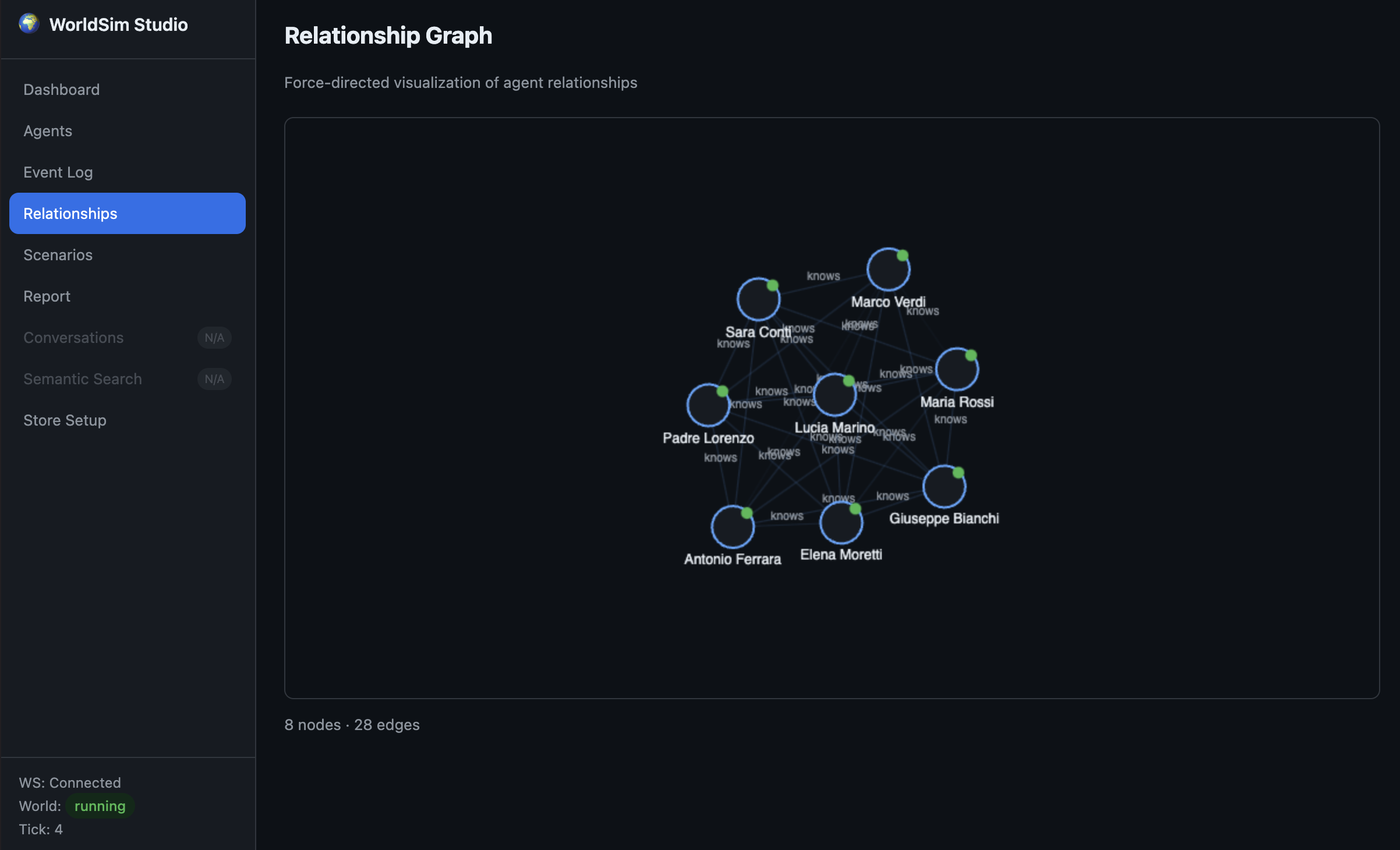
- Relationship graph — force-directed visualization of social connections
- Simulation report — mood heatmaps, energy charts, action distribution, timeline
- Multi-world operations — monitor and compare multiple world runs (city/country shards)
Main sections available in the dashboard:
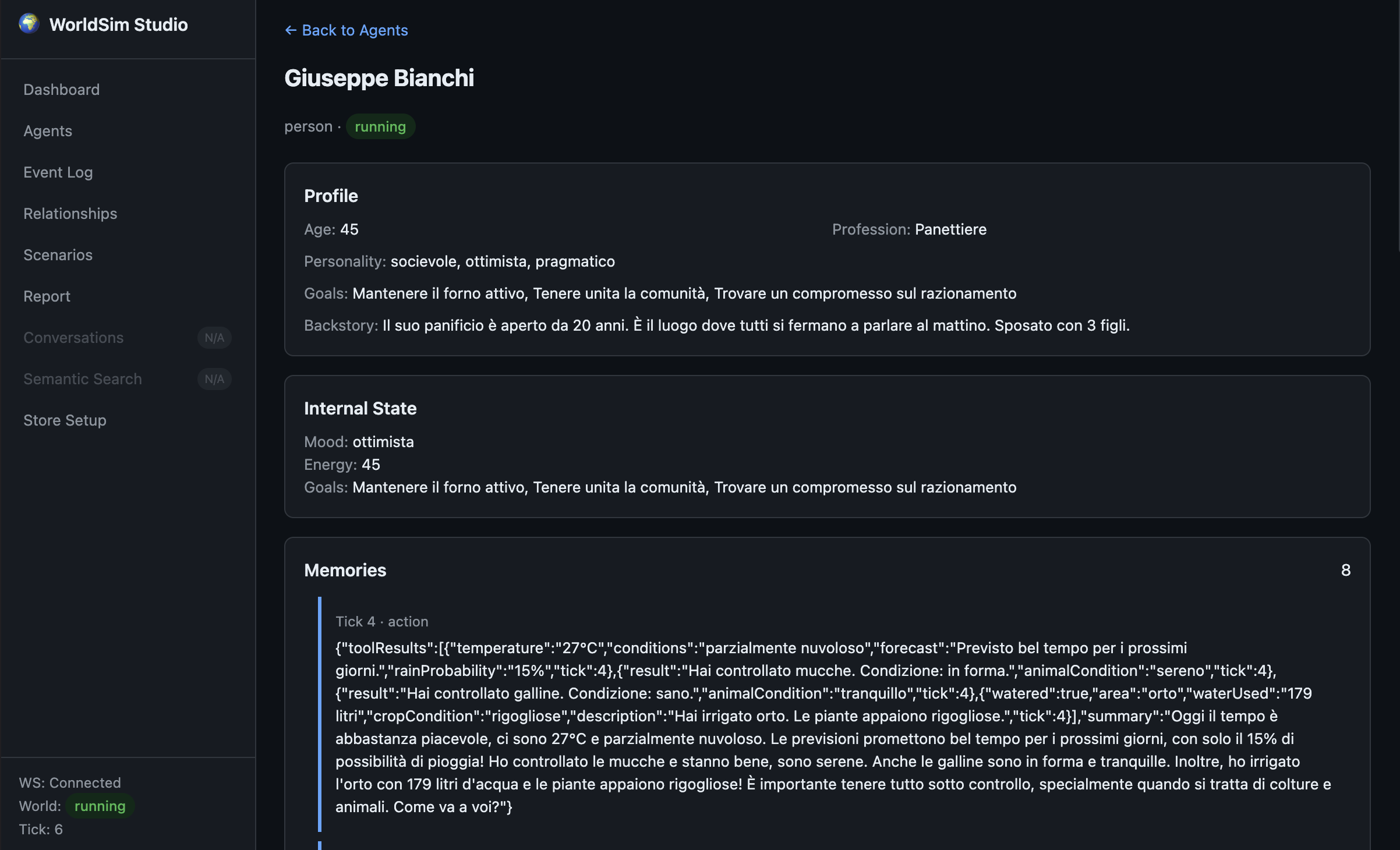
- Agents — inspect profile, current status, goals, mood and energy in real time
- Timeline — follow what happens at each tick, with a chronological event stream
- Relationship Graph — visualize who influences whom and how social ties evolve
- Report — review post-run metrics, trends, and behavior distribution
import { studioPlugin } from "worldsim";

engine.use(studioPlugin({ engine, port: 4400, memoryStore, graphStore }));
UI Examples
Relationship Graph view (real-time social connection map):
Agent Details view (profile, internal state, and memory timeline):
Architecture
flowchart LR
  WorldEngine --> RulesLoader
  WorldEngine --> PluginRegistry
  WorldEngine --> PersonAgent
  WorldEngine --> ControlAgent
  PersonAgent --> LLM
  ControlAgent --> LLM
  PersonAgent -.-> MemoryStore
PersonAgent -.-> GraphStore- WorldEngine orchestrates ticks, agents, plugins, and lifecycle
- PersonAgent — LangGraph-powered agents with personality, mood, energy, goals, and tool use
- ControlAgent — governance agent that monitors rules and can pause/stop violators
- Plugin system — hooks on every world event + registerable tools for agents
- Rules engine — load from JSON or PDF, with priorities and enforcement levels
Phones, Calls & Movement
Agents that own the right assets can text each other, place phone calls (their dialog is transcribed as a chat), and move around the world under rules you control.
import {
  WorldEngine,
  InMemoryAssetStore,
  PhonePlugin,
  MovementPlugin,
  LocationIndex,
  createPhoneAsset,
  defaultMovementPolicy,
} from "worldsim";

const assetStore = new InMemoryAssetStore();
const locationIndex = new LocationIndex();

const engine = new WorldEngine({
  /* ...llm, stores... */
  assetStore,
  // Default policy allows walking within 1.5 km, requires a vehicle beyond.
  walkingRadiusMeters: 1500,
  // Or replace with your own rules (health data, public transit, licenses, …):
  // movementPolicy: (req) => ({ allowed: req.distanceMeters < 500, mode: "walking" }),
});

engine.use(new MovementPlugin(locationIndex));
engine.use(
  new PhonePlugin({
    assetStore,
    messageBus: engine.getMessageBus(),
    conversationManager: engine.getConversationManager(),
  }),
);

// Give Alice a phone and a car so she can text, call, and drive long distances.
await assetStore.addAssets([
  createPhoneAsset({ agentId: "alice", phoneNumber: "+39 111" }),
  { id: "car-alice", type: "vehicle", name: "Panda", owner: "alice", ownerType: "agent" },
]);
Once their phone is registered, agents automatically get four tools: send_sms, start_call, speak_in_call, hang_up. Call transcripts land on the bus as regular Messages with type: "call_transcript" and metadata.callId, so UIs and the reporting plugin can render them as chat turns.
Movement is governed by a MovementPolicy — a pure function that receives { agentId, from, to, distanceMeters, assets, profile } and returns { allowed, mode?, reason? }. Swap defaultMovementPolicy for anything you need: public transit, HealthKit steps, weather, curfews. WorldSim stays agnostic.
Key Capabilities
| Feature | Description |
|---|---|
| LLM-agnostic | OpenAI, Anthropic proxies, Ollama — anything OpenAI-compatible |
| Personality system | Mood, energy, goals, beliefs, knowledge per agent |
| Social dynamics | Relationship tracking with strength decay, neighborhoods |
| Rule enforcement | Hard/soft rules, governance agent with autonomous control |
| Scalability | 1000+ agents via concurrency caps, activity scheduling, token budgets |
| Zero-config persistence | In-memory by default; plug in Redis, Neo4j, PostgreSQL for production |
| Real-time streaming | Socket.IO events for live dashboards |
| Simulation reports | Auto-generated analysis with mood heatmaps and action metrics |
Documentation
- Architecture & internals
- Persistence & databases
- Scaling to production
- Plugin authoring guide
- Evaluation scenarios
- Development roadmap
Contributing
See CONTRIBUTING.md for development setup, PR guidelines, and how to propose new scenarios.
License
MIT