
Package Exports
- @angular-material-extensions/password-strength
This package does not declare an exports field, so the exports above have been automatically detected and optimized by JSPM instead. If any package subpath is missing, it is recommended to post an issue to the original package (@angular-material-extensions/password-strength) to support the "exports" field. If that is not possible, create a JSPM override to customize the exports field for this package.
Readme

@angular-material-extensions/password-strength - Material password strength meter to indicate how secure is the provided password - Angular V9 supported incl. schematics









Please use the latest version of this library --> V6 which is supporting angular V9 @angular-material-extensions/password-strength@5.0.0 should be skipped --> @angular-material-extensions/password-strength@5.1.0 ---> @angular-material-extensions/password-strength@6.0.0 is better
Built by and for developers ❤️
Do you have any question or suggestion ? Please do not hesitate to contact us! Alternatively, provide a PR | open an appropriate issue here
If you like this project, support angular-material-extensions by starring ⭐ and sharing it 📢
Table of Contents
- Demo
- Components
- Dependencies
- Installation
- API
- Usage
- Run Demo App Locally
- Development
- Other Angular Libraries
- Support
- License
Demo
View all the directives and components in action at https://angular-material-extensions.github.io/password-strength
Library's components
<mat-password-strength>used to calculate and display the strength of a provided password
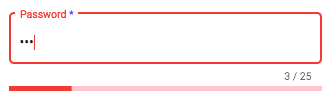
- strength score <= 20%
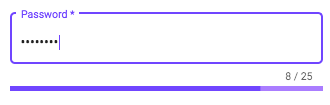
- strength score <= 80%
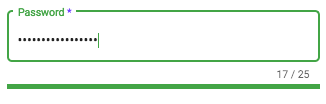
- strength score > 80%
<mat-password-strength-info>used to display more information about the strength of a provided password
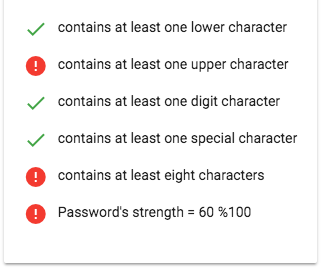
<mat-pass-toggle-visibility>used to show/hide the password provided in the input element
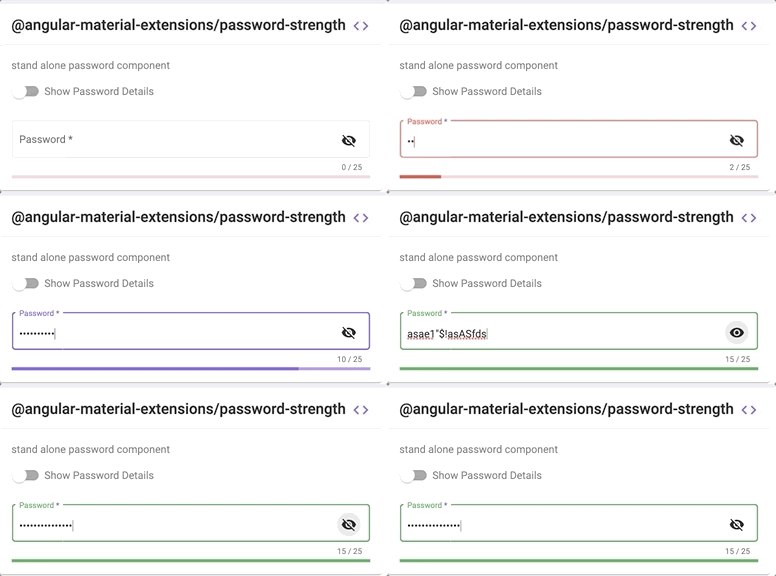
Dependencies
- Angular developed and tested with
9.x
Installation
1. Install via ng add. (Recommended)
If Angular Material Design is not setup, just run ng add @angular/material learn more
Now add the library via the angular schematics
ng add @angular-material-extensions/password-strength2. Install via npm. (Alternative)
Now install @angular-material-extensions/password-strength via:
npm install --save @angular-material-extensions/password-strengthSystemJS
Note:If you are using
SystemJS, you should adjust your configuration to point to the UMD bundle. In your systemjs config file,mapneeds to tell the System loader where to look for@angular-material-extensions/password-strength:
{
  '@angular-material-extensions/password-strength';: 'node_modules/@angular-material-extensions/password-strength/bundles/password-strength.umd.js',
}
-> follow the instructions here
Import the library
Once installed you need to import the main module:
import { MatPasswordStrengthModule } from '@angular-material-extensions/password-strength';The only remaining part is to list the imported module in your application module. The exact method will be slightly
different for the root (top-level) module for which you should end up with the code similar to (notice MatPasswordStrengthModule .forRoot()):
import { MatPasswordStrengthModule } from '@angular-material-extensions/password-strength';

@NgModule({
  declarations: [AppComponent, ...],
  imports: [MatPasswordStrengthModule.forRoot(), ...],
  bootstrap: [AppComponent]
})
export class AppModule {
}
Other modules in your application can simply import MatPasswordStrengthModule:
import { MatPasswordStrengthModule } from '@angular-material-extensions/password-strength';

@NgModule({
  declarations: [OtherComponent, ...],
  imports: [MatPasswordStrengthModule, ...],
})
export class OtherModule {
}
API
<mat-password-strength> used to calculate and display the strength of a provided password - see the demo examples
| option | bind | type | default | description |
|---|---|---|---|---|
| password | Input() |
string | - | the password to calculate its strength |
| customValidator | Input() |
RegExp | - | custom regex validator |
| externalError | Input() |
boolean |
false |
used to change the color of the password to warn if an external error occurs |
| enableLengthRule | Input() |
boolean |
true |
whether to validate the length of the password |
| enableLowerCaseLetterRule | Input() |
boolean |
true |
whether a lowercase letter is optional |
| enableUpperCaseLetterRule | Input() |
boolean |
true |
whether a uppercase letter is optional |
| enableDigitRule | Input() |
boolean |
true |
whether a digit char is optional |
| enableSpecialCharRule | Input() |
boolean |
true | whether a special char is optional |
| min | Input() |
number |
8 | the minimum length of the password |
| max | Input() |
number |
30 | the maximum length of the password |
| warnThreshold | Input() |
number |
21 | password strength less than this number shows the warn color |
| accentThreshold | Input() |
number |
81 | password strength less than this number shows the accent color |
| onStrengthChanged | Output() | number |
- | emits the strength of the provided password in % e.g: 20%, 40%, 60%, 80% or 100% |
<mat-password-strength-info> used to display more information about the strength of a provided password - see the demo examples
| option | bind | type | default | description |
|---|---|---|---|---|
| passwordComponent | Input() |
PasswordStrengthComponent | - | the password component used in the template in order to display more info related to the provided password |
| enableScoreInfo | Input() |
boolean |
false |
whether to show the password's score in % |
| lowerCaseCriteriaMsg | Input() |
string |
contains at least one lower character | an appropriate msg for the lower case % |
| upperCaseCriteriaMsg | Input() |
string |
contains at least one upper character | an appropriate msg for the upper case % |
| digitsCriteriaMsg | Input() |
string |
contains at least one digit character | an appropriate msg for the digit case % |
| specialCharsCriteriaMsg | Input() |
string |
contains at least one special character | an appropriate msg for the special case % |
| customCharsCriteriaMsg | Input() |
string |
contains at least one custom character | an appropriate msg for the custom validator case % |
| minCharsCriteriaMsg | Input() |
string |
contains at least ${this.passwordComponent.min} characters | an appropriate msg for the minimum number of chars % |
<mat-pass-toggle-visibility> used to show/hide the password provided in the input element
| option | bind | type | default | description |
|---|---|---|---|---|
| isVisible | Input() |
boolean |
false |
whether the password is visible or hidden |
Usage
add the @angular-material-extensions/password-strength element to your template:
<mat-password-strength  [password]="password.value">
</mat-password-strength>
This will display only the material password strength meter in form of a progress without any input fields or similar.
In the following example, we integration a material input container with @angular-material-extensions/password-strength 's component.
NOTE: In order to repaint the mat-form-field correctly after changing the value of the password's strength, please consider to change the detection strategy for the parent component -->
import {ChangeDetectionStrategy, Component, OnInit, ViewEncapsulation} from '@angular/core';
import {Title} from '@angular/platform-browser';
import {MatSlideToggleChange} from '@angular/material';
import {MatPasswordStrengthComponent} from '@angular-material-extensions/password-strength';

@Component({
  selector: 'app-home',
  templateUrl: './home.component.html',
  styleUrls: ['./home.component.scss'],
  encapsulation: ViewEncapsulation.None,
  changeDetection: ChangeDetectionStrategy.OnPush
})
export class HomeComponent implements OnInit {}<div>
<mat-form-field appearance="outline" style="width: 100%" [color]="passwordComponent.color">
<mat-label>Password</mat-label>
<input matInput #password
[type]="inputType"
required
placeholder="Password">
<mat-hint align="end" aria-live="polite">
{{password.value.length}} / 25
</mat-hint>
</mat-form-field>
<mat-password-strength #passwordComponent
(onStrengthChanged)="onStrengthChanged($event)"
[password]="password.value">
</mat-password-strength>
</div>learn more about mat-form-field
Example of how to use the emitted strength of the password in your template
<div fxLayout="row" fxLayoutGap="10px">
   <div *ngIf="passwordComponent.strength === 100; then done else error">
   </div>
   <ng-template #done>
     <mat-icon color="primary">done</mat-icon>
   </ng-template>
   <ng-template #error>
     <mat-icon color="warn">error</mat-icon>
   </ng-template>
   <div>
     <p>Password's strength = {{passwordComponent.strength}} %100</p>
   </div>
</div>
Use the toggle visibility component
- add the
mat-pass-toggle-visibilityto yourmat-form-field - give it a name to use it in the html file like
toggle - set the type of the input to that value emitted from the
mat-pass-toggle-visibilitycomponent<input matInput [type]="toggle.type"/>
<mat-form-field appearance="outline" style="width: 100%" [color]="passwordComponent.color">
  <mat-label>Password</mat-label>
  <!-- HERE DOWN :D-->
  <mat-pass-toggle-visibility #toggle matSuffix></mat-pass-toggle-visibility>
  <!-- THERE ABOVE ;)-->
  <input matInput #password
         [type]="toggle.type"
         required
         placeholder="Password">
  <mat-hint align="end" aria-live="polite">
    {{password.value.length}} / 25
  </mat-hint>
</mat-form-field>
Client Side password's validation using a built in angular formController
- add an input element to your template with an appropriate @angular-material-extensions/password-strength's component
- hold a reference of the @angular-material-extensions/password-strength's component by adding
passwordComponentWithValidation(or whatever you want) inside the element
e.g:
 <mat-password-strength #passwordComponentWithValidation
                       [password]="passwordWithValidation.value">
</mat-password-strength>- bind the form controller of the mat-password-strength to the input element
- you can access the form controller of @angular-material-extensions/password-strength using the chile view -->
passwordComponentWithValidation.passwordFormControl - bind the form controller to an input element -->
[formControl]="passwordComponentWithValidation.passwordFormControl"
- Full example - see below
<div>
  <mat-form-field appearance="outline" style="width: 100%">
    <mat-label>Password</mat-label>
    <input matInput #passwordWithValidation
           [type]="inputType"
           required
           [formControl]="passwordComponentWithValidation.passwordFormControl"
           placeholder="Password">
    <mat-hint align="end" aria-live="polite">
      {{passwordWithValidation.value.length}} / 25
    </mat-hint>
    <mat-error *ngIf="passwordComponentWithValidation.passwordFormControl.hasError('required')">
      Password is required
    </mat-error>
    <mat-error *ngIf="passwordComponentWithValidation.passwordFormControl.hasError('pattern')">
      Password is not valid
    </mat-error>
  </mat-form-field>
  <mat-password-strength #passwordComponentWithValidation
                                  (onStrengthChanged)="onStrengthChanged($event)"
                                  [password]="passwordWithValidation.value">
  </mat-password-strength>
  <!--Password's strength info-->
  <mat-password-strength-info
    [passwordComponent]="passwordComponentWithValidation">
  </mat-password-strength-info>
</div>
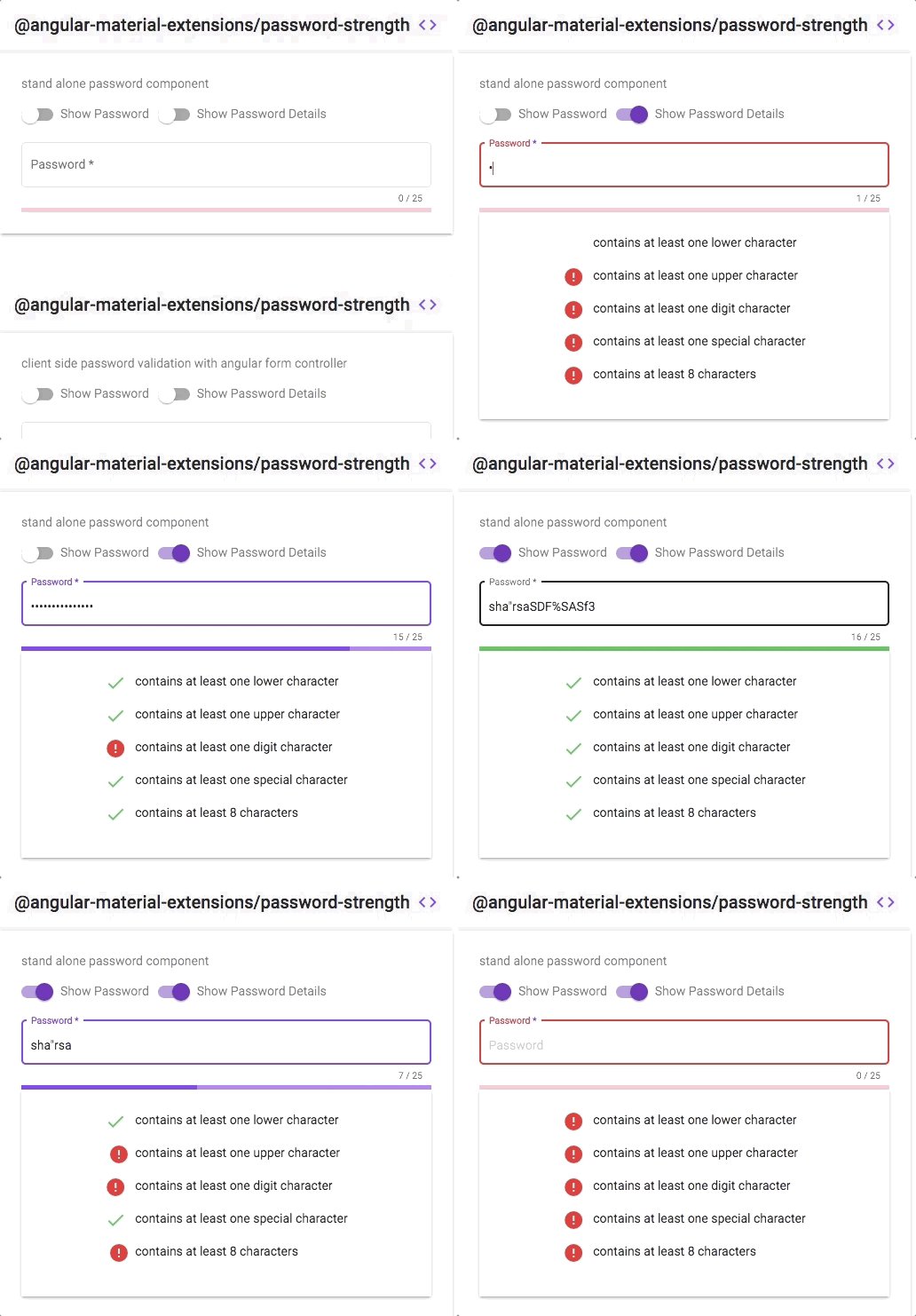
this will looks like -->
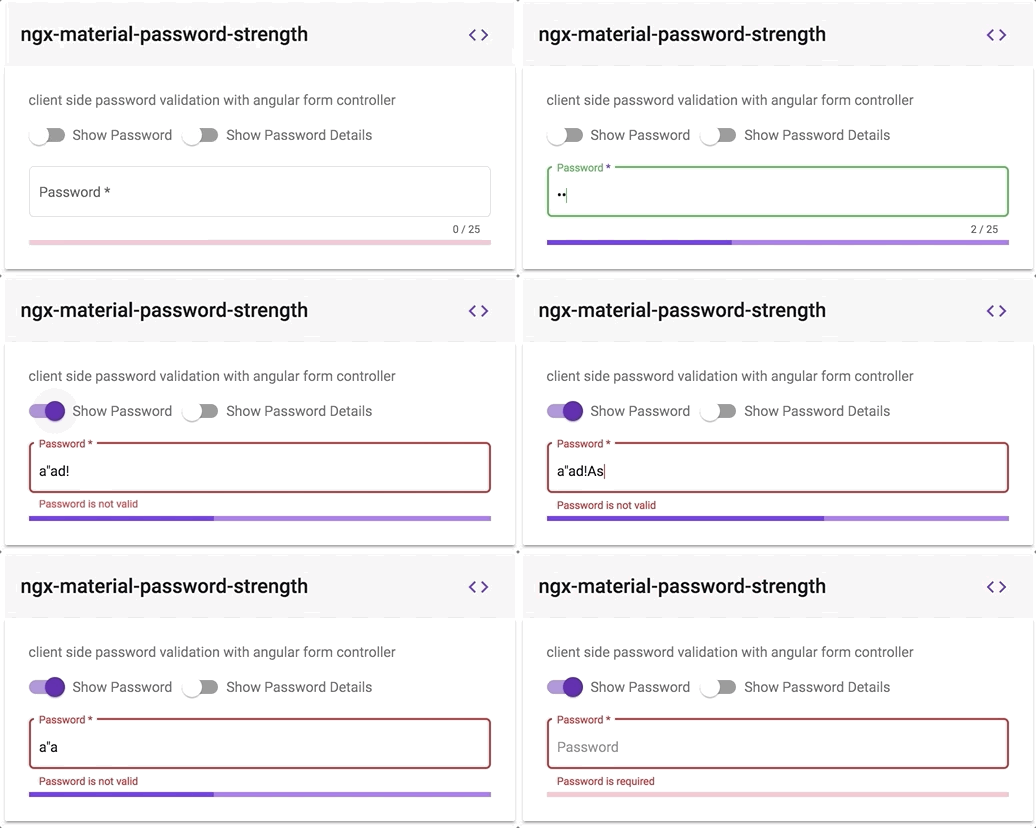
custom regex validation
please consider to use the customValidator input (see below)
<mat-slide-toggle #toggle>Show Password Details</mat-slide-toggle>

 <mat-form-field appearance="outline" style="width: 100%" [color]="passwordComponent.color">
  <mat-label>Password</mat-label>
  <mat-pass-toggle-visibility #toggleVisbility matSuffix></mat-pass-toggle-visibility>
  <input matInput #password
         [type]="toggleVisbility.type"
         placeholder="Password">
  <mat-hint align="end" aria-live="polite">
    {{password.value.length}} / {{passwordComponent.max}}
  </mat-hint>
</mat-form-field>


<mat-password-strength #passwordComponent
  (onStrengthChanged)="onStrengthChanged($event)"
  [password]="password.value"
  [customValidator]="pattern">
</mat-password-strength>

<mat-password-strength-info
  *ngIf="toggle.checked"
  [passwordComponent]="passwordComponent6"
  customCharsCriteriaMsg="1 german special chars is required"
  [enableScoreInfo]="true">
</mat-password-strength-info>
pattern = new RegExp(/^(?=.*?[äöüÄÖÜß])/);Confirm the password with built in angular form controllers - see the live example
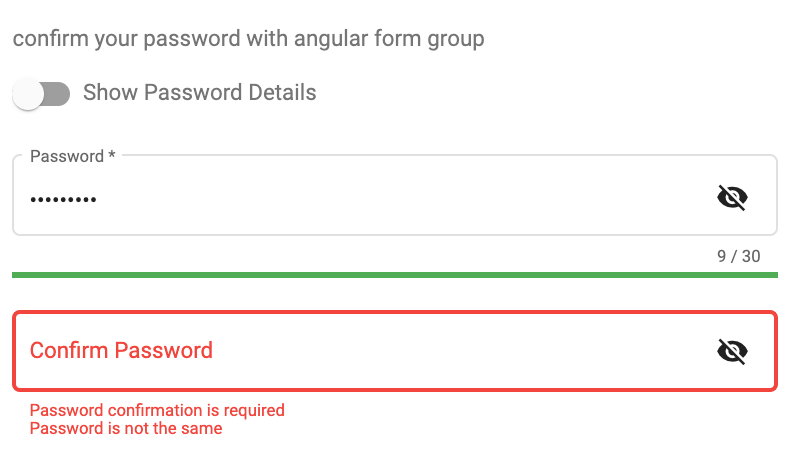
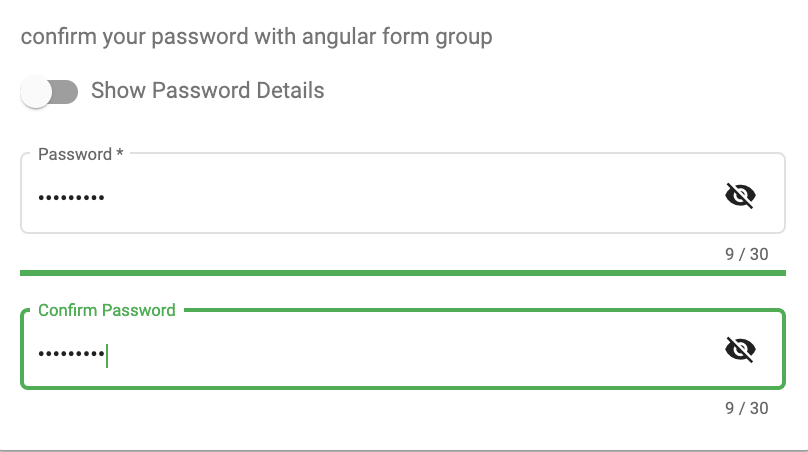
Use always the green color for a strong password just by adding the green css class to the mat-password-strength
<mat-password-strength #passwordComponent
                       class="green"
                       [password]="password.value">
</mat-password-strength>
Supporting custom messages and ngx-translate for the info component please check the example demo here
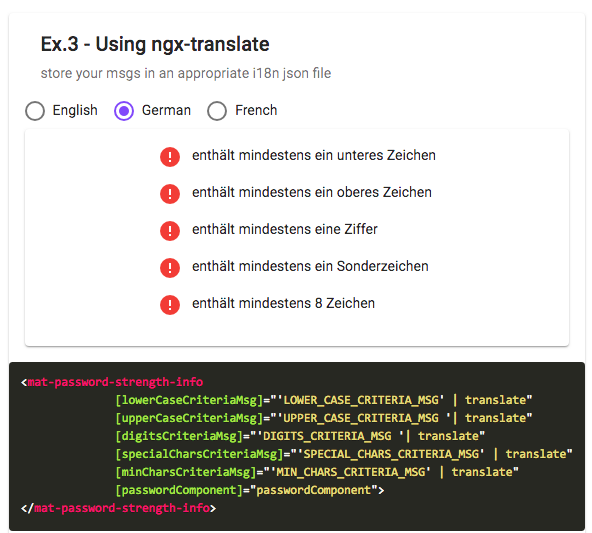
for more examples please visit this URL : (https://angular-material-extensions.github.io/password-strength/examples
Please checkout the full documentation here or follow the official tutorial
Run Demo App Locally
Development
Other Angular Libraries
- ngx-auth-firebaseui
- ngx-linkifyjs
- @firebaseui/ng-bootstrap
- @angular-material-extensions/google-maps-autocomplete
- @angular-material-extensions/select-country
- @angular-material-extensions/fab-menu
- @angular-material-extensions/link-preview
- @angular-material-extensions/pages
- @angular-material-extensions/contacts
- @angular-material-extensions/faq
- @angular-material-extensions/combination-generator
Support
- Drop an email to: Anthony Nahas
- or open an appropriate issue
- let us chat on Gitter
Built by and for developers ❤️ we will help you 👊

This project is supported by jetbrains with 1 ALL PRODUCTS PACK OS LICENSE incl. webstorm
License
Copyright (c) 2019 Anthony Nahas. Licensed under the MIT License (MIT)