
Package Exports
- detectrtc
- detectrtc/DetectRTC
- detectrtc/DetectRTC.min
This package does not declare an exports field, so the exports above have been automatically detected and optimized by JSPM instead. If any package subpath is missing, it is recommended to post an issue to the original package (detectrtc) to support the "exports" field. If that is not possible, create a JSPM override to customize the exports field for this package.
Readme
DetectRTC.js / Try LIVE Demo



A tiny JavaScript library that can be used to detect WebRTC features e.g. system having speakers, microphone or webcam, screen capturing is supported, number of audio/video devices etc.
It is MIT Licenced, which means that you can use it in any commercial/non-commercial product, free of cost.
npm install detectrtc

# or
bower install detectrtc
Check all releases
Latest stable release is: 1.0.9
Proposed NEW API
DetectRTC.isSetSinkIdSupported                  // (implemented)
DetectRTC.isRTPSenderReplaceTracksSupported     // (implemented)
DetectRTC.isORTCSupported                       // (implemented)
DetectRTC.isRemoteStreamProcessingSupported     // (implemented)

# Below API are NOT implemented yet
DetectRTC.browser.googSupportedFlags.googDAEEchoCancellation
DetecRTC.browser.googSupportedFlags.echoCancellation
DetectRTC.isMediaHintsSupportsNewSyntax
Test in LocalHost
node server.js

// and open:
127.0.0.1:9001

// or
http://localhost:9001
To use it:
<script src="./node_modules/detectrtc/DetectRTC.js"></script>

<!-- or CDN link -->
<script src="//cdn.webrtc-experiment.com/DetectRTC.js"></script>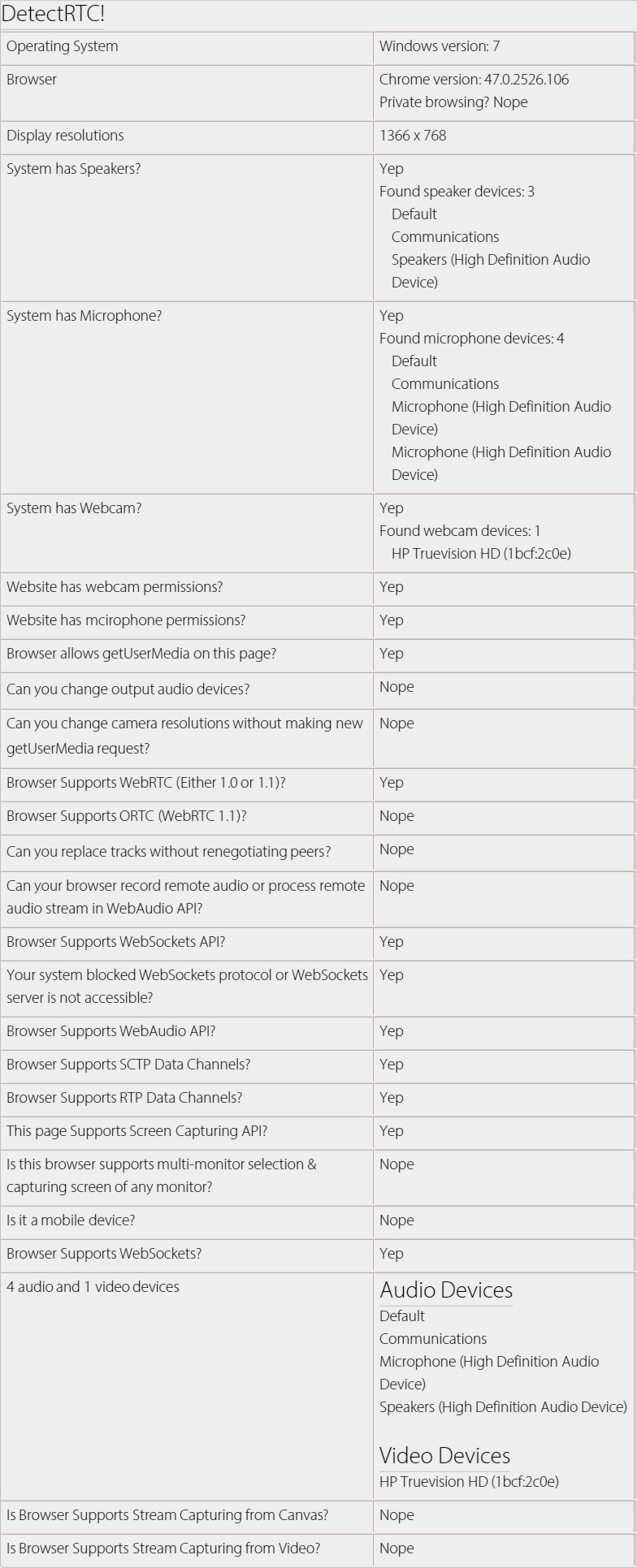
How to use it?
DetectRTC.load(function() {
    // DetectRTC.hasWebcam (has webcam device!)
    // DetectRTC.hasMicrophone (has microphone device!)
    // DetectRTC.hasSpeakers (has speakers!)
    // DetectRTC.isScreenCapturingSupported
    // DetectRTC.isSctpDataChannelsSupported
    // DetectRTC.isRtpDataChannelsSupported
    // DetectRTC.isAudioContextSupported
    // DetectRTC.isWebRTCSupported
    // DetectRTC.isDesktopCapturingSupported
    // DetectRTC.isMobileDevice
    // DetectRTC.isWebSocketsSupported

    // DetectRTC.osName

    // DetectRTC.browser.name === 'Edge' || 'Chrome' || 'Firefox'
    // DetectRTC.browser.version
    // DetectRTC.browser.isChrome
    // DetectRTC.browser.isFirefox
    // DetectRTC.browser.isOpera
    // DetectRTC.browser.isIE
    // DetectRTC.browser.isSafari
    // DetectRTC.browser.isEdge

    // DetectRTC.isCanvasSupportsStreamCapturing
    // DetectRTC.isVideoSupportsStreamCapturing

    // DetectRTC.DetectLocalIPAddress(callback)
});
Why load method?
If you're not detecting audio/video input/outupt devices then you can skip this method.
DetectRTC.load simply makes sure that all devices are captured and valid result is set for relevant properties.

Rules to Contribute
git clone --depth=50 --branch=development git://github.com/muaz-khan/DetectRTC.git muaz-khan/DetectRTC

# install all dependencies
[sudo] npm install

# install grunt for code style verifications
[sudo] npm install grunt-cli
[sudo] npm install grunt

# verify your changes
npm test  # or "grunt"

# Success? Make a pull request!
License
DetectRTC.js is released under MIT licence . Copyright (c) Muaz Khan.