

Package Exports
- html-bundler-webpack-plugin
- html-bundler-webpack-plugin/plugins
- html-bundler-webpack-plugin/plugins/favicons-bundler-plugin
Readme

HTML Bundler Plugin for Webpack






HTML template as entry point
_HTML as an entry point works in both Vite and Parcel, and now also in Webpack._
Bundle your source files of scripts, styles and images with HTML template.
The HTML Bundler Plugin generates static HTML from any template containing source files of scripts, styles, images, fonts and other resources, similar to how it works in Vite or Parcel. The plugin allows using a template file as an entry point. You can import a template into JS as a compiled template function and render it with variables in runtime on the client-side in the browser.
This plugin is an advanced successor to html-webpack-plugin and a replacement of the plugins and loaders.
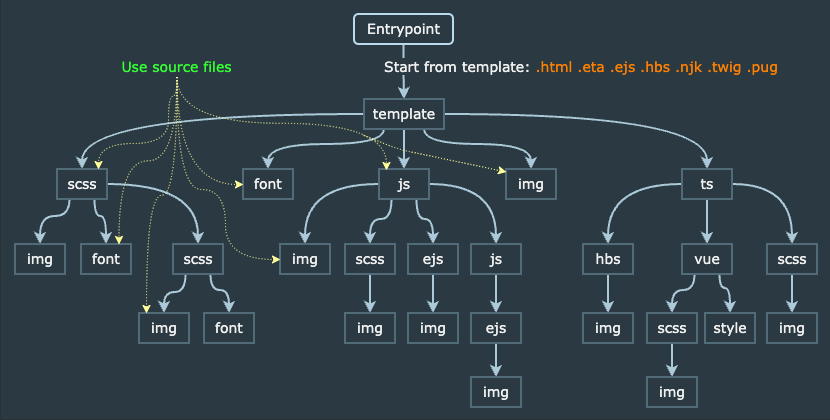
All source file paths in dependencies will be resolved and auto-replaced with correct URLs in the bundled output. The resolved assets will be processed via Webpack plugins/loaders and placed into the output directory. You can use a relative path or Webpack alias to a source file.
See: Contents | Install and Quick Start | Simple example | Usage examples
🦖 Mozilla already uses this plugin to build static HTML files for the Mozilla AI GUIDE site.
Try to use this powerful plugin too.The plugin has been actively developed for more than 2 years, and since 2023 it is open source.
Please support this project by giving it a star ⭐.
💡 Highlights
- An entry point is any HTML template.
- Auto processing multiple HTML templates in the entry path.
- Allows to specify
scriptandstylesource files directly in HTML:<link href="./styles.scss" rel="stylesheet"><script src="./app.tsx" defer="defer"></script>
- Resolves source files in default attributes
hrefsrcsrcsetetc. using relative path or alias:<link href="../images/favicon.svg" type="image/svg" rel=icon /><img src="@images/pic.png" srcset="@images/pic400.png 1x, @images/pic800.png 2x" />
- Inlines JS and CSS into HTML.
- Inlines images into HTML and CSS.
- Supports styles used in
*.vuefiles. - Renders the template engines such as Eta, EJS, Handlebars, Nunjucks, TwigJS, LiquidJS.
- Compile a template into template function for usage in JS on the client-side.
- Generates the preload tags for fonts, images, video, scripts, styles, etc.
- Generates the integrity attribute in the
linkandscripttags. - Generates the favicons of different sizes for various platforms.
- You can create own plugin using the Plugin Hooks.
- Over 400 tests.
See the full list of features.
❤️ Sponsors & Patrons
Thank you to all our sponsors and patrons!

JetBrains |

Sentry |

StackAid |

Buckley Robinson |

Pirang |

Marcel Robitaille |

Marian Kannwischer |

Raymond Ackloo |
⚙️ How works the plugin
The plugin resolves references in the HTML template and adds them to the Webpack compilation. Webpack will automatically process the source files, and the plugin replaces the references with their output filenames in the generated HTML. See the usage example and how the plugin works under the hood.
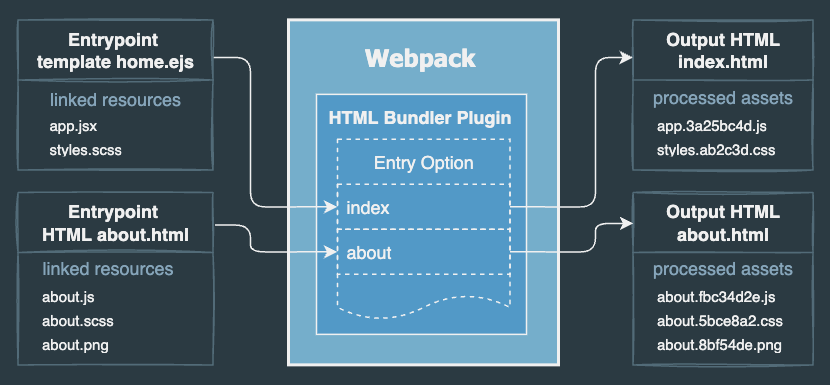
✅ Profit
Simplify Webpack config using one powerful plugin instead of many different plugins and loaders.
Start from HTML, not from JS. Define an HTML template file as an entry point.
Specify script and style source files directly in an HTML template, and you no longer need to define them in Webpack entry or import styles in JavaScript.
Use any template engine without additional plugins and loaders. Most popular template engines supported "out of the box".
❓Question / Feature Request / Bug
If you have discovered a bug or have a feature suggestion, feel free to create an issue on GitHub.
📚 Read it
- Using HTML Bundler Plugin for Webpack to generate HTML files
- Keep output directory structure in Webpack
- Auto generate an integrity hash for
linkandscripttags - Use a HTML file as an entry point? (Webpack issue, #536)
- Comparison and Benchmarks of Node.js libraries to colorize text in terminal (offtopic)
🔆 What's New in v3
- NEW added support for the template function in JS runtime on the client-side.
- NEW added Twig preprocessor.
- NEW added CSS extraction from styles used in
*.vuefiles. - NEW added Hooks & Callbacks. Now you can create own plugin to extend this plugin.
- NEW added the build-in FaviconsBundlerPlugin to generate and inject favicon tags.
🔆 What's New in v2
- NEW added importing style files in JavaScript.
- NEW added support the integrity.
- NEW you can add/delete/rename a template file in the entry path without restarting Webpack
For full release notes see the changelog.
Warning
LimitationThe current version works stable with
cache.typeas'memory'(Webpack's default setting).
Support for the'filesystem'cache type is experimental and under development.
Simple usage example
Start with an HTML template. Add the <link> and <script> tags.
You can directly include asset source files such as SCSS, JS, images, and other media files in an HTML template.
The plugin resolves <script src="..."> <link href="..."> and <img src="..."> that references your JavaScript, style and image source files.
<html>
  <head>
    <!-- include a SCSS file -->
    <link href="./styles.scss" rel="stylesheet" />
    <!-- include a source script file -->
    <script src="./main.js" defer="defer"></script>
  </head>
  <body>
    <h1>Hello World!</h1>
    <!-- reference an image file -->
    <img src="./picture.png" />
  </body>
</html>
All source filenames should be relative to the current HTML template, or you can use Webpack alias. The references are rewritten in the generated HTML so that they link to the correct output files.
The generated HTML contains the output filenames:
<html>
  <head>
    <link href="css/styles.05e4dd86.css" rel="stylesheet" />
    <script src="js/main.f4b855d8.js" defer="defer"></script>
  </head>
  <body>
    <h1>Hello World!</h1>
    <img src="img/picture.58b43bd8.png" />
  </body>
</html>
HTML templates can be defined in the entry option:
const HtmlBundlerPlugin = require('html-bundler-webpack-plugin');

module.exports = {
  plugins: [
    new HtmlBundlerPlugin({
      // define a relative or absolute path to entry templates
      entry: 'src/views/',
      // OR define many templates manually
      entry: {
        index: 'src/views/home.html', // => dist/index.html
        'news/sport': 'src/views/news/sport/index.html', // => dist/news/sport.html
      },
    }),
  ],
  // loaders for styles, images, etc.
  module: {
    rules: [
      {
        test: /\.(css|sass|scss)$/,
        use: ['css-loader', 'sass-loader'],
      },
      {
        test: /\.(ico|png|jp?g|webp|svg)$/,
        type: 'asset/resource',
      },
    ],
  },
};
If the entry option is a path, the plugin finds all templates automatically
and keep the same directory structure in the output directory.
If the entry option is an object, the key is an output filename without .html extension and the value is a template file.
| Simple example SPA |
|
| Automatically processing many HTML templates |
|
| Create multiple HTML pages |
See boilerplate |
Contents
- Features
- Install and Quick start
- Webpack options
- Build-in Plugins
- FaviconsBundlerPlugin (generates favicon tags)
- Third-party Plugins
- Hooks & Callbacks
- Plugin options
- test (RegEx to handle matching templates)
- entry (entry as a list of template files)
- entry dynamic (entry as a path to template files)
- outputPath (output path of HTML file)
- filename (output filename of HTML file)
- js (options to extract JS)
- css (options to extract CSS)
- data (🔗reference to loaderOptions.data)
- beforePreprocessor (callback, 🔗reference to loaderOptions.beforePreprocessor)
- preprocessor (callback or string, 🔗reference to loaderOptions.preprocessor)
- preprocessorOptions (🔗reference to loaderOptions.preprocessorOptions)
- postprocess (callback)
- beforeEmit (callback)
- afterEmit (callback)
- preload (inject preload link tags)
- integrity (inject subresource integrity hash into script and style tags)
- minify and minifyOptions (minification of generated HTML)
- extractComments
- watchFiles
- hotUpdate
- verbose
- loaderOptions (reference to loader options)
- Loader options
- sources (processing of custom tag attributes)
- root (allow to resolve root path in attributes)
- beforePreprocessor (callback)
- preprocessor (callback or string) and preprocessorOptions (templating)
- data (pass data into templates)
- Using template engines
- Using template in JavaScript
- Setup Live Reload
- Recipes
- How to keep source directory structure for HTML
- How to keep source directory structure for assets (fonts, images, etc.)
- How to use source images in HTML
- How to resize and generate responsive images
- How to preload fonts
- How to inline CSS in HTML
- How to inline JS in HTML
- How to inline SVG, PNG images in HTML
- How to load CSS file dynamically
- How to process a PHP template
- How to pass data into multiple templates
- How to use some different template engines
- How to config
splitChunks - How to keep package name for split chunks from node_modules
- How to split CSS files
- Problems & Solutions
- Demo sites
-
Usage examples
- Simple example "Hello World!" View in browser | source
- Automatically processing multiple HTML templates View in browser | source
- Bootstrap with Webpack View in browser | source
- Tailwind CSS with Webpack View in browser | source
- Twig with Webpack View in browser
- Handlebars with Webpack View in browser | source
- Extend Handlebars layout with blocks View in browser | source
- Auto generate integrity hash for
linkandscripttags View in browser | source - Inline multiple SVG files w/o ID collision View in browser | source
- Bundle Vue app into single HTML file with embedded JS, CSS, images View in browser | source
Features
- HTML template is the entry point for all resources
- extracts JS from the source script filename specified in HTML via a
<script>tag - extracts CSS from the source style filename specified in HTML via a
<link>tag - importing style files in JavaScript
- resolves source asset files in HTML attributes and in the CSS
url() - supports styles used in
*.vuefiles - generated HTML contains output filenames
- supports the module types
asset/resourceasset/inlineassetasset/source(*) - inline CSS in HTML
- inline JavaScript in HTML
- inline image as
base64 encodeddata-URL for PNG, JPG, etc. in HTML and CSS - inline SVG as SVG tag in HTML
- inline SVG as
utf-8data-URL in CSS - auto generation of
<link rel="preload">to preload assets - supports the
autopublicPath - enable/disable extraction of comments to
*.LICENSE.txtfile - supports template engines such as Eta, EJS, Handlebars, Nunjucks, TwigJS, LiquidJS and others
- supports a template function for usage in JS on the client-side
- supports both
asyncandsyncpreprocessor - auto processing multiple HTML templates using the entry path
- pass data into template from the plugin config
- dynamically loading template variables using the data option, change data w/o restarting
- supports the integrity attribute in the
linkandscripttags - minification of generated HTML
- allows extending base functionality using hooks & callbacks
- generates favicons of different sizes for various platforms and injects them into HTML
(*) - asset/source works currently for SVG only, in a next version will work for other files too
Just one HTML bundler plugin replaces the functionality of the plugins and loaders:
| Package | Features |
|---|---|
| html-webpack-plugin | creates HTML and inject script tag for compiled JS file into HTML |
| mini-css-extract-plugin | injects link tag for processed CSS file into HTML |
| webpack-remove-empty-scripts | removes generated empty JS files |
| html-loader | exports HTML, resolving attributes |
| style-loader | injects an inline CSS into HTML |
| html-webpack-inject-preload | inject preload link tags |
| preload-webpack-plugin | inject preload link tags |
| html-webpack-inline-source-plugin | inline JS and CSS into HTML |
| html-inline-css-webpack-plugin | inline CSS into HTML |
| posthtml-inline-svg | injects an inline SVG icon into HTML |
| resolve-url-loader | resolves a relative URL in CSS |
| svg-url-loader | encodes a SVG data-URL as utf8 |
| handlebars-webpack-plugin | renders handlebars templates |
| handlebars-loader | import a templates function in JS on client-side |
| webpack-subresource-integrity | enables Subresource Integrity |
| favicons-webpack-plugin | generates favicons and icons |
Install and Quick start
Install the html-bundler-webpack-plugin:
npm install html-bundler-webpack-plugin --save-devor
yarn add -D html-bundler-webpack-pluginor
pnpm add -D html-bundler-webpack-pluginIt's recommended to combine html-bundler-webpack-plugin with the css-loader and the sass-loader.
Install additional packages for styles:
npm install css-loader sass-loader sass --save-devor
yarn add -D css-loader sass-loader sassor
pnpm add -D css-loader sass-loader sassFor example, there is a template ./src/views/home/index.html:
<html>
  <head>
    <title><%= title %></title>
    <link href="./favicon.ico" rel="icon" />
    <link href="./styles.scss" rel="stylesheet" />
    <script src="./main.js" defer="defer"></script>
  </head>
  <body>
    <h1>Hello <%= name %>!</h1>
    <img src="./picture.png" />
  </body>
</html>
To compile this template use the following Webpack configuration:
const HtmlBundlerPlugin = require('html-bundler-webpack-plugin');

module.exports = {
  plugins: [
    new HtmlBundlerPlugin({
      entry: {
        // define templates here
        index: {
          // => dist/index.html
          import: 'src/views/home.html', // template file
          data: { title: 'Homepage', name: 'Heisenberg' }, // pass variables into template
        },
      },
      js: {
        // output filename of compiled JavaScript, used if `inline` option is false (defaults)
        filename: 'assets/js/[name].[contenthash:8].js',
        //inline: true, // inlines JS into HTML
      },
      css: {
        // output filename of extracted CSS, used if `inline` option is false (defaults)
        filename: 'assets/css/[name].[contenthash:8].css',
        //inline: true, // inlines CSS into HTML
      },
    }),
  ],
  module: {
    rules: [
      {
        test: /\.(css|sass|scss)$/,
        use: ['css-loader', 'sass-loader'],
      },
      {
        test: /\.(ico|png|jp?g|webp|svg)$/,
        type: 'asset/resource',
        generator: {
          filename: 'assets/img/[name].[hash:8][ext][query]',
        },
      },
    ],
  },
};
Note
To define the JS output filename, use the
js.filenameoption of the plugin.
Don't use Webpack'soutput.filename, hold all relevant settings in one place - in plugin options.
Both places have the same effect, butjs.filenamehas priority overoutput.filename.
No additional template loader is required. The plugin handels templates with base EJS-like syntax automatically.
The default templating engine is Eta.
For using the native EJS syntax see Templating with EJS.
For using the Handlebars see Templating with Handlebars.
For other templates see Template engines.
For custom templates, you can use the preprocessor option to handels any template engine.
↑ back to contents
Webpack options
Important Webpack options used to properly configure this plugin.
output.path
Type: string Default: path.join(process.cwd(), 'dist')
The root output directory for all processed files, as an absolute path.
You can omit this option, then all generated files will be saved under dist/ in your project directory.
output.publicPath
Type: string|function Default: auto
The value of the option is prefixed to every URL created by this plugin.
If the value is not the empty string or auto, then the option must end with /.
The possible values:
publicPath: 'auto'- automatically determines a path of an asset relative of their issuer. The generated HTML page can be opened directly form the local directory and all js, css and images will be loaded in a browser.publicPath: ''- a path relative to an HTML page, in the same directory. The resulting path is different from a path generated withauto.publicPath: '/'- a path relative todocument rootdirectory on a serverpublicPath: '/assets/'- a sub path relative todocument rootdirectory on a serverpublicPath: '//cdn.example.com/'- an external URL with the same protocol (http://orhttps://)publicPath: 'https://cdn.example.com/'- an external URL with thehttps://protocol only
output.filename
Type: string|function Default: [name].js
The output name of a generated JS file.
Highly recommended to define the filename in the Plugin option js.filename.
The output name of a generated CSS file is determined in the Plugin option css.filename.
Define output JS and CSS filenames in the Plugin option, in one place:
const HtmlBundlerPlugin = require('html-bundler-webpack-plugin');
module.exports = {
  plugins: [
    new HtmlBundlerPlugin({
      js: {
        // define the output name of a generated JS file here
        filename: 'assets/js/[name].[contenthash:8].js',
      },
      css: {
        // define the output name of a generated CSS file here
        filename: 'assets/css/[name].[contenthash:8].css',
      },
    }),
  ],
};
entry
The starting point to build the bundle.
Note
Using this plugin an
entry pointis an HTML template. All script and style source files must be specified in the HTML template.
You can use the Webpack entry option to define HTML templates,
but it is highly recommended to define all templates in plugin option entry,
because it has an additional data property (not available in the Webpack entry)
to pass custom variables into the HTML template.
For details see the plugin option entry.
↑ back to contents
Build-in Plugins
There are the most useful plugins available "out of the box". The build-in plugins maintained by the HtmlBundlerPlugin.
All build-in plugins are in the /plugins subdirectory of the HtmlBundlerPlugin.
FaviconsBundlerPlugin
The FaviconsBundlerPlugin generates favicons for different devices and injects favicon tags into HTML head.
Install
This plugin requires the additional favicons package.
npm install favicons -DConfig
const HtmlBundlerPlugin = require('html-bundler-webpack-plugin');
const { FaviconsBundlerPlugin } = require('html-bundler-webpack-plugin/plugins');

module.exports = {
  plugins: [
    new HtmlBundlerPlugin({
      entry: {
        // source favicon file must be specified directly in HTML using link tag
        index: './src/views/index.html',
      },
    }),
    // add the favicons plugin
    new FaviconsBundlerPlugin({
      enabled: 'auto', // true, false, auto - generate favicons in production mode only
      // favicons configuration options, see https://github.com/itgalaxy/favicons#usage
      faviconOptions: {
        path: '/img/favicons', // favicons output path relative to webpack output.path
        icons: {
          android: true, // Create Android homescreen icon.
          appleIcon: true, // Create Apple touch icons.
          appleStartup: false, // Create Apple startup images.
          favicons: true, // Create regular favicons.
          windows: false, // Create Windows 8 tile icons.
          yandex: false, // Create Yandex browser icon.
        },
      },
    }),
  ],
  module: {
    rules: [
      {
        test: /\.(png|jpe?g|ico|svg)$/,
        type: 'asset/resource',
      },
    ],
  },
};
FaviconsBundlerPlugin options
enabled: boolean | 'auto'
if is'auto'then generate favicons in production mode only, in development mode will be used original favicon processed via webpack asset module.faviconOptions: FaviconOptions- options of the favicons module. See configuration options.
Usage
The source file of your favicon must be specified directly in HTML as the link tag with rel="icon" attribute.
If the FaviconsBundlerPlugin is disabled or as auto in development mode,
then the source favicon file will be processed via webpack.
If the FaviconsBundlerPlugin is enabled or as auto in production mode,
then the source favicon file will be processed via favicons module and
the original link tag with favicon will be replaced with generated favicon tags.
For example, there is the src/views/index.html
<!DOCTYPE html>
<html>
<head>
  <!-- source favicon file relative to this HTML file, or use a webpack alias -->
  <link href="./myFavicon.png" rel="icon" />
</head>
<body>
  <h1>Hello World!</h1>
</body>
</html>
The generated HTML when FaviconsBundlerPlugin is disabled:
<!DOCTYPE html>
<html>
<head>
  <!-- output favicon file -->
  <link href="assets/img/myFavicon.1234abcd.png" rel="icon" />
</head>
<body>
  <h1>Hello World!</h1>
</body>
</html>
The generated HTML when FaviconsBundlerPlugin is enabled:
<!DOCTYPE html>
<html>
<head>
  <!-- original tag is replaced with tags generated by favicons module -->
  <link rel="apple-touch-icon" sizes="1024x1024" href="/img/favicons/apple-touch-icon-1024x1024.png">
  <link rel="apple-touch-icon" sizes="114x114" href="/img/favicons/apple-touch-icon-114x114.png">
  <link rel="apple-touch-icon" sizes="120x120" href="/img/favicons/apple-touch-icon-120x120.png">
  <link rel="apple-touch-icon" sizes="144x144" href="/img/favicons/apple-touch-icon-144x144.png">
  <link rel="apple-touch-icon" sizes="152x152" href="/img/favicons/apple-touch-icon-152x152.png">
  <link rel="apple-touch-icon" sizes="167x167" href="/img/favicons/apple-touch-icon-167x167.png">
  <link rel="apple-touch-icon" sizes="180x180" href="/img/favicons/apple-touch-icon-180x180.png">
  <link rel="apple-touch-icon" sizes="57x57" href="/img/favicons/apple-touch-icon-57x57.png">
  <link rel="apple-touch-icon" sizes="60x60" href="/img/favicons/apple-touch-icon-60x60.png">
  <link rel="apple-touch-icon" sizes="72x72" href="/img/favicons/apple-touch-icon-72x72.png">
  <link rel="apple-touch-icon" sizes="76x76" href="/img/favicons/apple-touch-icon-76x76.png">
  <link rel="icon" type="image/png" sizes="16x16" href="/img/favicons/favicon-16x16.png">
  <link rel="icon" type="image/png" sizes="32x32" href="/img/favicons/favicon-32x32.png">
  <link rel="icon" type="image/png" sizes="48x48" href="/img/favicons/favicon-48x48.png">
  <link rel="icon" type="image/x-icon" href="/img/favicons/favicon.ico">
  <link rel="manifest" href="/img/favicons/manifest.webmanifest">
  <meta name="apple-mobile-web-app-capable" content="yes">
  <meta name="apple-mobile-web-app-status-bar-style" content="black-translucent">
  <meta name="apple-mobile-web-app-title" content="My App">
  <meta name="application-name" content="My App">
  <meta name="mobile-web-app-capable" content="yes">
  <meta name="theme-color" content="#fff">
</head>
<body>
  <h1>Hello World!</h1>
</body>
</html>
↑ back to contents
Third-party Plugins
The third-party plugins not maintained by the HtmlBundlerPlugin. It potentially does not have the same support, security policy or license as Build-in Plugins.
You can create own plugin using the plugin hooks. As a reference plugin, you can use the FaviconsBundlerPlugin.
If you have a useful plugin, create a PR with the link to you plugin.
The plugin name must end with -bundler-plugin, e.g. hello-world-bundler-plugin.
Currently there are no plugins yet. Be the first to create one.
↑ back to contents
Hooks & Callbacks
Using hooks and callbacks, you can extend the functionality of this plugin.
The hook can be defined in an external plugin.
The callback is defined as an option in the HTMLBundlerPlugin.
Most hooks have a callback with the same name. Each callback is called after hook with the same name. So with a callback, you can change the result of the hook.
When using callbacks
If you have small code just for your project or are doing debugging, you can use callbacks.
When using hooks
Using hooks you can create your own plugin.
How the plugin works under the hood.
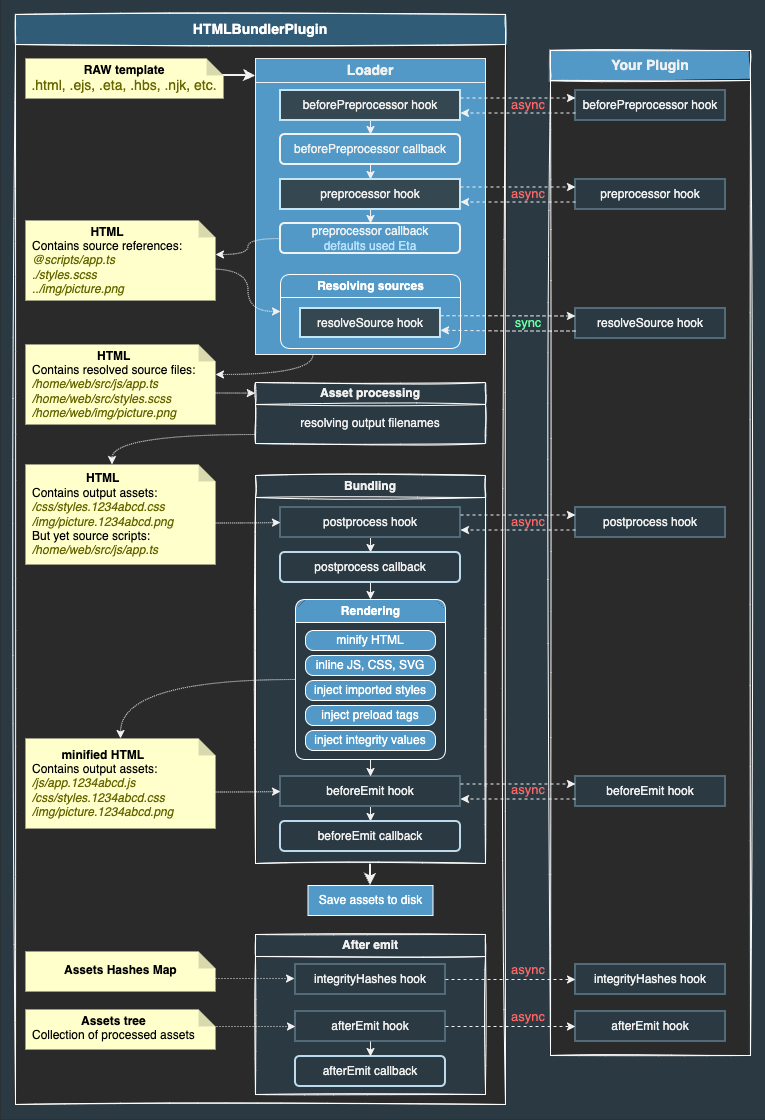
How to use hooks
The simplest way, add the { apply() { ... } } object to the array of the Webpack plugins:
const HtmlBundlerPlugin = require('html-bundler-webpack-plugin');

module.exports = {
  plugins: [
    new HtmlBundlerPlugin({
      entry: {
        index: './src/index.html',
      },
    }),
    // your plugin
    {
      apply(compiler) {
        const pluginName = 'MyPlugin';

        compiler.hooks.compilation.tap(pluginName, (compilation) => {
          const hooks = HtmlBundlerPlugin.getHooks(compilation);

          // modify generated HTML of the index.html template
          hooks.beforeEmit.tap(pluginName, (content, { name, sourceFile, assetFile }) => {
            return content.replace('something...', 'other...')
          });
        });
      },
    },
  ],
};
You can use this template as the basis for your own plugin:
const HtmlBundlerPlugin = require('html-bundler-webpack-plugin');

class MyPlugin {
  pluginName = 'my-plugin';
  options = {};

  /**
   * @param {{ enabled: boolean | 'auto'}} options The options of your plugin.
   */
  constructor(options = {}) {
    this.options = options;
  }

  apply(compiler) {
    // you can use the API of the HtmlBundlerPlugin.option
    const enabled = HtmlBundlerPlugin.option.toBool(this.options?.enabled, true, 'auto');
    const outputPath = HtmlBundlerPlugin.option.getWebpackOutputPath();

    if (!enabled) {
      return;
    }

    const { pluginName } = this;
    const { webpack } = compiler; // instance of the Webpack
    const fs = compiler.inputFileSystem.fileSystem; // instance of the Webpack FyleSystem

    // start your plugin from the webpack compilation hook
    compiler.hooks.compilation.tap(pluginName, (compilation) => {
      const hooks = HtmlBundlerPlugin.getHooks(compilation);

      // usage of the sync, async and promise hooks

      // sync hook
      hooks.<hookName>.tap(pluginName, (...arguments) => {
        // do somthing here ...
        const result = 'your result';
        // return the result
        return result;
      });

      // async hook
      hooks.<hookName>.tapAsync(pluginName, (...arguments, callback) => {
        // do somthing here ...
        const result = 'your result';
        // call the callback function to resolve the async hook
        callback(result);
      });

      // promise hook
      hooks.<hookName>.tapPromise(pluginName, (...arguments) => {
        // do somthing here ...
        const result = 'your result';
        // return the promise with the result
        return Promise.resolve(result);
      });
    });
  }
}

module.exports = MyPlugin;
Then add your plugin in the webpack config:
const HtmlBundlerPlugin = require('html-bundler-webpack-plugin');
const MyBundlerPlugin = require('my-bundler-plugin');

module.exports = {
  plugins: [
    new HtmlBundlerPlugin({
      entry: {
        index: './src/index.html',
      },
    }),
    // your plugin
    new MyBundlerPlugin({ enabled: true });
  ],
};
For an example implementation see FaviconsBundlerPlugin.
↑ back to contents
beforePreprocessor
AsyncSeriesWaterfallHook<[
  content: string,
  loaderContext: LoaderContext<Object> & { data: { [key: string]: any } | string }
]>;
For details on AsyncSeriesWaterfallHook see the hook interface.
For details on hook parameters, see in the beforePreprocessor callback option.
↑ back to contents
preprocessor
AsyncSeriesWaterfallHook<[
  content: string,
  loaderContext: LoaderContext<Object> & { data: { [key: string]: any } | string }
]>;
For details on AsyncSeriesWaterfallHook see the hook interface.
For details on hook parameters, see in the preprocessor callback option.
↑ back to contents
resolveSource
SyncWaterfallHook<[
  source: string,
  info: {
    type: 'style' | 'script' | 'asset';
    tag: string;
    attribute: string;
    value: string;
    resolvedFile: string;
    issuer: string
  },
]>;
no calback
Called after resolving of a source attribute defined by source loader option.
For details on SyncWaterfallHook see the hook interface.
Hook parameters:
source- a source of the tag where are parsed attributes, e.g.<link href="./favicon.png" rel="icon">info- an object with parsed information:type- the type of the tagtag- the tag name, e.g.'link','script','img', etc.attribute- the attribute name, e.g.'src','href', etc.value- the attribute valueresolvedFile- the resolved file from the valueissuer- the template file
Return a string to override the resolved value of the attribute or undefined to keep the resolved value.
↑ back to contents
postprocess
AsyncSeriesWaterfallHook<[content: string, info: TemplateInfo]>;For details on AsyncSeriesWaterfallHook see the hook interface.
For details on hook parameters, see in the postprocess callback option.
↑ back to contents
beforeEmit
AsyncSeriesWaterfallHook<[content: string, entry: CompileEntry]>;For details on AsyncSeriesWaterfallHook see the hook interface.
For details on hook parameters, see in the beforeEmit callback option.
↑ back to contents
afterEmit
AsyncSeriesHook<[entries: CompileEntries]>;For details on AsyncSeriesHook see the hook interface.
For details on hook parameters, see in the afterEmit callback option.
↑ back to contents
integrityHashes
AsyncSeriesHook<{
  // the map of the output asset filename to its integrity hash
  hashes: Map<string, string>;
}>;
Called after all assets have been processed and hashes have finite values and cannot be changed, at the afterEmit stage.
This can be used to retrieve the integrity values for the asset files.
For details on AsyncSeriesHook see the hook interface.
Callback Parameter: hashes is the map of the output asset filename to its integrity hash.
The map only contains JS and CSS assets that have a hash.
You can write your own plugin, for example, to extract integrity values into the separate file:
const fs = require('fs');
const path = require('path');
const HtmlBundlerPlugin = require('html-bundler-webpack-plugin');
module.exports = {
  output: {
    crossOriginLoading: 'anonymous', // required for Subresource Integrity
  },
  plugins: [
    new HtmlBundlerPlugin({
      entry: {
        index: './src/index.html',
      },
      js: {
        filename: '[name].[contenthash:8].js',
        chunkFilename: '[name].[contenthash:8].chunk.js',
      },
      css: {
        filename: '[name].[contenthash:8].css',
        chunkFilename: '[name].[contenthash:8].chunk.css',
      },
      integrity: 'auto',
    }),
    // your plugin to extract the integrity values
    {
      apply(compiler) {
        compiler.hooks.compilation.tap('MyPlugin', (compilation) => {
          const hooks = HtmlBundlerPlugin.getHooks(compilation);
          hooks.integrityHashes.tapAsync(
            'MyPlugin',
            (hashes) => Promise.resolve().then(() => {
                if (hashes.size > 0) {
                  const saveAs = path.join(__dirname, 'dist/integrity.json');
                  const json = Object.fromEntries(hashes);
                  fs.writeFileSync(saveAs, JSON.stringify(json, null, '  ')); // => save to file
                  console.log(hashes); // => output to console
                }
              })
            );
          }
        );
      },
    },
  ],
};
The content of the dist/integrity.json file looks like:
{
  "815.49b3d882.chunk.js": "sha384-dBK6nNrKKk2KjQLYmHZu6tuWwp7kBzzEvdX+4Ni11UzxO2VHvP4A22E/+mmeduul",
  "main.9c043cce.js": "sha384-AbfLh7mk6gCp0nhkXlAnOIzaHeJSB8fcV1/wT/FWBHIDV7Blg9A0sukZ4nS3xjtR"
  "main.dc4ea4af.chunk.css": "sha384-W/pO0vwqqWBj4lq8nfe+kjrP8Z78smCBttkCvx1SYKrVI4WEdJa6W6i0I2hoc1t7",
  "style.47f4da55.css": "sha384-gaDmgJjLpipN1Jmuc98geFnDjVqWn1fixlG0Ab90qFyUIJ4ARXlKBsMGumxTSu7E",
}
↑ back to contents
Plugin options
test
Type: RegExp Default: /\.(html|ejs|eta|hbs|handlebars|njk)$/
The test option allows to handel only those templates as entry points that match the name of the source file.
For example, if you have other templates, e.g. *.liquid, as entry points, then you can set the option to match custom template files: test: /\.(html|liquid)$/.
The test value is used in the default loader.
Why is it necessary to define it? Can't it be automatically processed?
This plugin is very powerful and has many experimental features not yet documented.
One of the next features will be the processing scripts and styles as entry points for library bundles without templates.
To do this, the plugin must differentiate between a template entry point and a script/style entry point.
This plugin can completely replace the functionality of mini-css-extract-plugin and webpack-remove-empty-scripts in future.
entry
Type: EntryObject | string.
The EntryObject is identical to Webpack entry
plus additional data property to pass custom variables into the HTML template.
Specify template files as entry points in the entry option.
An HTML template is a starting point for collecting all the dependencies used in your web application. Specify source scripts (JS, TS) and styles (CSS, SCSS, LESS, etc.) directly in HTML. The plugin automatically extracts JS and CSS whose source files are specified in an HTML template.
type EntryObject = {
  [name: string]: EntryDescription | string;
};
The key of the EntryObject is the output filename without an extension, relative to the outputPath option.
Simple syntax
When the entry point value is a string, it must be an absolute or relative template file.
For example:
{
  entry: {
    index: path.join(__dirname, 'src/views/home/index.html'), // => dist/index.html
    'news/sport': 'src/views/news/sport/index.html', // => dist/news/sport.html
  },
}
Advanced syntax
If you need to pass data to a template or want to dynamically generate an output filename regardless of the entry key,
you can define the value of an entry as an EntryDescription object.
type EntryDescription = {
  /**
   * Template file, relative of context or absolute.
   */
  import: string;
  /**
   * Specifies the filename of the output file.
   */
  filename?: FilenameTemplate;
  /**
   * The template data.
   */
  data?: { [key: string]: any } | string;
};

type FilenameTemplate =
  | string
  | ((pathData: import('webpack/Compilation').PathData, assetInfo?: import('webpack/Compilation').AssetInfo) => string);
import
The import is a path to a template file, absolute or relative to the Webpack context option.
filename
When the filename is defined as a string, it will be used as the output html filename.
In this case, the entry key can be any unique string.
For example:
{
  entry: {
    page01: {
      import: 'src/views/news/sport/index.html', // <= source template
      filename: 'news/sport.html', // => output ./dist/news/sport.html
    },
  },
}
When the filename is defined as a template string,
then the entry key will be used as the [name] in the template string. Defaults, the filename is the [name].html template string.
For example:
{
  entry: {
    'news/sport': {
      import: 'src/views/news/sport/index.html', // <= source template
      filename: '[name].html', // => output ./dist/news/sport.html
    },
  },
}
The example above is equivalent to the simple syntax:
{
  entry: {
    'news/sport': 'src/views/news/sport/index.html',
  },
}
data
The data is passed into preprocessor to render the template with variables.
When the data is an object, it will be loaded once with Webpack start.
After changing the data, you need to restart Webpack.
For example:
{
  entry: {
    index: {
      import: 'src/views/index.html',
      // pass data as an object
      data: {
        title: 'Home',
      }
    },
}
When the data is a string, it must be an absolute or relative path to a file.
The file can be a JSON file or a JS file that exports the data as an object.
Use the data as a file if you want to get dynamic data in a template.
The data file will be reloaded after changes, without restarting Webpack.
For example:
{
  entry: {
    index: {
      import: 'src/views/index.html',
      // load data from JSON file
      data: 'src/data/home.json',
    },
  },
}
The data file src/data/home.json:
{
  "title": "Home"
}
To pass global variables in all templates use the data loader option.
Note
You can define templates both in Webpack
entryand in theentryoption of the plugin. The syntax is identical. But thedataproperty can only be defined in theentryoption of the plugin.
Entry as a path to templates
You can define the entry as a path to recursively detect all templates from that directory.
When the value of the entry is a string, it must be an absolute or relative path to the templates' directory.
Templates matching the test option are detected recursively from the path.
The output files will have the same folder structure as source template directory.
For example, there are files in the template directory ./src/views/
./src/views/index.html
./src/views/about/index.html
./src/views/news/sport/index.html
./src/views/news/sport/script.js
./src/views/news/sport/styles.scss
...
Define the entry option as the relative path to pages:
new HtmlBundlerPlugin({
  entry: 'src/views/',
});
Files that are not matching to the test option are ignored. The output HTML filenames keep their source structure in the output directory relative to the entry path:
./dist/index.html
./dist/about/index.html
./dist/news/sport/index.html
...
If you need to modify the output HTML filename, use the filename option as the function.
For example, we want keep a source structure for all pages,
while ./src/views/home/index.html should not be saved as ./dist/home/index.htm, but as ./dist/index.htm:
new HtmlBundlerPlugin({
  // path to templates
  entry: 'src/views/',

  filename: ({ filename, chunk: { name } }) => {
    // transform 'home/index' filename to output file 'index.html'
    if (name === 'home/index') {
      return 'index.html'; // save as index.html in output directory
    }
    // bypass the original structure
    return '[name].html';
  },
});
Note
In serve/watch mode, you can add/delete/rename a template file in the entry path without restarting Webpack.
↑ back to contents
outputPath
Type: string Default: webpack output.path
The output directory for generated HTML files only.
This directory can be absolute or relative to webpack output.path.
For example, here are html and js files:
src/index.html
src/main.js
src/index.html
<!doctype html>
<html>
  <head>
    <script src="./main.js"></script>
  </head>
  <body>
    <h1>Hello World!</h1>
  </body>
</html>
There is webpack config:
const path = require('path');
const HtmlBundlerPlugin = require('html-bundler-webpack-plugin');
module.exports = {
  output: {
    path: path.join(__dirname, 'dist/'), // the root output directory for all assets
  },
  plugins: [
    new HtmlBundlerPlugin({
      // absoulte html output directory
      outputPath: path.join(__dirname, 'dist/example/'),
      // OR relative to output.path
      // outputPath: 'example/',
      entry: {
        index: './src/index.html', // => dist/example/index.html
      },
      js: {
        filename: '[name].bundle.js',
        outputPath: 'assets/js/', // output path for js files, relative to output.path
      },
    }),
  ],
};
The processed files in the output directory:
dist/example/index.html
dist/assets/js/main.bundle.js
The generated dist/example/index.html:
<!doctype html>
<html>
  <head>
    <script src="../assets/js/main.bundle.js"></script>
  </head>
  <body>
    <h1>Hello World!</h1>
  </body>
</html>
Warning
The
outputPathis NOT used for output assets (js, css, images, etc.).
filename
Type: string | Function Default: [name].html
The HTML output filename relative to the outputPath option.
If type is string then following substitutions (see output.filename for chunk-level) are available in template string:
[id]The ID of the chunk.[name]The filename without extension or path.[contenthash]The hash of the content.[contenthash:nn]Thennis the length of hashes (defaults to 20).
If type is Function then following arguments are available in the function:
@param {PathData} pathDatahas the useful properties (see the type PathData):pathData.filenamethe absolute path to source filepathData.chunk.namethe name of entry key
@return {string}The name or template string of output file.
↑ back to contents
js
Type:
type JsOptions = {
  filename?: FilenameTemplate;
  chunkFilename?: FilenameTemplate;
  outputPath?: string;
  inline?: 'auto' | boolean | JsInlineOptions;
};

type JsInlineOptions = {
  enabled?: 'auto' | boolean;
  chunk?: RegExp | Array<RegExp>;
  source?: RegExp | Array<RegExp>;
  attributeFilter?: (props: {
    attribute: string;
    value: string;
    attributes: { [attributeName: string]: string };
  }) => boolean | void;
};
Default properties:
{
  filename: '[name].js',
  chunkFilename: '[id].js',
  outputPath: null,
  inline: false,
}filename- an output filename of JavaScript. Details see by filename option.chunkFilename- an output filename of non-initial chunk files. Details see by chunkFilename.outputPath- an output path of JavaScript. Details see by outputPath option.
The inline property allows to inline compiled JavaScript chunks into HTML.
If inline is 'auto' or boolean, available values:
false- stores JavaScript in an output file (defaults)true- adds JavaScript to the DOM by injecting a<script>tag'auto'- indevelopmentmode - adds to DOM, inproductionmode - stores as a file
If inline is an object:
enabled- has the values:true(defaults),falseor'auto', descriptsion see above,
if theenabledis undefined, then using theinlineas theobject, the value istruechunk- inlines the single chunk when output chunk filename matches a regular expression(s)source- inlines all chunks when source filename matches a regular expression(s)attributeFilter- filter function to keep/remove attributes for inlined script tag. If undefined, all attributes will be removed.
Destructed arguments:attribute- attribute namevalue- attribute valueattributes- all attributes of the script tag
Return:
true- keep the attribute in the inlined script tagfalseorundefined- remove the attribute
You can use both the chunk and the source options,
then there will be inlined chunks matching regular expressions with OR logic.
For example, there is used the optimization.splitChunks and we want to inline only the small webpack runtime chunk
but other JS chunks of the same split app.js file should be saved to chunk files, then use the following inline option:
js: {
  filename: 'assets/js/[name].[contenthash:8].js',
  inline: {
    chunk: [/runtime.+[.]js/],
  },
},
Then the app.js file will be split to many output chunks, e.g.:
assets/js/325.xxxxxxxx.js  -> save as file
assets/js/545.xxxxxxxx.js  -> save as file
assets/js/app.xxxxxxxx.js  -> save as file
runtime.xxxxxxxx.js        -> inline the chunk into HTML and NOT save as file
The single runtime.xxxxxxxx.js chunk will be injected into HTML, other chunks will be saved to output directory.
Note
The
filenameandchunkFilenameoptions are the same as in Webpackoutputoptions, just defined in one place along with other relevant plugin options. You don't need to define them in the in Webpackoutputoptions anymore. Keep the config clean & clear.
To keep some original script tag attributes in the inlined script tag, use the attributeFilter.
For example, there is a script tag with attributes:
<script id="js-main" src="./main.js" defer></script>Use the attributeFilter:
new HtmlBundlerPlugin({
  // ...
  js: {
    inline: {
      attributeFilter: ({ attributes, attribute, value }) => {
        if (attribute === 'id') return true;
      },
    },
  },
}
The inlined tag contains the id attribute, but the src and defer are removed:
<script id="js-main">
  // inlined JavaScript code
</script>
All source script files specified in <script src="..."> are automatically resolved,
and JS will be extracted to output file. The source filename will be replaced with the output filename.
For example:
<script src="./main.js"></script>The default JS output filename is [name].js.
You can specify your own filename using webpack filename substitutions:
const HtmlBundlerPlugin = require('html-bundler-webpack-plugin');
module.exports = {
  plugins: [
    new HtmlBundlerPlugin({
      js: {
        filename: 'assets/js/[name].[contenthash:8].js',
      },
    }),
  ],
};
The [name] is the base filename script.
For example, if source file is main.js, then output filename will be assets/js/main.1234abcd.js.
If you want to have a different output filename, you can use the filename options as the function.
The chunkFilename option only takes effect if you have the optimization.splitChunks option.
For example:
const HtmlBundlerPlugin = require('html-bundler-webpack-plugin');
module.exports = {
  plugins: [
    new HtmlBundlerPlugin({
      entry: {
        index: 'src/views/index.html',
      },
      js: {
        filename: 'assets/js/[name].[contenthash:8].js',
        chunkFilename: 'assets/js/[id].[contenthash:8].js',
      },
    }),
  ],
  optimization: {
    splitChunks: {
      cacheGroups: {
        scripts: {
          test: /\.(js|ts)$/, // <= IMPORTANT: split only JS files
          chunks: 'all',
        },
      },
    },
  },
};
Warning
Webpack tries to split and concatenate chunks of all files (templates, styles, scripts) into jumbles. Therefore, the
testoptionMUSTbe specified to match only source JS files, otherwise Webpack will generate invalid output files.
Also see How to keep package name for split chunks from node_modules.
↑ back to contents
css
Type:
type CssOptions = {
  test?: RegExp;
  filename?: FilenameTemplate;
  chunkFilename?: FilenameTemplate;
  outputPath?: string;
  inline?: 'auto' | boolean;
};
Default properties:
{
  test: /\.(css|scss|sass|less|styl)$/,
  filename: '[name].css',
  chunkFilename: '[name].css',
  outputPath: null,
  inline: false,
}test- an RegEpx to process all source styles that pass test assertionfilename- an output filename of extracted CSS. Details see by filename option.chunkFilename- an output filename of non-initial chunk files, e.g., a style file imported in JavaScript.outputPath- an output path of extracted CSS. Details see by outputPath option.inline- inlines extracted CSS into HTML, available values:false- stores CSS in an output file (defaults)true- adds CSS to the DOM by injecting a<style>tag'auto'- indevelopmentmode - adds to DOM, inproductionmode - stores as a file
All source style files specified in <link href="..." rel="stylesheet"> are automatically resolved,
and CSS will be extracted to output file. The source filename will be replaced with the output filename.
For example:
<link href="./styles.scss" rel="stylesheet" />Warning
Don't import source styles in JavaScript. Styles should be specified directly in HTML.
Don't define source JS files in Webpack entry. Scripts must be specified directly in HTML.
The default CSS output filename is [name].css.
You can specify your own filename using webpack filename substitutions:
const HtmlBundlerPlugin = require('html-bundler-webpack-plugin');
module.exports = {
  plugins: [
    new HtmlBundlerPlugin({
      css: {
        filename: 'assets/css/[name].[contenthash:8].css',
      },
    }),
  ],
};
The [name] is the base filename of a loaded style.
For example, if source file is styles.scss, then output filename will be assets/css/styles.1234abcd.css.
If you want to have a different output filename, you can use the filename options as the function.
Warning
Don't use
mini-css-extract-pluginbecause the bundler plugin extracts CSS much faster than other plugins.Don't use
resolve-url-loaderbecause the bundler plugin resolves all URLs in CSS, including assets from node modules.Don't use
style-loaderbecause the bundler plugin can auto inline CSS.
↑ back to contents
data
Since the v2.5.0, the data plugin option is the reference to loaderOptions.data.
Now it is possible to define the data option directly in the plugin options to simplify the config.
The NEW syntactic "sugar":
new HtmlBundlerPlugin({
  entry: {
    index: './src/views/home.ejs',
  },
  // new reference to the loaderOptions.data
  data: {...},
}),
The old syntax is still valid and will never be deprecated:
new HtmlBundlerPlugin({
  entry: {
    index: './src/views/home.ejs',
  },
  loaderOptions: {
    // original option is under loaderOptions
    data: {...},
  },
}),
Please see the details below under the data loader options.
↑ back to contents
beforePreprocessor
Reference to loaderOption.beforePreprocessor
The plugin option is the reference to loaderOptions.beforePreprocessor.
Type:
type BeforePreprocessor =
  | false
  | ((
      content: string,
      loaderContext: LoaderContext<Object> & { data: { [key: string]: any } | string }
    ) => string | undefined);
Default: false
The content is the raw content of a template.
The description of all loaderContext attributes see in the Webpack documentation.
Returns the modified template. If you are not changing the template, you should return undefined or not use return at all.
The callback function called right before the preprocessor. This can be useful when using one of the predefined preprocessors and modifying the raw template or the data passed to the template.
For example:
new HtmlBundlerPlugin({
  entry: {
    index: 'src/views/pages/',
  },
  data: {
    title: 'Welcome to [sitename] website',
  },
  beforePreprocessor: (content, { resourcePath, data }) => {
    let sitename = 'Homepage';
    if (resourcePath.includes('/about.html')) sitename = 'About';
    data.title = data.title.replace('[sitename]', sitename); // modify template data
    return content.replaceAll('{{old_var}}', '{{new_var}}'); // modify template content
  },
  preprocessor: 'handlebars', // use the templating engine
});
↑ back to contents
preprocessor (callback or string) and preprocessorOptions
The plugin options are the references to loaderOptions.preprocessor and loaderOptions.preprocessorOptions.
Now it is possible to define these options directly in the plugin options to simplify the config.
The NEW syntactic "sugar":
new HtmlBundlerPlugin({
  entry: {
    index: './src/views/home.ejs',
  },
  // new references to options in the loaderOptions
  preprocessor: 'ejs',
  preprocessorOptions: {...},
}),
The old syntax is still valid and will never be deprecated:
new HtmlBundlerPlugin({
  entry: {
    index: './src/views/home.ejs',
  },
  loaderOptions: {
    // original options are under loaderOptions
    preprocessor: 'ejs',
    preprocessorOptions: {...},
  },
}),
Please see the details below under the preprocessor and the preprocessorOptions loader options.
↑ back to contents
postprocess callback
Type:
type postprocess = (
  content: string,
  info: TemplateInfo,
  compilation: Compilation
) => string | undefined;

type TemplateInfo = {
  name: string;
  assetFile: string;
  sourceFile: string;
  resource: string;
  outputPath: string;
};
Default: null
Called after the template has been compiled, but not yet finalized, before injection of the split chunks and inline assets.
The postprocess have the following arguments:
content: string- a content of processed fileinfo: TemplateInfo- info about current filecompilation: Compilation- the Webpack compilation object
The TemplateInfo have the following properties:
name: string- the entry nameassetFile: string- the output asset filename relative tooutputPathsourceFile: string- the absolute path of the source file, without a queryresource: string- the absolute path of the source file, including a queryoutputPath: string- the absolute path of the output directory
Return new content as a string.
If return undefined, the result processed via Webpack plugin is ignored and will be saved a result processed via the loader.
↑ back to contents
beforeEmit callback
Type:
type BeforeEmit = (
  content: string,
  entry: CompileEntry,
  compilation: Compilation
) => string | undefined;

type CompileEntry = TemplateInfo & {
  // assets used in html
  assets: Array<CompileAsset>;
};
Default: null
Called at the latest stage of the processAssets hook, before emitting. This is the latest stage where you can change the html before it will be saved on the disk.
Callback parameters:
content: string- the final version html contententry: CompileEntrythe information about the entry containing all dependent assets,
the description of theTemplateInfosee by postprocesscompilation: Compilation- the Webpack compilation object
Return new content as a string.
If return undefined then content will not be changed.
↑ back to contents
afterEmit callback
Type:
type AfterEmit = (
  entries: Array<CompileEntry>,
  compilation: Compilation
) => Promise<void> | void;
Default: null
Called after emitting assets to output directory. This callback can be useful to create a manifest file containing source and output filenames.
Callback parameters:
entries: Array<CompileEntry>the collection of entries containing all dependent assets,
the description of theCompileEntrysee by beforeEmitcompilation: Compilation- the Webpack compilation object
↑ back to contents
preload
Type:
type Preload = Array<{
  test: RegExp;
  as?: string;
  rel?: string;
  type?: string;
  attributes?: { [attributeName: string]: string | boolean };
}>;
Default: null
Generates and injects preload tags <link rel="preload"> in the head before all link or script tags for all matching source assets resolved in templates and styles.
The descriptions of the properties:
test- an RegEpx to match source asset files.as- a content type, one ofaudiodocumentembedfontimageobjectscriptstyletrackvideoworkerrel- a value indicates how to load a resource, one ofpreloadprefetch, defaultspreloadtype- a MIME type of the content.
Defaults the type is detected automatically, for example:picture.pngasimage/pngpicture.jpgasimage/jpegpicture.svgasimage/svg+xmlfilm.mp4asvideo/mp4film.ogvasvideo/oggfilm.webmasvideo/webmsound.mp3asaudio/mpegsound.ogaasaudio/oggsound.webaasaudio/webm- etc.
attributes- an object with additional custom attributes likecrossoriginmediaetc.,
e.g.attributes: { crossorigin: true },attributes: { media: '(max-width: 900px)' }.
Defaults{}.
If you define the attributes than you can write the as, rel and type properties in the attributes.
For example:
{
  test: /\.(ttf|woff2?)$/,
  attributes: { as: 'font', rel: 'prefetch', crossorigin: true },
},
Preload styles
preload: [
  {
    test: /\.(css|scss|less)$/,
    as: 'style',
  },
],
The generated preload tag like the following:
<link rel="preload" href="css/styles.1f4faaff.css" as="style" />Preload scripts
preload: [
  {
    test: /\.(js|ts)$/,
    as: 'script',
  },
],
The generated preload tag like the following:
<link rel="preload" href="js/main.c608b1cd.js" as="script" />Preload images
To preload all images use the options:
preload: [
  {
    test: /\.(png|jpe?g|webp|svg)$/,
    as: 'image',
  },
],
The generated preload tags like the following:
<link rel="preload" href="img/apple.697ef306.png" as="image" type="image/png" />
<link rel="preload" href="img/lemon.3666c92d.svg" as="image" type="image/svg+xml" />
You can preload images with a URL query, e.g. image.png?size=640, using the media attribute:
preload: [
  {
    test: /\.(png|jpe?g|webp)\?.*size=480/,
    attributes: { as: 'image', media: '(max-width: 480px)' },
  },
  {
    test: /\.(png|jpe?g|webp)\?.*size=640/,
    attributes: { as: 'image', media: '(max-width: 640px)' },
  },
],
Note
The
mediaattribute be useful when used responsive-loader.
Preload fonts
preload: [
  {
    test: /\.(ttf|woff2?)$/,
    attributes: { as: 'font', crossorigin: true },
  },
],
Note
Font preloading requires the
crossoriginattribute to be set. See font preload.
Preload tags order
The generated preload tags are grouped by content type and sorted in the order of the specified preload options.
For example, there is an HTML template with specified source assets:
<html>
  <head>
    <script src="./main.js" defer></script>
    <link href="./styles.scss" rel="stylesheet" />
  </head>
  <body>
    <img src="./apple.png" alt="apple" />
    <script src="./app.js"></script>
    <img src="./lemon.svg" alt="lemon" />
  </body>
</html>
Specify the order of preload tags:
preload: [
  // 1. preload images
  {
    test: /\.(png|jpe?g|webp|svg)$/,
    as: 'image',
  },
  // 2. preload styles
  {
    test: /\.(css|scss)$/,
    as: 'style',
  },
  // 3. preload scripts
  {
    test: /\.(js|ts)$/,
    as: 'script',
  },
],
The generated HTML contains the preload tags exactly in the order of preload options:
<html>
  <head>
    <!-- 1. preload images -->
    <link rel="preload" href="img/apple.697ef306.png" as="image" type="image/png" />
    <link rel="preload" href="img/lemon.3666c92d.svg" as="image" type="image/svg+xml" />
    <!-- 2. preload styles -->
    <link rel="preload" href="css/styles.1f4faaff.css" as="style" />
    <!-- 3. preload scripts -->
    <link rel="preload" href="js/main.c608b1cd.js" as="script" />
    <link rel="preload" href="js/app.2c8d13ac.js" as="script" />

    <script src="js/main.c608b1cd.js" defer></script>
    <link href="css/styles.1f4faaff.css" rel="stylesheet" />
  </head>
  <body>
    <img src="img/apple.697ef306.png" alt="apple" />
    <script src="js/app.2c8d13ac.js"></script>
    <img src="img/lemon.3666c92d.svg" alt="lemon" />
  </body>
</html>
↑ back to contents
minify
Type: 'auto'|boolean|Object Default: false
For minification generated HTML is used the html-minifier-terser with the following default options:
{
  collapseWhitespace: true,
  keepClosingSlash: true,
  removeComments: true,
  removeRedundantAttributes: false, // prevents styling bug when input "type=text" is removed
  removeScriptTypeAttributes: true,
  removeStyleLinkTypeAttributes: true,
  useShortDoctype: true,
  minifyCSS: true,
  minifyJS: true,
}
Possible values:
false- disable minificationtrue- enable minification with default optionsauto- indevelopmentmode disable minification, inproductionmode enable minification with default options, use minifyOptions to customize options{}- enable minification with custom options, this object are merged withdefault options
see options reference
minifyOptions
Type: Object Default: null
When the minify option is set to auto, you can configure minification options using the minifyOptions.
↑ back to contents
extractComments
Type: boolean Default: false
Whether comments shall be extracted to a separate file like the *.LICENSE.txt.
By default, the built-in Webpack plugin TerserWebpackPlugin extracts the license banner from node modules into a separate *.LICENSE.txt file,
although this is usually not necessary.
Therefore, by default, the Bundler Plugin does not allow extracting comments.
This has the same effect as explicitly defining the extractComments: false option of the TerserWebpackPlugin.
If you want to allow extraction of *.LICENSE.txt files, set this option to true.
↑ back to contents
integrity
Type: 'auto'|boolean|IntegrityOptions Default: false
The subresource integrity hash is a cryptographic value of the integrity attribute that used by a browser to verify that the content of an asset has not been manipulated. If the asset has been manipulated, the browser will never load it.
The Bundler Plugin adds the integrity attribute to the link and script tags when generating HTML.
No additional plugins required. This plugin computes integrity hashes itself.
type IntegrityOptions = {
  enabled?: 'auto' | boolean;
  hashFunctions?: HashFunctions | Array<HashFunctions>;
};
type HashFunctions = 'sha256' | 'sha384' | 'sha512';
If the integrity option is an object, then default options are:
{
  enabled: 'auto',
  hashFunctions: 'sha384',
}
Note
The W3C recommends using the
SHA-384hash algorithm.
The integrity or integrity.enabled has one of values:
auto- enable the integrity when Webpack mode isproductionand disable it when mode isdevelopmenttrue- enablefalse- disable
The hashFunctions option can be a string to specify a single hash function name,
or an array to specify multiple hash functions for compatibility with many browsers.
Warning
When used the
integrityoption:
- the
js.filenameandcss.filenameoptions must contain thecontenthash;- the
output.crossOriginLoadingWebpack option must be specified;- the
optimization.realContentHashWebpack option must be enabled, is enabled by default in production mode only.This requirement is necessary to avoid the case where the browser tries to load a contents of a file from the local cache since the filename has not changed, but the
integrityvalue has changed on the server. In this case, the browser will not load the file because theintegrityof the cached file computed by the browser will not match theintegrityattribute computed on the server.
Add the integrity option in the Webpack config:
const HtmlBundlerPlugin = require('html-bundler-webpack-plugin');

module.exports = {
  output: {
    // required for `integrity` to work in the browser
    crossOriginLoading: 'anonymous',
  },
  plugins: [
    new HtmlBundlerPlugin({
      entry: {
        index: 'src/views/index.html', // template where are included link and script tags
      },
      js: {
        filename: '[name].[contenthash:8].js', // the filename must contains a contenthash
      },
      css: {
        filename: '[name].[contenthash:8].js', // the filename must contains a contenthash
      },
      integrity: 'auto', // enable in `production`, disable in `development` mode
    }),
  ],
};
The source HTML template src/views/index.html:
<html>
  <head>
    <!-- include source style -->
    <link href="./style.scss" rel="stylesheet" />
    <!-- include source script -->
    <script src="./main.js" defer="defer"></script>
  </head>
  <body>
    <h1>Hello World!</h1>
  </body>
</html>
The generated HTML contains the integrity hashes:
<html>
  <head>
    <link
      href="style.1234abcd.css"
      rel="stylesheet"
      integrity="sha384-gaDmgJjLpipN1Jmuc98geFnDjVqWn1fixlG0Ab90qFyUIJ4ARXlKBsMGumxTSu7E"
      crossorigin="anonymous" />

    <script
      src="main.abcd1234.js"
      defer="defer"
      integrity="sha384-E4IoJ3Xutt/6tUVDjvtPwDTTlCfU5oG199UoqWShFCNx6mb4tdpcPLu7sLzNc8Pe"
      crossorigin="anonymous"></script>
  </head>
  <body>
    <h1>Hello World!</h1>
  </body>
</html>
integrityHashes hook
For details see the integrityHashes hook.
↑ back to contents
watchFiles
Type:
type WatchFiles = {
  paths?: Array<string>;
  files?: Array<RegExp>;
  ignore?: Array<RegExp>;
};
Default:
watchFiles: {
  paths: ['./src'],
  files: [/\.(html|ejs|eta)$/],
  ignore: [
    /[\\/](node_modules|dist|test)$/, // ignore standard project dirs
    /[\\/]\..+$/, // ignore hidden dirs and files, e.g.: .git, .idea, .gitignore, etc.
    /package(?:-lock)*\.json$/, // ingnore npm files
    /webpack\.(.+)\.js$/, // ignore Webpack config files
    /\.(je?pg|png|ico|webp|svg|woff2?|ttf|otf|eot)$/, // ignore binary assets
  ],
}
Allows to configure paths and files to watch file changes for rebuild in watch or serv mode.
Note
To watch changes with a
live reloadin the browser, you must additionally configure thewatchFilesindevServer, see setup live reload.
Properties:
paths- A list of relative or absolute paths to directories where should be watchedfiles.
The watching path for each template defined in the entry will be autodetect as the first level subdirectory of the template relative to the project's root path. E.g., the template./src/views/index.htmlhas the watching path of./src.files- Watch the files specified inpaths, exceptignore, that match the regular expressions. Defaults, are watched only files that match thetestplugin option.ignore- Ignore the specified paths or files, that match the regular expressions.
For example, all source files are in the ./src directory,
while some partials included in a template are in ./vendor/ directory, then add it to the paths:
watchFiles: {
  paths: ['vendor'],
},
If you want watch changes in some special files used in your template that are only loaded through the template engine,
add them to the files property:
watchFiles: {
  paths: ['vendor'],
  files: [
    /data\.(js|json)$/,
  ],
},
To exclude watching of files defined in paths and files, you can use the ignore property.
This option has the prio over paths and files.
Note
To display all watched files, enable the
verboseoption.
↑ back to contents
hotUpdate
Type: boolean Default: false
If the value is true, then in the serve or watch mode, the hot-update.js file is injected into each generated HTML file to enable the live reloading.
Use this options only if you don't have a referenced source file of a script in html.
Note
The
devServer.hotmust betrue.
If you already have a js file in html, this setting should be false as Webpack automatically injects the hot update code into the compiled js file.
Also see Setup Live Reload.
verbose
Type: 'auto'|boolean Default: false
The verbose option allows displaying in the console the processing information about extracted resources. All resources are grouped by their issuers.
Possible values:
false- do not display informationtrue- display informationauto- indevelopmentmode enable verbose, inproductionmode disable verbose
Note
If you want to colorize the console output in your app, use the best Node.js lib ansis.
↑ back to contents
loaderOptions
This is the reference to the loader options.
You can specify loader options here in the plugin options to avoid explicitly defining the HtmlBundlerPlugin.loader in module.rules.
The HtmlBundlerPlugin.loader will be added automatically.
For example, both configurations are functionally identical:
1) the variant using the loaderOptions (recommended for common use cases)
const HtmlBundlerPlugin = require('html-bundler-webpack-plugin');
module.exports = {
  plugins: [
    new HtmlBundlerPlugin({
      entry: {
        index: 'src/views/index.ejs',
      },
      loaderOptions: {
        // resolve files specified in non-standard attributes 'data-src', 'data-srcset'
        sources: [{ tag: 'img', attributes: ['data-src', 'data-srcset'] }],
        // compile a template into HTML using `ejs` module
        preprocessor: 'ejs',
      },
    }),
  ],
};
2) the variant using the module.rules
const HtmlBundlerPlugin = require('html-bundler-webpack-plugin');
module.exports = {
  plugins: [
    new HtmlBundlerPlugin({
      entry: {
        index: 'src/views/index.ejs',
      },
    }),
  ],
  module: {
    rules: [
      {
        test: /.(html|ejs)$/,
        loader: HtmlBundlerPlugin.loader,
        options: {
          sources: [{ tag: 'img', attributes: ['data-src', 'data-srcset'] }],
          preprocessor: 'ejs',
        },
      },
    ],
  },
};
For common use cases, the first option is recommended. So your config is smaller and cleaner.
The second variant use only for special cases, e.g. when you have templates with different syntax. An example see by How to use some different template engines.
Note
Options defined in
module.rulestake precedence over the same options defined inloaderOptions.
↑ back to contents
Loader options
{
  test: /\.(html|ejs|eta|hbs|handlebars|njk)$/,
  loader: HtmlBundlerPlugin.loader,
}
You can omit the loader in Webpack modules.rules.
If the HtmlBundlerPlugin.loader is not configured, the plugin add it with default options automatically.
The default loader handles HTML files and EJS-like templates.
Note
It is recommended to define all loader options in the
loaderOptionsby the plugin options to keep the webpack config clean and smaller.
Warning
The plugin works only with the own loader
HtmlBundlerPlugin.loader. Do not use another loader. This loader replaces the functionality ofhtml-loaderand many other template loaders.
sources
Type:
type Sources =
  | boolean
  | Array<{
      tag?: string;
      attributes?: Array<string>;
      filter?: (props: {
        tag: string;
        attribute: string;
        value: string;
        parsedValue: Array<string>;
        attributes: { [attributeName: string]: string };
        resourcePath: string;
      }) => boolean | undefined;
    }>;
Default: true
The sources option allow to specify a tag attribute that should be resolved.
Default attributes
By default, resolves source files in the following tags and attributes:
| Tag | Attributes |
|---|---|
link |
href for type="text/css" rel="stylesheet" as="style" as="script"imagesrcset for as="image" |
script |
src |
img |
src srcset |
image |
href xlink:href |
use |
href xlink:href |
input |
src (for type="image") |
source |
src srcset |
audio |
src |
track |
src |
video |
src poster |
object |
data |
Warning
It is not recommended to use the deprecated
xlink:hrefattribute by theimageandusetags.
Note
Automatically are processed only attributes containing a relative path or Webpack alias:
src="./image.png"orsrc="image.png"- an asset in the local directorysrc="../../assets/image.png"- a relative path to parent directorysrc="@images/image.png"- an image directory as Webpack aliasUrl values are not processed:
src="https://example.com/img/image.png"src="//example.com/img/image.png"src="/img/image.png"Others not file values are ignored, e.g.:
src="data:image/png; ..."src="javascript: ..."
filter function
Using the filter function, you can enable/disable resolving of specific assets by tags and attributes.
The filter is called for all attributes of the tag defined as defaults and in sources option.
The argument is an object containing the properties:
tag: string- a name of the HTML tagattribute: string- a name of the HTML attributevalue: string- an original value of the HTML attributeparsedValue: Array<string>- an array of filenames w/o URL query, parsed in the value
it's useful for thesrcsetattribute containing many image files, e.g.:the<img src="image.png?size=800" srcset="image1.png?size=200 200w, image2.png 400w">parsedValuefor thesrcis['image.png'], the array with one parsed filename
theparsedValuefor thesrcsetis['image1.png', 'image2.png']attributes: { [attributeName: string]: string }- all attributes of the tagresourcePath: string- a path of the HTML template
The processing of an attribute can be ignored by returning false.
To disable the processing of all attributes, set the sources option as false.
Examples of using argument properties:
{
  tag: 'img',
  // use the destructuring of variables from the object argument
  filter: ({ tag, attribute, value, attributes, resourcePath }) => {
    if (attribute === 'src') return false;
    if (value.endsWith('.webp')) return false;
    if ('srcset' in attributes && attributes['srcset'] === '') return false;
    if (resourcePath.indexOf('example')) return false;
    // otherwise return 'true' or nothing (undefined) to allow the processing
  },
}
The default sources can be extended with new tags and attributes.
For example, enable the processing for the non-standard data-src and data-srcset attributes in the img tag:
new HtmlBundlerPlugin({
  entry: {
    index: 'src/views/index.html',
  },
  loaderOptions: {
    sources: [
      {
        tag: 'img',
        attributes: ['data-src', 'data-srcset'],
      },
    ],
  },
});
You can use the filter function to allow the processing only specific attributes.
The filter function must return true or undefined to enable the processing of specified tag attributes.
Return false to disable the processing.
For example, allow processing only for images in content attribute of the meta tag:
<html>
  <head>
    <!-- ignore the 'content' attribute via filter -->
    <meta name="theme-color" content="#ffffff" />
    <meta property="og:title" content="Frutis" />
    <meta property="og:image:type" content="image/png" />
    <meta property="og:video:type" content="video/mp4" />

    <!-- resolve the 'content' attribute via filter  -->
    <meta property="og:image" content="./frutis.png" />
    <meta property="og:video" content="./video.mp4" />
  </head>
  <body>
    <!-- resolve standard 'src' attribute -->
    <img src="./image.png" />
  </body>
</html>
Use the filter function:
new HtmlBundlerPlugin({
  entry: {
    index: 'src/views/index.html',
  },
  loaderOptions: {
    sources: [
      {
        tag: 'meta',
        attributes: ['content'],
        // allow to handlen an image in the 'content' attribute of the 'meta' tag
        // when the 'property' attribute contains one of: 'og:image', 'og:video'
        filter: ({ attributes }) => {
          const attrName = 'property';
          const attrValues = ['og:image', 'og:video']; // allowed values of the property
          if (!attributes[attrName] || attrValues.indexOf(attributes[attrName]) < 0) {
            return false; // return false to disable processing
          }
          // return true or undefined to enable processing
        },
      },
    ],
  },
});
The filter can disable an attribute of a tag.
For example, disable the processing of default attribute srcset of the img tag:
new HtmlBundlerPlugin({
  entry: {
    index: 'src/views/index.html',
  },
  loaderOptions: {
    sources: [
      {
        tag: 'img',
        filter: ({ attribute }) => attribute !== 'srcset',
      },
    ],
  },
});
↑ back to contents
root
Type: string|boolean Default: false
The root option allow to resolve an asset file with leading / root path.
Defaults is disabled because the file with leading / is a valide URL in the public path, e.g. dist/.
The files with leading / are not processed.
Define the root option as the absolute path to the source directory to enable the processing.
For example, there are project files:
./src/views/index.html
./src/styles/styles.scss
./src/scripts/main.js
./src/images/apple.png
Define the root loader option:
new HtmlBundlerPlugin({
  entry: {
    index: 'src/views/index.html',
  },
  loaderOptions: {
    root: path.join(__dirname, 'src'),
  },
});
Now you can use the / root path for the source assets:
<html>
  <head>
    <link href="/styles/styles.scss" rel="stylesheet" />
    <script src="/scripts/main.js" defer="defer"></script>
  </head>
  <body>
    <h1>Hello World!</h1>
    <img src="/images/apple.png" />
  </body>
</html>
↑ back to contents
beforePreprocessor
See the description in the beforePreprocessor.
Usage in loaderOptions:
new HtmlBundlerPlugin({
  entry: {
    index: 'src/views/pages/',
  },
  loaderOptions: {
    beforePreprocessor: (content, { resourcePath, data }) => {
      // modify content
      return content;
    },
  },
});
↑ back to contents
preprocessor
Type:
type Preprocessor =
  | false
  | 'eta'
  | 'ejs'
  | 'handlebars'
  | 'nunjucks'
  | 'twig'
  | ((
      content: string,
      loaderContext: LoaderContext<Object> & { data: { [key: string]: any } | string }
    ) => string | Promise<any> | undefined);
Default: 'eta'
You can use the preprocessor as a string for supported template engines,
or define your own preprocessor as a function to use any template engine.
Supported templating engines "out of the box"
type Preprocessor = 'eta' | 'ejs' | 'handlebars' | 'nunjucks' | 'twig';The preprocessor is ready to use the most popular templating engines: Eta, EJS, Handlebars, Nunjucks, Twig.
Defaults used the Eta templating engine,
because Eta has the EJS-like syntax, is only 2KB gzipped and is much fasted than EJS.
The npm package eta is already installed with this plugin.
You can pass a custom options of the templating engine using the preprocessorOptions.
For example, if you have EJS templates:
install npm package ejs
npm i -D ejsdefine the preprocessor as the 'ejs' string
const HtmlBundlerPlugin = require('html-bundler-webpack-plugin');
module.exports = {
  plugins: [
    new HtmlBundlerPlugin({
      entry: {
        index: 'src/views/pages/home/index.ejs',
      },
      loaderOptions: {
        preprocessor: 'ejs',
      },
    }),
  ],
};
Note
Since the
v2.2.0is available new syntax, the preprocessor and the preprocessorOptions can be defined directly in the plugin option to simplify the config:const HtmlBundlerPlugin = require('html-bundler-webpack-plugin'); module.exports = { plugins: [ new HtmlBundlerPlugin({ entry: { index: 'src/views/pages/home/index.ejs', }, preprocessor: 'ejs', preprocessorOptions: {...} }), ], };
Custom templating engine
To use any templating engine, you can define the preprocessor as a function.
type Preprocessor = (
  content: string,
  loaderContext: LoaderContext<Object> & { data: { [key: string]: any } | string }
) => string | Promise<any> | undefined;
The function arguments:
content- a raw content of a template file defined in theentryoption.loaderContext- the Loader Context object contained useful properties:mode: string- a Webpack mode:production,development,nonerootContext: string- a path to Webpack contextresource: string- a template file, including queryresourcePath: string- a template filedata: object|null- variables passed inentry.{page}.dataandloader.data
The preprocessor is called for each entry file, before processing of the content. The function can be used to compile the template with any template engine, such as Eta, EJS, Handlebars, Mustache, Nunjucks, LiquidJS, etc.
Returns new content as a string for sync or Promise for async processing.
When the function returns undefined, the contents of the template will not change.
The example for your own sync render function:
{
  preprocessor: (content, { data }) => render(content, data);
}
The example of using Promise for your own async render function:
{
  preprocessor: (content, { data }) =>
    new Promise((resolve) => {
      const result = render(content, data);
      resolve(result);
    });
}
The default preprocessor is pre-configured as the following function:
const { Eta } = require('eta');
const eta = new Eta({
  async: false, // defaults is false, wenn is true then must be used `await includeAsync()`
  useWith: true, // allow to use variables in template without `it.` scope
  views: process.cwd(), // directory that contains templates
});
preprocessor = (content, { data }) => eta.renderString(content, data);
Note
The plugin supports
EJS-like templates "out of the box" therefore theHtmlBundlerPlugin.loadercan be omitted in the Webpack config.
Disable templating engine
You can use this plugin to resolve all source asset files in any HTML-like template used by server-side rendering.
In this case, disable the preprocessor.
The plugin resolves all source files and replaces them with the output filenames.
The original template remains unchanged except for the filenames being replaced.
{
  preprocessor: false,
}
See How to process a PHP template.
↑ back to contents
preprocessorOptions
Type: Object Default: {}
With the preprocessorOptions you can pass template engine options when used the preprocessor as the string: eta, ejs, handlebars, nunjucks, twig.
Each preprocessor has its own options, depend on using template engine.
This loader option is referenced as the preprocessorOptions plugin option to simplify the config.
Options for preprocessor: 'eta' (default)
{
  preprocessor: 'eta',
  preprocessorOptions: {
    async: false, // defaults 'false', wenn is 'true' then must be used `await includeAsync()`
    useWith: true, // defaults 'true', use variables in template without `it.` scope
    views: 'src/views', // relative path to directory that contains templates
    // views: path.join(__dirname, 'src/views'), // absolute path to directory that contains templates
  },
},
For the complete list of options see here.
For example, there are a template page and partials:
src/views/page/home.html
src/views/includes/gallery.html
src/views/includes/teaser.html
src/views/partials/footer.html
src/views/partials/menu/nav.html
src/views/partials/menu/top/desktop.html
Include the partials in the src/views/page/home.html template with the include():
<%~ include('teaser.html') %>
<%~ include('menu/nav.html') %>
<%~ include('menu/top/desktop.html') %>
<%~ include('footer.html') %>
If partials have .eta extensions, then the extension can be omitted in the include argument.
Options for preprocessor: 'ejs'
{
  preprocessor: 'ejs',
  preprocessorOptions: {
    async: false, // defaults 'false'
    // defaults process.cwd(), root path for includes with an absolute path (e.g., /file.html)
    root: path.join(__dirname, 'src/views/'), // defaults process.cwd()
    // defaults [], an array of paths to use when resolving includes with relative paths
    views: [
      'src/views/includes', // relative path
      path.join(__dirname, 'src/views/partials'), // absolute path
    ],
  },
},
For the complete list of options see here.
For example, there are template page and partials:
src/views/page/home.html
src/views/includes/gallery.html
src/views/includes/teaser.html
src/views/partials/footer.html
src/views/partials/menu/nav.html
src/views/partials/menu/top/desktop.html
Include the partials in the src/views/page/home.html template with the include():
<!-- root path -->
<%- include('/includes/gallery.html') %>

<!-- views paths -->
<%- include('menu/top/desktop.html') %>
<%- include('menu/nav.html') %>
<%- include('teaser.html') %>
<%- include('footer.html') %>
If you have partials with .ejs extensions, then the extension can be omitted.
Options for preprocessor: 'handlebars'
The preprocessor has built-in include helper, to load a partial file directly in a template without registration of partials.
The include helper has the following de facto standard options:
{
  preprocessor: 'handlebars',
  preprocessorOptions: {
    // defaults process.cwd(), root path for includes with an absolute path (e.g., /file.html)
    root: path.join(__dirname, 'src/views/'), // defaults process.cwd()
    // defaults [], an array of paths to use when resolving includes with relative paths
    views: [
      'src/views/includes', // relative path
      path.join(__dirname, 'src/views/partials'), // absolute path
    ],
  },
},
For example, there are template page and partials:
src/views/page/home.html
src/views/includes/gallery.html
src/views/includes/teaser.html
src/views/partials/footer.html
src/views/partials/menu/nav.html
src/views/partials/menu/top/desktop.html
Include the partials in the src/views/page/home.html template with the include helper:
<!-- root path -->
{{ include '/includes/gallery' }}

<!-- views paths -->
{{ include 'menu/top/desktop' }}
{{ include 'menu/nav' }}
{{ include 'teaser' }}
{{ include 'footer' }}
The include helper automatically resolves .html and .hbs extensions, it can be omitted.
The partials option
Type: Array<string>|Object Default: []
If you use the partials syntax {{> footer }} to include a file, then use the partials option.
Partials will be auto-detected in paths recursively and registered under their relative paths, without an extension.
{
  preprocessor: 'handlebars',
  preprocessorOptions: {
    // an array of relative or absolute paths to partials
    partials: [
      'src/views/includes', // relative path
      path.join(__dirname, 'src/views/partials'), // absolute path
    ],
  },
},
For example, if the partial path is the src/views/partials then the file src/views/partials/menu/top/desktop.html will have the partial name menu/top/desktop.
You can define all partials manually using the option as an object:
{
  preprocessor: 'handlebars',
    preprocessorOptions: {
    // define partials manually
    partials: {
      teaser: path.join(__dirname, 'src/views/includes/teaser.html'),
      gallery: path.join(__dirname, 'src/views/includes/gallery.html'),
      footer: path.join(__dirname, 'src/views/partials/footer.html'),
      'menu/nav': path.join(__dirname, 'src/views/partials/menu/nav.html'),
      'menu/top/desktop': path.join(__dirname, 'src/views/partials/menu/top/desktop.html'),
    },
  },
},
Include the partials in the src/views/page/home.html template:
{{> menu/top/desktop }}
{{> menu/nav }}
{{> teaser }}
{{> gallery }}
{{> footer }}
The helpers option
Type: Array<string>|Object Default: []
When the helpers is an array of relative or absolute paths to helpers,
then the name of a helper is the relative path to the helper file without an extension.
For example, there are helper files:
src/views/helpers/bold.js
src/views/helpers2/italic.js
src/views/helpers2/wrapper/span.js
The preprocessor options:
{
  preprocessor: 'handlebars',
  preprocessorOptions: {
    // an array of relative or absolute paths to helpers
    helpers: [
      'src/views/helpers',
      'src/views/helpers2',
    ],
  },
},
Usage of helpers:
{{#bold}}The bold text.{{/bold}} {{#italic}}The italic text.{{/italic}}

<!-- the helper with namespace `wrapper/span` -->
{{#[wrapper/span]}}The text wrapped with span tag.{{/[wrapper/span]}}
Note
- The helper located in a subdirectory, e.g.
wrapper/span.jswill be available in template as[wrapper/span].- When helper name contain the
/slash, then the helper name must be wrapped with the[].
You can define helpers manually using name: function object:
{
  preprocessor: 'handlebars',
  preprocessorOptions: {
    // define helpers manually
    helpers: {
      bold: (options) => new Handlebars.SafeString(`<strong>${options.fn(this)}</strong>`),
    },
  },
},
This plugin has own build-in helpers:
include- includes a template file relative to paths defined inviewsoption, the default path is the project root path{{include 'TEMPLATE_FILE'}}assign- creates a new named variable or override old. You can define many variables. The variables are available in included partials.{{assign title='Homepage' header='Home'}} {{> layout}}layout.hbs
<title>{{title}}</title> <h1>{{header}}</h1>partialandblock:partial- defines the block content{{#partial 'BLOCK_NAME'}}BLOCK_CONTENT{{/partial}}block- outputs the block content, it can be used in another partial file, e.g. in a layout partial{{#block 'BLOCK_NAME'}}default content or empty{{/block}}
For the complete list of Handlebars compile options see here.
Options for preprocessor: 'nunjucks'
{
  preprocessor: 'nunjucks',
  preprocessorOptions: {
    // here are preprocessor options
    // an array of relative or absolute templates paths, defaults the current working directory
    views: [
      'src/views/includes',
      'src/views/partials',
    ],
    async: false, // defaults 'false'
    jinjaCompatibility: false, // installs support for Jinja compatibility, defaults 'false'

    // here are original Nunjucks options
    autoescape: true, // escape dangerous characters, defaults 'true'
    // ...
  },
},
For all available options, see the Nunjucks API configure.
Options for preprocessor: 'twig'
The TwigJS have few useful options:
async {boolean}defaults is'false'.autoescape {boolean}defaults is'false'. Escape dangerous characters.namespaces {Object}defaults is{}.
The key is a namespace (like Webpack alias) used in the template instead a relative path.
The value is an absolute a path relative to the project directory.
{
  preprocessor: 'twig',
  preprocessorOptions: {
    async: false,
    autoescape: false,
    namespaces: {
      layouts: 'src/views/layouts',
      partials: 'src/views/partials',
    },
  },
},
The used namespace must begin with the leading @ symbol:
{% extends "@layouts/default.twig" %}
{% include "@partials/articles/sidebar.twig" %}
You can use a relative path:
{% extends "../layouts/default.twig" %}
{% include "../partials/articles/sidebar.twig" %}
Warning
The dynamic including is not supported.
For example, passingmyTemplateas a parameter does not work:{# page.twig #} {% extends myTemplate %}
Warning
The Twig template containing
tabswill not be compiled into HTML.
Use thespacesas an indent in templates. Thetabsare not supported byTwigJS.
↑ back to contents
data
Type: Object|string Default: {}
Since
v2.5.0thedataoption is referenced in the plugin options.
The properties of the data option are available as global variables in all templates.
To pass variables to a specific template, use the entry.{name}.data option.
Data as an object
Type: Object
The data defined as an object are loaded once with Webpack start.
Data as file path
Type: string
The string value is an absolute or relative filename of a JSON or JS file. The JS file must export an object. The data file will be reloaded after changes.
Note
Use the
dataas a path to dynamically update variables in a template without restarting Webpack.
Warning
The entry.{name}.data property overrides the same property defined in the loader
data.
For example, there are variables defined in both the entry property and the loader option:
const HtmlBundlerPlugin = require('html-bundler-webpack-plugin');

module.exports = {
  plugins: [
    new HtmlBundlerPlugin({
      entry: {
        index: {
          import: 'src/views/home.html',
          data: {
            // page specifically variables
            title: 'Home', // overrides the `title` defined in the loader data
            headline: 'Homepage',
          },
          // - OR -
          data: 'src/data/home.json',
        },
        about: 'src/views/about.html',
      },
      data: {
        // global variables for all pages
        title: 'Default Title',
        globalData: 'Global Data',
      },
      // - OR -
      data: 'src/data/global.js',
    }),
  ],
};
JSON data file src/data/home.json
{
  "title": "Home",
  "headline": "Homepage"
}
JS data file src/data/global.js
module.exports = {
  title: 'Default Title',
  globalData: 'Global Data',
};
In the ./src/views/home.html template are available following variables:
{
  title: 'Home',
  headline: 'Homepage',
  globalData: 'Global Data',
}
In the ./src/views/about.html template are available following variables:
{
  title: 'Default Title',
  globalData: 'Global Data',
}
↑ back to contents
Template engines
Using the preprocessor, you can compile any template with a template engine such as:
Note
For Pug templates use the pug-plugin. This plugin works on the same codebase but has additional Pug-specific options and features.
Using the Eta
Supported "out of the box"
Eta is compatible* with EJS syntax, is smaller and faster than EJS.
For example, there is the template src/views/page/index.eta
<html>
  <body>
    <h1><%= headline %></h1>
    <ul class="people">
      <% for (let i = 0; i < people.length; i++) {%>
      <li><%= people[i] %>></li>
      <% } %>
    </ul>
    <%~ include('/src/views/partials/footer') %>
  </body>
</html>
The minimal Webpack config:
const HtmlBundlerPlugin = require('html-bundler-webpack-plugin');

module.exports = {
  plugins: [
    new HtmlBundlerPlugin({
      entry: {
        index: {
          // output dist/imdex.html
          import: './src/views/page/index.eta',
          data: {
            headline: 'Breaking Bad',
            people: ['Walter White', 'Jesse Pinkman'],
          },
        },
      },
    }),
  ],
};
The default preprocessor is eta, you can omit it:
new HtmlBundlerPlugin({
  entry: {
    index: './src/views/page/index.eta',
  },
  // preprocessor: 'eta', // defaults is used Eta
  // preprocessorOptions: {...},
});
See the eta preprocessor options.
Warning
For compatibility the Eta compiler with the EJS templates, the default preprocessor use the
useWith: trueEta option to use variables in template without the Eta-specificit.scope.
↑ back to contents
Using the EJS
You need to install the ejs package:
npm i -D ejsFor example, there is the template src/views/page/index.ejs
<html>
  <body>
    <h1><%= headline %></h1>
    <ul class="people">
      <% for (let i = 0; i < people.length; i++) {%>
      <li><%= people[i] %>></li>
      <% } %>
    </ul>
    <%- include('/src/views/partials/footer.html'); %>
  </body>
</html>
Define the preprocessor as ejs:
const HtmlBundlerPlugin = require('html-bundler-webpack-plugin');

module.exports = {
  plugins: [
    new HtmlBundlerPlugin({
      entry: {
        index: {
          // output dist/imdex.html
          import: './src/views/page/index.ejs',
          data: {
            headline: 'Breaking Bad',
            people: ['Walter White', 'Jesse Pinkman'],
          },
        },
      },
      preprocessor: 'ejs', // use EJS templating engine
      // preprocessorOptions: {...},
    }),
  ],
};
See the ejs preprocessor options.
↑ back to contents
Using the Handlebars
You need to install the handlebars package:
npm i -D handlebarsFor example, there is the template src/views/page/home.hbs
<!DOCTYPE html>
<html>
<head>
  <title>{{ title }}</title>
</head>
<body>
  {{> header }}
  <div class="container">
    <h1>Handlebars</h1>
    <div>{{ arraySize persons }} persons:</div>
    <ul class="person">
      {{#each persons}}
        {{> person person=.}}
      {{/each}}
    </ul>
  </div>
  {{> footer }}
</body>
</html>
Where the {{> header }}, {{> person person=.}} and {{> footer }} are partials.
Define the preprocessor as handlebars:
const HtmlBundlerPlugin = require('html-bundler-webpack-plugin');

module.exports = {
  plugins: [
    new HtmlBundlerPlugin({
      entry: {
        // define templates here
        index: {
          import: 'src/views/pages/home.hbs', // => dist/index.html
          // pass data to template as an object
          // data: { title: 'Handlebars', persons: [...] },
          // OR define the data file
          data: 'src/views/pages/homeData.js',
        },
      },
      // use handlebars templating engine
      preprocessor: 'handlebars',
      // define handlebars options
      preprocessorOptions: {
        partials: ['src/views/partials'],
        helpers: {
          arraySize: (array) => array.length,
        },
      },
    }),
  ],
};
See the handlebars preprocessor options.

↑ back to contents
Using the Mustache
You need to install the mustache package:
npm i -D mustacheFor example, there is the template src/views/page/index.mustache
<html>
  <body>
    <h1>{{ headline }}</h1>
    <ul class="people">
      {{#people}}
      <li>{{.}}</li>
      {{/people}}
    </ul>
  </body>
</html>
Add the template compiler to preprocessor:
const HtmlBundlerPlugin = require('html-bundler-webpack-plugin');
const Mustache = require('mustache');

module.exports = {
  plugins: [
    new HtmlBundlerPlugin({
      test: /\.(html|mustache)$/, // add the test option to match *.mustache files in entry
      index: {
        import: './src/views/page/index.mustache',
        data: {
          headline: 'Breaking Bad',
          people: ['Walter White', 'Jesse Pinkman'],
        },
      },
      // define preprocessor as the function that shoud return a string or promise
      preprocessor: (content, { data }) => Mustache.render(content, data),
    }),
  ],
};
↑ back to contents
Using the Nunjucks
You need to install the nunjucks package:
npm i -D nunjucksFor example, there is the template src/views/page/index.njk
<html>
  <body>
    <h1>{{ headline }}!</h1>
    <ul class="people">
      {% for name in people %}
      <li class="name">{{ name }}</li>
      {% endfor %}
    </ul>
  </body>
</html>
Define the preprocessor as nunjucks:
const HtmlBundlerPlugin = require('html-bundler-webpack-plugin');

module.exports = {
  plugins: [
    new HtmlBundlerPlugin({
      entry: {
        index: {
          import: './src/views/page/index.njk',
          data: {
            headline: 'Breaking Bad',
            people: ['Walter White', 'Jesse Pinkman'],
          },
        },
      },
      preprocessor: 'nunjucks', // use Nunjucks templating engine
      // preprocessorOptions: {...},
    }),
  ],
};
See the nunjucks preprocessor options.
↑ back to contents
Using the TwigJS
You need to install the twig package:
npm i -D twigFor example, there is the layout template src/views/layout/default.twig
<!DOCTYPE html>
<html>
  <head>
    <title>{{ title }}</title>
    <script src="@scripts/main.js" defer="defer"></script>
  </head>
  <body>
    <h1>{{ headline }}!</h1>
    <div id="content">{% block content %}{% content %}</div>
    {% include "@partials/footer.twig" %}
  </body>
</html>
The page template src/views/pages/home.twig can be extended from the layout:
{% extends '@layouts/default.twig' %}

{% block content %}
  <ul id="people">
    {% for item in people %}
        <li>{{ item }}</li>
    {% endfor %}
  </ul>
{% endblock %}
Define the preprocessor as twig:
const path = require('path');
const HtmlBundlerPlugin = require('html-bundler-webpack-plugin');

module.exports = {
  resolve: {
    alias: {
      '@scripts': path.join(__dirname, 'src/scripts/'), // alias to scripts used in template
    },
  },
  plugins: [
    new HtmlBundlerPlugin({
      entry: {
        index: {
          import: 'src/views/page/home.twig',
          data: {
            title: 'Strartpage',
            headline: 'Breaking Bad',
            people: ['Walter White', 'Jesse Pinkman'],
          },
        },
      },
      preprocessor: 'twig', // use TwigJS templating engine
      preprocessorOptions: {
        // aliases used for extends/include
        namespaces: {
          layouts: 'src/views/layout/',
          partials: 'src/views/partials/',
        },
      },
    }),
  ],
};
See the twig preprocessor options.
↑ back to contents
Using the LiquidJS
You need to install the liquidjs package:
npm i -D liquidjsFor example, there is the template src/views/page/index.liquid
<html>
  <body>
    <h1>{{ headline }}!</h1>
    <ul class="people">
      {% for name in people %}
      <li class="name">{{ name }}</li>
      {% endfor %}
    </ul>
  </body>
</html>
Add the template compiler to preprocessor:
const HtmlBundlerPlugin = require('html-bundler-webpack-plugin');
const { Liquid } = require('liquidjs');

const LiquidEngine = new Liquid();

module.exports = {
  plugins: [
    new HtmlBundlerPlugin({
      test: /\.(html|liquid)$/, // add the test option to match *.liquid files in entry
      entry: {
        index: {
          import: './src/views/page/index.liquid',
          data: {
            headline: 'Breaking Bad',
            people: ['Walter White', 'Jesse Pinkman'],
          },
        },
      },
      // async parseAndRender method return the promise
      preprocessor: (content, { data }) => LiquidEngine.parseAndRender(content, data),
    }),
  ],
};
↑ back to contents
Using template in JavaScript
The preprocessor works in two modes: render and compile.
Render mode
The render is the default mode for the template defined in the entry option.
The rendered template is an HTML string, which is saved as an HTML file.
You can import the template file as a generated HTML string in JS using the ?render query.
To pass simple variables into the imported template you can use query parameters, e.g.: ?render&name=Arnold&age=25.
To pass complex variables such as an array or an object use the global data option.
Note
At runtime in JavaScript will be used the already rendered HTML from the template.
For example:
import html from './partials/star-button.html?render&buttonText=Star';

document.getElementById('star-button').innerHTML = html;
./partials/star-button.html
<button class="btn-star">
  <!-- you can use a source image file with webpack alias,
       in the bundle it will be auto replaced with the output asset filename -->
  <img src="@images/star.svg">
  <!-- the `buttonText` variable is passed via query -->
  <span><%= buttonText %></span>
</button>
Compile mode
The compile is the default mode for the template imported in JavaScript file.
The compiled template is a template function,
which can be executed with passed variables in the runtime on the client-side in the browser.
For example:
import tmpl from './partials/people.ejs';

// template variables
const locals = {
  people: [
    'Walter White',
    'Jesse Pinkman',
  ],
};

// render template function with variables in browser
document.getElementById('people').innerHTML = tmpl(locals);
./partials/people.ejs
<!-- you can use a source image file with webpack alias,
     in the bundle it will be auto replaced with the output asset filename -->
<img src="@images/people.png">
<ul class="people">
  <% for (let i = 0; i < people.length; i++) {%>
  <li><%= people[i] %></li>
  <% } %>
</ul>
Warning
Not all template engines can generate a template function that can be executed with local variables at runtime.
Template engines that do support the template function on client-side
- eta - generates a template function with runtime (~3KB)
includeis supported - ejs - generates a fast smallest pure template function w/o runtime (recommended for use on client-side)
includeis supported - handlebars - generates a precompiled template with runtime (~28KB)
includeis NOT supported (yet) - nunjucks - generates a precompiled template with runtime (~41KB)
includeis supported - twig - generates a precompiled template with runtime (~110KB)
includeis supported - pug (the support will be added later) - generates a small pure template function
Template engines that do NOT support the template function on client-side
- LiquidJS
↑ back to contents
Setup Live Reload
To enable reloading of the browser after changes, add the devServer option to the Webpack config:
module.exports = {
  // enable live reload
  devServer: {
    static: path.join(__dirname, 'dist'),
    watchFiles: {
      paths: ['src/**/*.*'],
      options: {
        usePolling: true,
      },
    },
  },
};
Warning
If you don't have a referenced source script file in HTML, then set the hotUpdate option to
trueto enable live reload. Besides, thedevServer.hotmust betrue(defaults).
↑ back to contents
How to keep source directory structure for HTML
Define the entry option as a path to templates. The output path will have the same directory structure.
For details, see the entry path.
↑ back to contents
How to keep source directory structure for assets
Define the filename as a function.
For example, we want to keep original directory structure for fonts, which can be in the source or in the node_modules directory:
node_modules/material-icons/iconfont/material-icons-sharp.woff2
node_modules/material-symbols/material-symbols-sharp.woff2
src/assets/fonts/Roboto/Roboto-Regular.woff2
Use the following function:
{
  test: /[\\/]fonts|node_modules[\\/].+(woff(2)?|ttf|otf|eot|svg)$/i,
    type: 'asset/resource',
    generator: {
    // keep original directory structure
    filename: ({ filename }) => {
      const srcPath = 'src/assets/fonts';
      const regExp = new RegExp(`[\\\\/]?(?:${path.normalize(srcPath)}|node_modules)[\\\\/](.+?)$`);
      const assetPath = path.dirname(regExp.exec(filename)[1].replace('@', '').replace(/\\/g, '/'));

      return `fonts/${assetPath}/[name][ext][query]`;
    },
  },
},
The destructed filename argument of the function is a source file. It can be absolute or relative.
The output directory dist/ will have the same structure:
dist/fonts/material-icons/iconfont/material-icons-sharp.woff2
dist/fonts/material-symbols/material-symbols-sharp.woff2
dist/fonts/Roboto/Roboto-Regular.woff2
The example to keep original directory structure for images:
{
  test: /[\\/]images|node_modules[\\/].+(png|jpe?g|webp|ico|svg)$/i,
    type: 'asset/resource',
    generator: {
    // keep original directory structure
    filename: ({ filename }) => {
      const srcPath = 'src/assets/images';
      const regExp = new RegExp(`[\\\\/]?(?:${path.normalize(srcPath)}|node_modules)[\\\\/](.+?)$`);
      const assetPath = path.dirname(regExp.exec(filename)[1].replace('@', '').replace(/\\/g, '/'));

      return `images/${assetPath}/[name].[hash:8][ext]`;
    },
  },
},
Note
For images, it is recommended to use the hashed output filename.
↑ back to contents
How to use source image files in HTML
Add to Webpack config the rule:
module: {
  rules: [
    {
      test: /\.(png|jpe?g|ico|svg)$/,
      type: 'asset/resource',
      generator: {
        filename: 'assets/img/[name].[hash:8][ext]',
      },
    },
  ],
}
Add a source file using a relative path or Webpack alias in HTML:
<html>
  <head>
    <link href="./favicon.ico" rel="icon" />
  </head>
  <body>
    <img src="./apple.png" srcset="./apple1.png 320w, ./apple2.png 640w" alt="apple" />
    <picture>
      <source srcset="./fig1.jpg, ./fig2.jpg 320w, ./fig3.jpg 640w" />
    </picture>
  </body>
</html>
The generated HTML contains hashed output images filenames:
<html>
  <head>
    <link href="/assets/img/favicon.05e4dd86.ico" rel="icon" />
  </head>
  <body>
    <img
      src="/assets/img/apple.f4b855d8.png"
      srcset="/assets/img/apple1.855f4bd8.png 320w, /assets/img/apple2.d8f4b855.png 640w"
      alt="apple" />
    <picture>
      <source
        srcset="
          /assets/img/fig1.605e4dd8.jpg,
          /assets/img/fig2.8605e4dd.jpg 320w,
          /assets/img/fig3.e4605dd8.jpg 640w
        " />
    </picture>
  </body>
</html>
↑ back to contents
How to resize and generate responsive images
To resize or generate responsive images is recommended to use the responsive-loader.
Install additional packages:
npm i -D responsive-loader sharpTo resize an image use the query parameter size:
<!-- resize source image to max. 640px -->
<img src="./image.png?size=640" />
To generate responsible images use in srcset attribute the query parameter sizes als JSON5 to avoid parsing error,
because many images must be separated by commas , but we use the comma to separate sizes for one image:
<!-- responsible images with different sizes: 320px, 480px, 640px -->
<img src="./image.png?size=480" srcset="./image.png?{sizes:[320,480,640]}" />
You can convert source image to other output format. For example, we have original image 2000px width as PNG and want to resize to 640px and save as WEBP:
<img src="./image.png?size=640&format=webp" />You can create a small inline image placeholder. To do this, use the following query parameters:
placeholder=true- enable to generate the placeholderplaceholderSize=35- the size of the generating placeholderprop=placeholder- the plugin-specificpropparameter retrieves the property from the object generated byresponsive-loader
<img
  src="./image.png?placeholder=true&placeholderSize=35&prop=placeholder"
  srcset="./image.png?{sizes:[320,480,640]}" />
The generated HTML:
<img
  src="data:image/png;base64,iVBORw0K ..."
  srcset="/img/image-320w.png 320w, /img/image-480w.png 480w, /img/image-640w.png 640w" />
Add to Webpack config the rule for responsive images:
module.exports = {
  module: {
    rules: [
      {
        test: /\.(png|jpe?g|webp)$/,
        type: 'asset/resource',
        use: {
          loader: 'responsive-loader',
          options: {
            // output filename of images, e.g. dist/assets/img/image-640w.png
            name: 'assets/img/[name]-[width]w.[ext]',
            sizes: [640], // max. image size, if 'size' query is not used
          },
        },
      },
      // ... other loaders
    ],
  },
};
↑ back to contents
How to preload fonts
To preload resources such as fonts, use the preload plugin option.
For example, there is the style used a font that should be preloaded:
styles.scss
@font-face {
  font-family: 'MyFont';
  // load source fonts using the `@fonts` Webpack alias to the font directory
  src:
    local(MyFont Regular),
    url('@fonts/myfont.woff2') format('woff2'),
    url('@fonts/myfont.woff') format('woff');
}

body {
  font-family: 'MyFont', serif;
}
The template index.html where is loaded the source style:
<html>
  <head>
    <title>Demo</title>
    <!-- include source style -->
    <link href="./styles.scss" rel="stylesheet" />
  </head>
  <body>
    <h1>Hello World!</h1>
  </body>
</html>
Use the minimal Webpack config:
const HtmlBundlerPlugin = require('html-bundler-webpack-plugin');

module.exports = {
  resolve: {
    alias: {
      '@fonts': path.join(__dirname, 'src/assets/fonts/'), // => add alias to the font directory
    },
  },
  plugins: [
    new HtmlBundlerPlugin({
      entry: {
        index: 'src/views/index.html', // => template where is loaded the style with fonts
      },
      css: {
        filename: 'css/[name].[contenthash:8].css', // => filename of extracted CSS
      },
      // => add the preload option with the config for fonts
      preload: [
        {
          test: /\.(woff2|woff)$/,
          attributes: { as: 'font', crossorigin: true },
        },
      ],
    }),
  ],
  module: {
    rules: [
      // => add the style rule
      {
        test: /\.(css|sass|scss)$/,
        use: ['css-loader', 'sass-loader'],
      },
      // => add the font rule
      {
        test: /\.(woff2|woff)$/,
        type: 'asset/resource',
        generator: {
          filename: 'fonts/[name][ext]',
        },
      },
    ],
  },
};
Note
Font preloading requires the
crossoriginattribute to be set. See font preload.
The generated HTML contains the preload tag with the font:
<html>
  <head>
    <title>Demo</title>
    <!-- preload fonts detected in style -->
    <link rel="preload" href="fonts/myfont.woff2" as="font" type="font/woff2" crossorigin="true" />
    <link rel="preload" href="fonts/myfont.woff" as="font" type="font/woff" crossorigin="true" />
    <!-- compiled style -->
    <link href="css/styles.1f4faaff.css" rel="stylesheet" />
  </head>
  <body>
    <h1>Hello World!</h1>
  </body>
</html>
Note
You don't need a plugin to copy files from source directory to public. All source fonts will be coped to output directory automatically.
↑ back to contents
How to inline CSS in HTML
There are two ways to inline CSS in HTML:
- inline all CSS globally with
css.inlineoption - inline single CSS with
?inlinequery added to a filename
The inline option can take the following values: false, true and 'auto'.
For details see the inline option.
Note
The individual
?inlinequery parameter takes precedence over the globallycss.inlineoption.
For example, ifcss.inline = trueand in HTML a single file has the?inline=falsequery, this file will be extracted in an output file, while all other styles will be inlined.
For example, there are two SCSS files:
main.scss
$bgColor: steelblue;
body {
  background-color: $bgColor;
}styles.scss:
$color: red;
h1 {
  color: $color;
}
There is the ./src/views/index.html with both style files:
<html>
  <head>
    <link href="./main.scss" rel="stylesheet" />
    <link href="./styles.scss" rel="stylesheet" />
  </head>
  <body>
    <h1>Hello World!</h1>
  </body>
</html>
To inline all CSS globally add the css.inline option:
const HtmlBundlerPlugin = require('html-bundler-webpack-plugin');
module.exports = {
  plugins: [
    new HtmlBundlerPlugin({
      entry: {
        index: 'src/views/index.html',
      },
      css: {
        // adds CSS to the DOM by injecting a `<style>` tag
        inline: true,
        // output filename of extracted CSS, used if inline is false
        filename: 'css/[name].[contenthash:8].css',
      },
    }),
  ],
  module: {
    rules: [
      {
        test: /\.(css|sass|scss)$/,
        use: ['css-loader', 'sass-loader'],
      },
    ],
  },
};
The generated HTML contains inlined CSS:
<html>
  <head>
    <style>
      body {
        background-color: steelblue;
      }
    </style>
    <style>
      h1 {
        color: red;
      }
    </style>
  </head>
  <body>
    <h1>Hello World!</h1>
  </body>
</html>
To inline a single CSS, add the ?inline query to a style file which you want to inline:
<html>
  <head>
    <!-- file CSS -->
    <link href="./main.scss" rel="stylesheet" />
    <!-- inline CSS -->
    <link href="./styles.scss?inline" rel="stylesheet" />
  </head>
  <body>
    <h1>Hello World!</h1>
  </body>
</html>
The generated HTML contains inline CSS already processed via Webpack:
<html>
  <head>
    <!-- file CSS -->
    <link href="/assets/css/main.05e4dd86.css" rel="stylesheet" />
    <!-- inline CSS -->
    <style>
      h1 {
        color: red;
      }
    </style>
  </head>
  <body>
    <h1>Hello World!</h1>
  </body>
</html>
Note
To enable the source map in inline CSS set the Webpack option
devtool.
↑ back to contents
How to inline JS in HTML
There are two ways to inline CSS in HTML:
- inline all JS globally with
js.inlineoption - inline single JS with
?inlinequery added to a filename
The inline option can take the following values: false, true and 'auto'.
For details see the inline option.
Note
The individual
?inlinequery parameter takes precedence over the globallyjs.inlineoption.
For example, ifjs.inline = trueand in HTML a single file has the?inline=falsequery, this file will be extracted in an output file, while all other scripts will be inlined.
For example, there are two JS files:
main.js
console.log('>> main.js');script.js
console.log('>> script.js');There is the ./src/views/index.html with both script files:
<html>
  <head>
    <script src="./main.js" defer="defer"></script>
  </head>
  <body>
    <h1>Hello World!</h1>
    <script src="./script.js"></script>
  </body>
</html>
To inline all JS globally add the js.inline option:
const HtmlBundlerPlugin = require('html-bundler-webpack-plugin');
module.exports = {
  plugins: [
    new HtmlBundlerPlugin({
      entry: {
        index: 'src/views/index.html',
      },
      js: {
        // adds JavaScript to the DOM by injecting a `<script>` tag
        inline: true,
        // output filename of compiled JavaScript, used if inline is false
        filename: 'js/[name].[contenthash:8].js',
      },
    }),
  ],
};
The generated HTML contains inlined JS scripts:
<html>
  <head>
    <script>
      (() => {
        'use strict';
        console.log('>> main.js');
      })();
    </script>
  </head>
  <body>
    <h1>Hello World!</h1>
    <script>
      (() => {
        'use strict';
        console.log('>> script.js');
      })();
    </script>
  </body>
</html>
To inline a single JS file, add the ?inline query to a script file which you want to inline:
<html>
  <head>
    <!-- file JS -->
    <script src="./main.js" defer="defer"></script>
    <!-- inline JS -->
    <script src="./script.js?inline"></script>
  </head>
  <body>
    <h1>Hello World!</h1>
  </body>
</html>
The generated HTML contains inline JS already compiled via Webpack:
<html>
  <head>
    <!-- file JS -->
    <script src="assets/js/main.992ba657.js" defer="defer"></script>
    <!-- inline JS -->
    <script>
      (() => {
        'use strict';
        console.log('>> script.js');
      })();
    </script>
  </head>
  <body>
    <h1>Hello World!</h1>
  </body>
</html>
Note
If Webpack is started as
serveorwatch, the inlined JS code will contain additional HMR code. Don't worry it is ok, so works Webpacklive reload.To enable the source map in inline JS set the Webpack option
devtool.
↑ back to contents
How to inline SVG, PNG images in HTML
You can inline the images in two ways:
- force inline image using
?inlinequery - auto inline by image size
Add to Webpack config the rule:
module: {
  rules: [
    {
      test: /\.(png|jpe?g|svg|webp|ico)$/i,
      oneOf: [
        // inline image using `?inline` query
        {
          resourceQuery: /inline/,
          type: 'asset/inline',
        },
        // auto inline by image size
        {
          type: 'asset',
          parser: {
            dataUrlCondition: {
              maxSize: 1024,
            },
          },
          generator: {
            filename: 'assets/img/[name].[hash:8][ext]',
          },
        },
      ],
    },
  ],
}
The plugin automatically inlines images smaller then maxSize.
↑ back to contents
How to load CSS file dynamically
For dynamic file loading, we need the output filename of extracted CSS from a source style file.
To get the CSS output filename in JavaScript, you can use the url query in require() function:
const cssFile = require('./style.scss?url');Where the ./style.scss is the source SCSS file relative to the JavaScript file.
To load a CSS file dynamically, you can use the function:
function loadCSS(file) {
  const style = document.createElement('link');
  style.href = file;
  style.rel = 'stylesheet';
  document.head.appendChild(style);
}

const cssFile = require('./style.scss?url');
loadCSS(cssFile);
The CSS will be extracted into separate file and the cssFile variable will contains the CSS output filename.
↑ back to contents
How to process a PHP template (.phtml)
The plugin can replace the source filenames of scripts, styles, images, etc. with their output filenames in a template.
For example, there is the PHP template src/views/index.phtml:
<?php
  $title = 'Home';
?>
<html>
<head>
  <title><?= $title ?></title>
  <link href="./styles.css" rel="stylesheet">
  <script src="./main.js" defer="defer"></script>
</head>
<body>
  <h1>Hello World!</h1>
</body>
</html>
The PHP template should not be compiled into pure HTML, but only should be processed the source assets.
In this case, the preprocessor must be disabled.
module.exports = {
  output: {
    path: path.join(__dirname, 'dist/'), // output directory
  },
  plugins: [
    new HtmlBundlerPlugin({
      test: /\.(php|phtml)$/i, // define template extensions to be processed
      filename: '[name].phtml', // define output filename for templates defined in entry
      entry: {
        index: './src/views/index.phtml',
      },
      js: {
        filename: 'assets/js/[name].[contenthash:8].js',
      },
      css: {
        filename: 'assets/css/[name].[contenthash:8].css',
      },
      preprocessor: false, // disable preprocessor
    }),
  ],
};
The processed PHP template dist/index.phtml:
<?php
  $title = 'Home';
?>
<html>
<head>
  <title><?= $title ?></title>
  <link href="assets/css/styles.026fd625.css" rel="stylesheet">
  <script src="assets/js/main.3347618e.js" defer="defer"></script>
</head>
<body>
  <h1>Hello World!</h1>
</body>
</html>
↑ back to contents
How to pass data into multiple templates
You can pass variables into template using a template engine, e.g. Handlebars. For multiple page configuration, better to use the Nunjucks template engine maintained by Mozilla.
For example, you have several pages with variables.
Both pages have the same layout src/views/layouts/default.html
<!doctype html>
<html>
  <head>
    <title>{{ title }}</title>
    <!-- block for specific page styles -->
    {% block styles %}{% endblock %}
    <!-- block for specific page scripts -->
    {% block scripts %}{% endblock %}
  </head>
  <body>
    <main class="main-content">
      <!-- block for specific page content -->
      {% block content %}{% endblock %}
    </main>
  </body>
</html>
src/views/pages/home/index.html
{% extends "src/views/layouts/default.html" %} {% block styles %}
<!-- include source style -->
<link href="./home.scss" rel="stylesheet" />
{% endblock %} {% block scripts %}
<!-- include source script -->
<script src="./home.js" defer="defer"></script>
{% endblock %} {% block content %}
<h1>{{ filmTitle }}</h1>
<p>Location: {{ location }}</p>
<!-- @images is the Webpack alias for the source images directory -->
<img src="@images/{{ imageFile }}" />
{% endblock %}
src/views/pages/about/index.html
{% extends "src/views/layouts/default.html" %} {% block styles %}
<link href="./about.scss" rel="stylesheet" />
{% endblock %} {% block scripts %}
<script src="./about.js" defer="defer"></script>
{% endblock %} {% block content %}
<h1>Main characters</h1>
<ul>
  {% for item in actors %}
  <li class="name">{{ item.firstname }} {{ item.lastname }}</li>
  {% endfor %}
</ul>
{% endblock %}
Webpack config
const HtmlBundlerPlugin = require('html-bundler-webpack-plugin');
const Nunjucks = require('nunjucks');

// Note:
// If your pages have a lot of variables, it's a good idea to define them separately
// to keep the configuration clean and clear.
const entryData = {
  // variables for home page
  home: {
    title: 'Home',
    filmTitle: 'Breaking Bad',
    location: 'Albuquerque, New Mexico',
    imageFile: 'picture.png',
  },
  // variables for about page
  about: {
    title: 'About',
    actors: [
      {
        firstname: 'Walter',
        lastname: 'White, "Heisenberg"',
      },
      {
        firstname: 'Jesse',
        lastname: 'Pinkman',
      },
    ],
  },
};

module.exports = {
  resolve: {
    alias: {
      '@images': path.join(__dirname, 'src/assets/images'),
    },
  },
  plugins: [
    new HtmlBundlerPlugin({
      entry: {
        // define your templates here
        index: {
          // => dist/index.html
          import: 'src/views/pages/home/index.html',
          data: entryData.home,
        },
        about: {
          // => dist/about.html
          import: 'src/views/pages/about/index.html',
          data: entryData.about,
        },
      },
      js: {
        filename: 'assets/js/[name].[contenthash:8].js',
      },
      css: {
        filename: 'assets/css/[name].[contenthash:8].css',
      },
      // the Nunjucks template engine is supported "out of the box"
      preprocessor: 'nunjucks',
      // -OR- use as the function for full controll
      // preprocessor: (content, { data }) => Nunjucks.renderString(content, data),
    }),
  ],
  module: {
    rules: [
      // styles
      {
        test: /\.(css|sass|scss)$/,
        use: ['css-loader', 'sass-loader'],
      },
      // images
      {
        test: /\.(png|svg|jpe?g|webp)$/i,
        type: 'asset/resource',
        generator: {
          filename: 'assets/img/[name].[hash:8][ext]',
        },
      },
    ],
  },
};
The generated dist/index.html
<!doctype html>
<html>
  <head>
    <title>Home</title>
    <link href="assets/css/home.2180238c.css" rel="stylesheet" />
    <script src="assets/js/home.790d746b.js" defer="defer"></script>
  </head>
  <body>
    <main class="main-content">
      <h1>Breaking Bad</h1>
      <p>Breaking Bad is an American crime drama</p>
      <p>Location: Albuquerque, New Mexico</p>
      <img src="assets/img/picture.697ef306.png" alt="location" />
    </main>
  </body>
</html>
The generated dist/about.html
<!doctype html>
<html>
<head>
<title>About</title>
<link href="assets/css/about.2777c101.css" rel="stylesheet" />
<script src="assets/js/about.1.c5e03c0e.js" defer="defer"></script>
</head>
<body>
<main class="main-content">
<h1>Main characters</h1>
<ul>
<li class="name">Walter White, "Heisenberg"</li>
<li class="name">Jesse Pinkman</li>
</ul>
</main>
</body>
</html>↑ back to contents
How to use some different template engines
When you have many templates with different syntax, you can use a separate module rules for each template engine. For example, in your project are mixed templates with EJS and Handlebars syntax.
- src/views/ejs/home.ejs
- src/views/hbs/about.hbs
To handle different templates, define the test plugin option that must match those templates and
add a preprocessor for each template type in the module rules.
const HtmlBundlerPlugin = require('html-bundler-webpack-plugin');
const ejs = require('ejs');
const Handlebars = require('handlebars');

module.exports = {
  plugins: [
    new HtmlBundlerPlugin({
      test: /\.(ejs|hbs)$/, // <= specify extensions for all template types here
      entry: {
        index: 'src/views/ejs/home.ejs', // EJS template
        about: 'src/views/hbs/about.hbs', // Handlebars template
      },
    }),
  ],
  module: {
    rules: [
      // the rule for EJS
      {
        test: /\.ejs$/,
        loader: HtmlBundlerPlugin.loader, // universal template loader
        options: {
          preprocessor: 'ejs',
          preprocessorOptions: {
            views: [path.join(__dirname, 'src/views/ejs/partials')],
          },
        },
      },
      // the rule for Handlebars
      {
        test: /\.hbs$/,
        loader: HtmlBundlerPlugin.loader, // universal template loader
        options: {
          preprocessor: 'handlebars',
          preprocessorOptions: {
            views: [path.join(__dirname, 'src/views/hbs/partials')],
          },
        },
      },
    ],
  },
};
↑ back to contents
How to config splitChunks
Webpack tries to split every entry file, include template files, which completely breaks the compilation process in the plugin.
To avoid this issue, you must specify which scripts should be split, using optimization.splitChunks.cacheGroups:
module.exports = {
  optimization: {
    splitChunks: {
      cacheGroups: {
        scripts: {
          test: /\.(js|ts)$/,
          chunks: 'all',
        },
      },
    },
  },
};
Note
In the
testoption must be specified all extensions of scripts which should be split.
See details by splitChunks.cacheGroups.
For example, in a template are used the scripts and styles from node_modules:
<html>
  <head>
    <title>Home</title>
    <link href="bootstrap/dist/css/bootstrap.min.css" rel="stylesheet" />
    <script src="bootstrap/dist/js/bootstrap.min.js" defer="defer"></script>
  </head>
  <body>
    <h1>Hello World!</h1>
    <script src="./main.js"></script>
  </body>
</html>
Note
In the generated HTML, all script tags remain in their original places, and the split chunks will be added there in the order in which Webpack generated them.
In this use case the optimization.cacheGroups.{cacheGroup}.test option must match exactly only JS files from node_modules:
module.exports = {
  optimization: {
    runtimeChunk: 'single',
    splitChunks: {
      cacheGroups: {
        vendor: {
          test: /[\\/]node_modules[\\/].+\.(js|ts)$/, // use exactly this Regexp
          name: 'vendor',
          chunks: 'all',
        },
      },
    },
  },
};
Warning
If you will to use the
testas/[\\/]node_modules[\\/], without extension specification, then Webpack concatenates JS code together with CSS in one file and Webpack compilation will failed or generate files with a wrong content. Webpack can't differentiate CSS module from JS module, therefore you MUST match only JS files.
↑ back to contents
How to keep package name for split chunks from node_modules
To save split chunks under a custom name use optimization.cacheGroups.{cacheGroup}.name as function.
For example, many node modules are imported in the main.js:
import { Button } from 'bootstrap';
import _, { map } from 'underscore';
// ...
There is a template used the main.js ./src/views/index.html:
<html>
  <head>
    <!-- include source script -->
    <script src="./main.js" defer="defer"></script>
  </head>
  <body>
    <h1>Hello World!</h1>
  </body>
</html>
Then, use the optimization.splitChunks.cacheGroups.{cacheGroup}.name as following function:
const HtmlBundlerPlugin = require('html-bundler-webpack-plugin');

module.exports = {
  plugins: [
    new HtmlBundlerPlugin({
      entry: {
        index: 'src/views/index.html',
      },
      js: {
        filename: 'js/[name].[contenthash:8].js',
        chunkFilename: 'js/[id].[contenthash:8].js',
      },
    }),
  ],
  optimization: {
    runtimeChunk: true,
    splitChunks: {
      // chunks: 'all', // DO NOT use it here, otherwise the compiled pages will be corrupted
      maxSize: 1000000, // split chunks bigger than 100KB, defaults is 20KB
      cacheGroups: {
        app: {
          test: /\.(js|ts)$/, // split only JS files
          chunks: 'all', // <- use it only in cache groups
          name({ context }, chunks, groupName) {
            // save split chunks of the node module under package name
            if (/[\\/]node_modules[\\/]/.test(context)) {
              const moduleName = context.match(/[\\/]node_modules[\\/](.*?)(?:[\\/]|$)/)[1].replace('@', '');
              return `npm.${moduleName}`;
            }
            // save split chunks of the application
            return groupName;
          },
        },
      },
    },
  },
};
Warning
The group name MUST be different from the script names used in the template. Otherwise, a chunk name conflict occurs.
For example, if you are already using
main.jsin the template, the group name should not bemain. Take another name, e.g.app.
The split files will be saved like this:
dist/js/runtime.9cd0e0f9.js
dist/js/npm.popperjs/core.f96a1152.js <- split chunks of node modules
dist/js/npm.bootstrap.f69a4e44.js
dist/js/npm.underscore.4e44f69a.js
dist/js/main.3010da09.js <- base code of main script
dist/js/app-5fa74877.7044e96a.js <- split chinks of main script
dist/js/app-d6ae2b10.92215a4e.js
dist/js/app-5fa74877.1aceb2db.js
↑ back to contents
How to split CSS files
Warning
Splitting CSS to many chunks is principally impossible. Splitting works only for JS files.
Using the bundler plugin, all your style source files should be specified directly in the template.
You can import style files in JavaScript, like it works using the mini-css-extract-plugin and html-webpack-plugin,
but it is a dirty hack, bad practice, processing is slow, avoid it if possible.
You can separate the styles into multiple bundles yourself.
For example, there are style files used in your app:
- components/banner/styles.scss 150 KB
- components/button/styles.scss  50 KB
- components/menu/styles.scss    50 KB
- components/modal/styles.scss  100 KB
- components/panel/styles.scss  100 KB
- styles/main.scss  250 KB
We want to have a bundle file ~250 KB, then create the bundles manually:
styles/bundle01.scss 200 KB
@use '../components/banner/styles.scss';
@use '../components/button/styles.scss';
styles/bundle02.scss 250 KB
@use '../components/menu/styles.scss';
@use '../components/modal/styles.scss';
@use '../components/panel/styles.scss';
Add the bundles in the template:
<html>
  <head>
    <title>Home</title>
    <link href="./styles/bundle01.scss" rel="stylesheet" />
    <link href="./styles/bundle02.scss" rel="stylesheet" />
    <link href="./styles/main.scss" rel="stylesheet" />
  </head>
  <body>
    <h1>Hello World!</h1>
  </body>
</html>
If you use vendor styles in your style file, then vendor styles will not be saved to a separate file, because sass-loader generates one CSS bundle code.
styles.scss
@use 'bootstrap/scss/bootstrap';
body {
color: bootstrap.$primary;
}
// ...If you want save module styles separate from your styles, then load them in a template separately:
<html>
<head>
<title>Home</title>
<!-- include module styles -->
<link href="bootstrap/dist/css/bootstrap.min.css" rel="stylesheet" />
<!-- include your styles -->
<link href="./styles.scss" rel="stylesheet" />
</head>
<body>
<h1>Hello World!</h1>
<script src="./main.js"></script>
</body>
</html>↑ back to contents
Problems & Solutions
Automatic resolving of file extensions
Defaults, the Webpack resolves the omitted .js extension.
If you use the TypeScript, you can add the .ts extension to be resolved.
For example, you have the files:
- moduleA.js
- moduleB.ts
- app.ts
- app.scssThe file extensions can be omitted:
app.ts
import moduleA from './moduleA';
import moduleB from './moduleB';To allow this magic, you should configure the resolve.extensions Webpack option.
module.exports = {
//...
resolve: {
extensions: ['.js', '.ts'],
},
};Problem with styles
If you import style files in your script and want automatically to resolve the .css, .scss extensions, e.g., as the following:
app.ts
import moduleA from './moduleA';
import moduleB from './moduleB';
// import app.scss file
import './app'; // <= DON'T DO IT!module.exports = {
//...
resolve: {
extensions: ['.js', '.ts', '.scss'], // <= DO NOT mix script and style extensions
},
};If you use as above, it won't work.
Solution
To import styles in a script, you MUST use a style extension and not add a style extension to the resolve.extensions option.
app.ts
import moduleA from './moduleA';
import moduleB from './moduleB';
import './app.scss'; // <= use the style extension↑ back to contents
Also See
- ansis - The Node.js lib for ANSI color styling of text in terminal
- pug-loader The Pug loader for Webpack
- pug-plugin The Pug plugin for Webpack