Package Exports
- oas-normalize
- oas-normalize/dist/index.js
- oas-normalize/dist/lib/utils
- oas-normalize/dist/lib/utils.js
This package does not declare an exports field, so the exports above have been automatically detected and optimized by JSPM instead. If any package subpath is missing, it is recommended to post an issue to the original package (oas-normalize) to support the "exports" field. If that is not possible, create a JSPM override to customize the exports field for this package.
Readme

Tooling for converting, valiating, and parsing OpenAPI, Swagger, and Postman API definitions




Installation
npm install oas-normalizeUsage
import OASNormalize from 'oas-normalize';
// const { default: OASNormalize } = require('oas-normalize'); // If you're using CJS.

const oas = new OASNormalize(
  'https://raw.githubusercontent.com/OAI/OpenAPI-Specification/master/examples/v3.0/petstore-expanded.yaml'
  // ...or a string, path, JSON blob, whatever you've got.
);

oas
  .validate()
  .then(definition => {
    // Definition will always be JSON, and valid.
    console.log(definition);
  })
  .catch(err => {
    console.log(err);
  });
#bundle()
Note
Because Postman collections don't support
$refpointers, this method will automatically upconvert a Postman collection to OpenAPI if supplied one.
Bundle up the given API definition, resolving any external $ref pointers in the process.
await oas.bundle().then(definition => {
  console.log(definition);
});
#deref()
Note
Because Postman collections don't support
$refpointers, this method will automatically upconvert a Postman collection to OpenAPI if supplied one.
Dereference the given API definition, resolving all $ref pointers in the process.
await oas.deref().then(definition => {
  console.log(definition);
});
#validate({ convertToLatest?: boolean })
Validate and optionally convert to OpenAPI, a given API definition. This supports Swagger 2.0, OpenAPI 3.x API definitions as well as Postman 2.x collections.
Please note that if you've supplied a Postman collection to the library it will always be converted to OpenAPI, using postman-to-openapi, and we will only validate resulting OpenAPI definition.
await oas.validate().then(definition => {
  console.log(definition);
});
Options
| Option | Type | Description |
|---|---|---|
convertToLatest |
Boolean | By default #validate will not upconvert Swagger API definitions to OpenAPI so if you wish for this to happen, supply true. |
Error Handling
For validation errors, when available, you'll get back an object:
{
  "details": [
    // Ajv pathing errors. For example:
    /* {
      "instancePath": "/components/securitySchemes/tlsAuth",
      "schemaPath": "#/properties/securitySchemes/patternProperties/%5E%5Ba-zA-Z0-9%5C.%5C-_%5D%2B%24/oneOf",
      "keyword": "oneOf",
      "params": { "passingSchemas": null },
      "message": "must match exactly one schema in oneOf"
    }, */
  ]
}
message is almost always there, but path is less dependable.
#version()
Load and retrieve version information about a supplied API definition.
await oas.version().then(({ specification, version }) => {
  console.log(specification); // openapi
  console.log(version); // 3.1.0
});
Options
Enable local paths
For security reasons, you need to opt into allowing fetching by a local path. To enable it supply the enablePaths option to the class instance:
const oas = new OASNormalize('./petstore.json', { enablePaths: true });Colorized errors
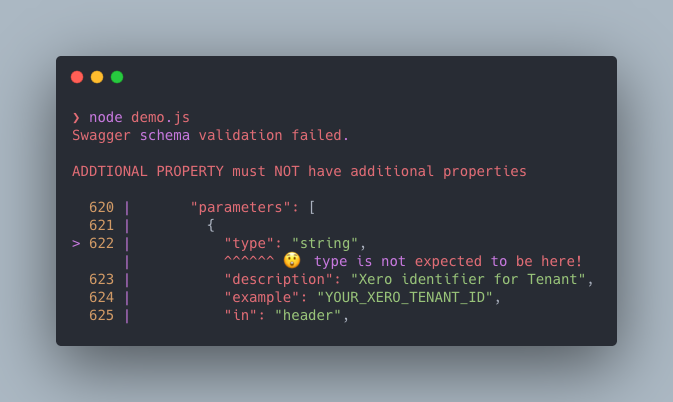
If you wish errors from .validate() to be styled and colorized, supply colorizeErrors: true to your instance of OASNormalize:
const oas = new OASNormalize('https://example.com/petstore.json', {
  colorizeErrors: true,
});
Error messages will look like such: