Package Exports
- taichi.js
- taichi.js/dist/taichi.js
- taichi.js/dist/taichi.umd.js
This package does not declare an exports field, so the exports above have been automatically detected and optimized by JSPM instead. If any package subpath is missing, it is recommended to post an issue to the original package (taichi.js) to support the "exports" field. If that is not possible, create a JSPM override to customize the exports field for this package.
Readme
taichi.js
taichi.js is a modern GPU computing framework for Javascript. It transforms Javascript functions into WebGPU Compute Shaders for massive parallelization. It is a Javascript version of the Python library Taichi.
Playground
On Chrome v113+, visit https://taichi-js.com/playground/ to see taichi.js in action. The webpage provides an interactive code editor that allows you to write, compile, and run taichi.js code.
Documentation
https://taichi-js.com/docs/docs/basics/getting-started
Sample Program
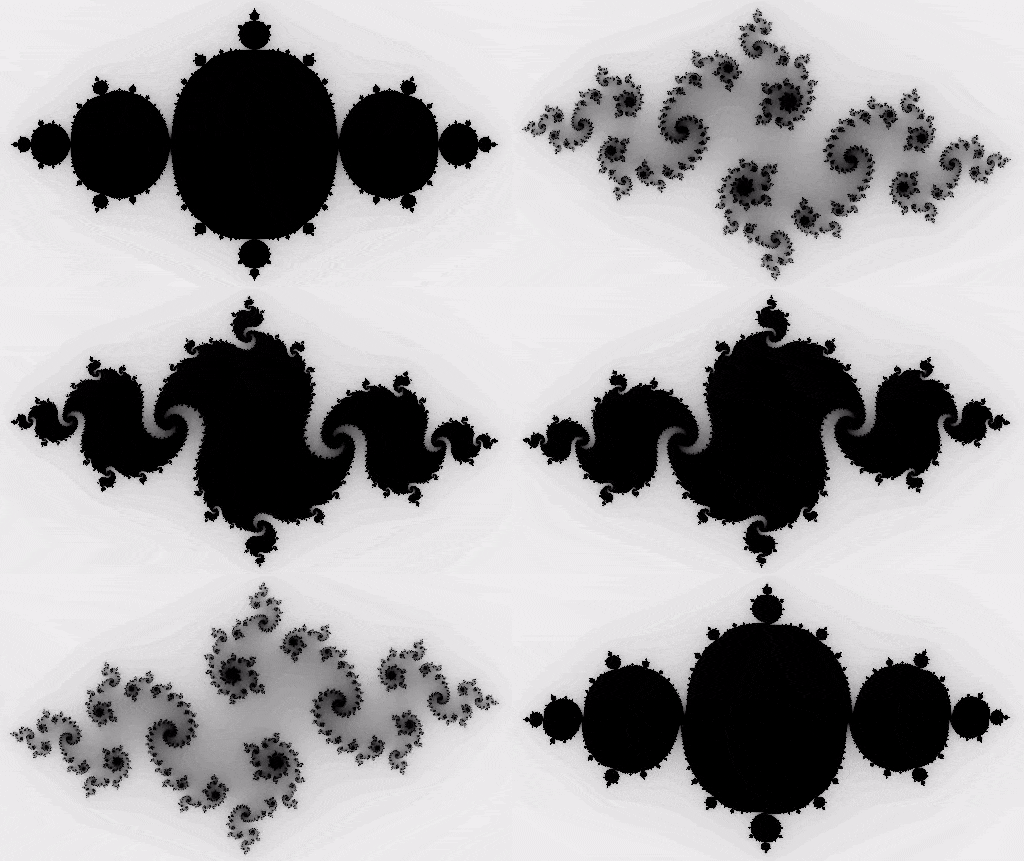
Provided that there exists a HTML canvas with id result_canvas, the following Javascript code will compute and animate a Julia Set fractal using WebGPU:
let fractal = async () => {
    await ti.init();

    let n = 320;
    let pixels = ti.Vector.field(4, ti.f32, [2 * n, n]);

    let complex_sqr = (z) => {
        return [z[0] ** 2 - z[1] ** 2, z[1] * z[0] * 2];
    };

    ti.addToKernelScope({ pixels, n, complex_sqr });

    let kernel = ti.kernel((t) => {
        for (let I of ndrange(n * 2, n)) {
            // Automatically parallelized
            let i = I[0];
            let j = I[1];
            let c = [-0.8, cos(t) * 0.2];
            let z = [i / n - 1, j / n - 0.5] * 2;
            let iterations = 0;
            while (z.norm() < 20 && iterations < 50) {
                z = complex_sqr(z) + c;
                iterations = iterations + 1;
            }
            pixels[(i, j)] = 1 - iterations * 0.02;
            pixels[(i, j)][3] = 1;
        }
    });

    let htmlCanvas = document.getElementById('result_canvas');
    htmlCanvas.width = 2 * n;
    htmlCanvas.height = n;
    let canvas = new ti.Canvas(htmlCanvas);

    let i = 0;
    async function frame() {
        kernel(i * 0.03);
        i = i + 1;
        canvas.setImage(pixels);
        requestAnimationFrame(frame);
    }
    requestAnimationFrame(frame);
};
fractal();
The canvas will show the following animation: