
Package Exports
- backport
This package does not declare an exports field, so the exports above have been automatically detected and optimized by JSPM instead. If any package subpath is missing, it is recommended to post an issue to the original package (backport) to support the "exports" field. If that is not possible, create a JSPM override to customize the exports field for this package.
Readme
backport


A simple CLI tool that automates the process of backporting commits
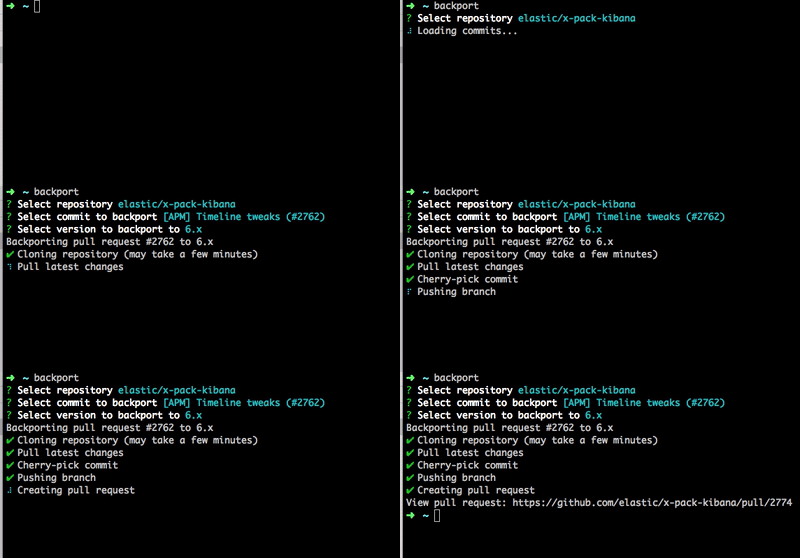
What is backporting?
Backporting is the action of taking parts from a newer version of a software system [..] and porting them to an older version of the same software. It forms part of the maintenance step in a software development process, and it is commonly used for fixing security issues in older versions of the software and also for providing new features to older versions.
Source: https://en.wikipedia.org/wiki/Backporting
Who is this tool for?
If your development workflow looks something like this:
- Write some code, merge those changes to master (eg. using a pull request)
- Cherry-pick one or more commits from master onto one or more branches
- Push those branches and a create new backport pull requests
Then backport might save you a lot of time and effort.
The CLI will ask you a few questions and then do those steps for you. You can even save a configuration with your preferences to make the process even more automated. See below for instructions on how to use and configure it.
Requirements
- Node 8 or higher
Install
npm install -g backportAfter installation you must update the global config with your Github username and a Github access token.
Usage
Run the CLI in your project folder (eg. in the Kibana folder):
$ backportFollow the steps. You can use the arrow keys to choose options, <space> to select checkboxes and <enter> to proceed.
Options
| Option | Description | Accepts |
|---|---|---|
| --multiple | Backport multiple commits and/or branches | boolean |
| --multiple-commits | Backport multiple commits | boolean (defaults to false) |
| --multiple-branches | Backport to multiple branches | boolean (defaults to true) |
| --own | Only show own commits | boolean (defaults to true) |
| --show-config | Show configuration | |
| --sha | Commit sha to backport | string |
| --help | Show help | |
| -v, --version | Show version number |
Configuration
Global configuration
During installation backport will create an empty configuration file in ~/.backport/config.json. You must update this file with your Github username and a Github Access Token
Example:
{
  "accessToken": "b4914600112ba18af7798b6c1a1363728ae1d96f",
  "username": "sqren"
}
accessToken (string) required
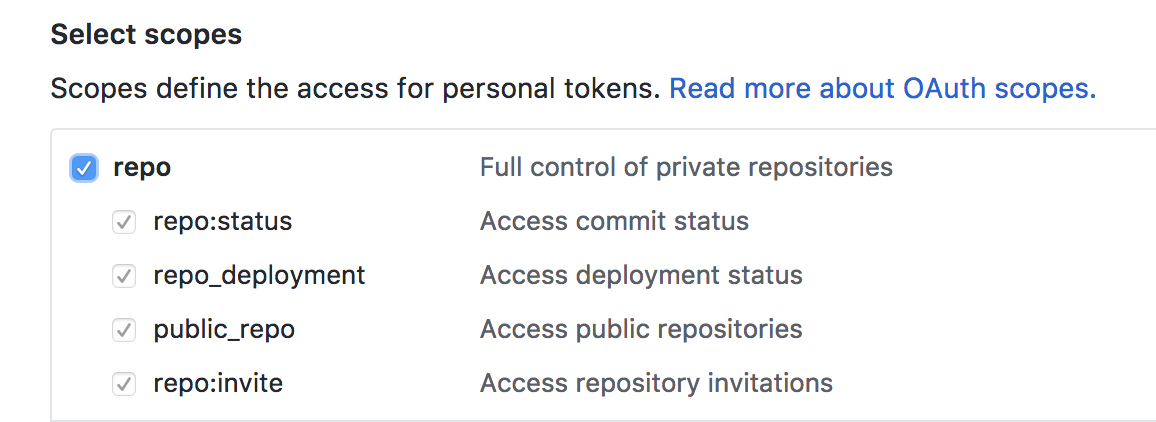
A personal access token can be created here: https://github.com/settings/tokens/new
Access scopes:
- Private repository: "Repo (Full control of private repositories)"
- Public repository: "public_repo (Access public repositories)"
username (string) required
Your Github username
projects (object[])
Note: This field is optional, and you probably don't need it A list of project-specific settings. This is useful if you want to override project-specific configurations. Read more about the project-specific configuration
The upstream property will determine which project-specific config to override. The following will override own and multipleCommits for elastic/kibana:
{
  "projects": [
    {
      "upstream": "elastic/kibana",
      "own": false,
      "multipleCommits": true
    }
  ]
}
Project-specific configuration
.backportrc.json can be added to every project where you use backport. This is useful for sharing configuration options with other project contributors.
Example:
{
  "upstream": "elastic/kibana",
  "branches": [{ "name": "6.x", "checked": true }, "6.0"],
  "own": true,
  "multipleCommits": false,
  "multipleBranches": true,
  "labels": ["backport"]
}
upstream (string) required
Github organization/user and repository name separated with forward slash.
branches (string[] | object[])
List of branches that will be available to backport to. The list can contain string and objects. If a string is given, it must be the name of a branch, if an object is given it must use the format {"name": "<string>", "checked": <boolean>} where name is the branch name and "checked" indicates whether the branch should be auto-selected. It is useful to auto-select branches you often backport to.
own (boolean)
true: only commits by you will be available to backport.
false: all commits in the repository will be displayed.
Default: true
multipleCommits (boolean)
true: you will be able to select multiple commits to backport. You will use <space> to select, and <enter> to confirm you selection.
false: you will only be able to select a single commit. You will use <enter> to confirm the selected item.
Default: false
multipleBranches (boolean)
true: you will be able to select multiple branches to backport to. You will use <space> to select, and
false: you will only be able to select a single branch. You will use <enter> to confirm the selected item.
Default: true
labels (string[])
List of labels that will be added to the backport pull request. These are often useful if you want to filter for backport PRs